
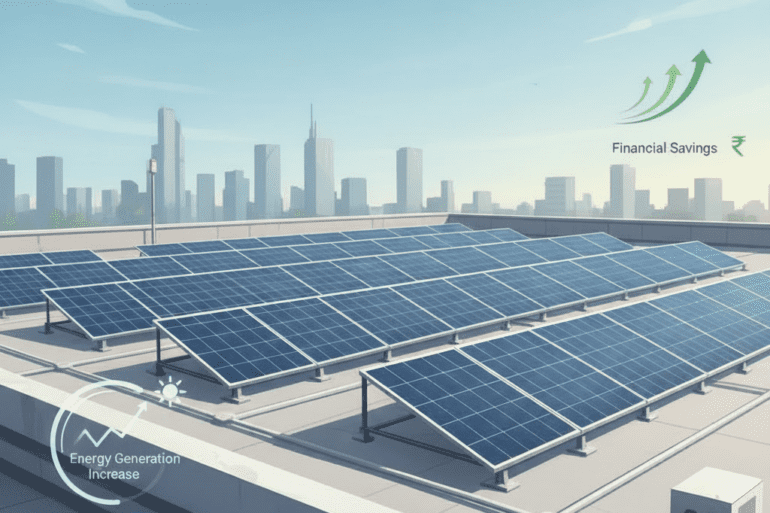
BEE’s New Building Code: Turbocharging Solar Power in India’s Commercial Buildings!
India’s skyline is undergoing a radical transformation, and it isn’t just about height or aesthetics—it’s about energy intelligence. As the nation accelerates toward its net-zero goals, the Bureau of Energy Efficiency (BEE) has introduced a game-changing framework: the Energy Conservation and Sustainable Building Code (ECSBC) 2024. This isn’t just an update; it is a mandate for a greener future. By shifting solar energy from an “afterthought” to a “foundational design requirement,” the BEE is paving the way for a commercial real estate sector that produces as much as it consumes. At Chirayu Power Pvt. Ltd., we recognize this as a pivotal moment for the Indian solar EPC industry.
The ECSBC 2024: Moving Beyond Voluntary Adoption
For years, integrating solar into commercial buildings was seen as a corporate social responsibility (CSR) initiative or an optional cost-saving measure. The new 2024 code changes the narrative by emphasizing solar integration at the design stage. By requiring developers to account for renewable energy during the initial architectural planning, the code ensures that buildings are optimized for maximum solar yield, proper load management, and seamless grid connectivity.
The code targets commercial and office buildings, covering everything from building envelopes and lighting to cooling systems. However, the true strength of this code lies in its localized implementation. For this vision to manifest, individual states must integrate these standards into their local building bylaws. This transition from a central guideline to a local mandate will be the catalyst for a nationwide surge in rooftop and ground-mounted solar installations across business parks, malls, and industrial hubs.
Synergy in the Energy Ecosystem: Growth, Security, and Storage
The timing of the BEE’s new code aligns perfectly with broader macroeconomic trends highlighted in the Economic Survey 2025-26. The survey underscores a holistic energy strategy where renewables are no longer peripheral but central to India’s economic growth and energy security. This is supported by several key industry milestones:
Competitive Tariffs and Grid Stability
The cost-effectiveness of solar continues to reach new benchmarks. Recently, the Uttar Pradesh Electricity Regulatory Commission (UPERC) approved a highly competitive tariff of ₹2.56/kWh for NTPC’s 400 MW solar project under a 25-year Power Purchase Agreement (PPA). Such low benchmarks make it increasingly difficult for commercial entities to ignore the financial benefits of transitioning to solar power.
The Rise of Pumped Storage
To address the intermittency of solar power, India is eyeing a massive expansion in storage. Projections suggest that India’s pumped storage capacity will hit 100 GW by 2035-36. This infrastructure will provide the necessary grid reliability to support the influx of distributed solar generation coming from commercial buildings under the new BEE code.
Climate-Specific Standards: A Global Necessity
India and Africa are currently experiencing a historic construction boom. Global climate experts have stressed that without stringent, climate-specific building codes, the carbon footprint of these new structures could be catastrophic. The ECSBC 2024 addresses this by advocating for standards tailored to India’s diverse climatic zones. By focusing on efficient envelopes and cooling, the code reduces the total energy demand of a building, making it easier for on-site solar systems to meet a significant percentage of its power requirements.
What This Means for Chirayu Power Pvt. Ltd.
As a leading Solar EPC company, Chirayu Power Pvt. Ltd. stands at the forefront of this transition. The move toward “Solar by Design” validates our long-standing philosophy of providing comprehensive, end-to-end energy solutions rather than just hardware installation.
For our clients in the commercial sector, the BEE 2024 code means that Solar EPCs are now strategic partners in the construction process. We are no longer just installers; we are energy consultants who work alongside architects and developers from day one. Our expertise in navigating regulatory landscapes, optimizing panel placement for high-density urban environments, and ensuring long-term O&M (Operations and Maintenance) excellence makes us the ideal partner for businesses looking to comply with—and benefit from—the new building codes.
Key Takeaways for Stakeholders
- Mandatory Integration: Solar power is moving from an optional add-on to a design-phase requirement for commercial buildings.
- State-Level Action: The success of the BEE 2024 code depends on states adopting these standards into local building bylaws.
- Financial Viability: With tariffs as low as ₹2.56/kWh and increasing grid support through pumped storage, the ROI for commercial solar has never been better.
- Strategic Alignment: The Economic Survey 2025-26 confirms that India’s growth will be powered by a mix of renewables and energy-efficient infrastructure.
- EPC Expertise: Developers must collaborate with experienced EPC players like Chirayu Power to ensure compliance and technical excellence.
The Future is Bright (and Solar-Powered)
The BEE’s Energy Conservation and Sustainable Building Code 2024 is more than a regulatory hurdle; it is a blueprint for a modern, resilient India. By mandating solar at the design stage, the government is ensuring that our commercial infrastructure is built for the challenges of the 21st century. This shift will reduce long-term operational costs for businesses, decrease the national carbon footprint, and solidify India’s position as a global leader in the renewable energy transition.
Is your commercial project ready for the new era of energy efficiency? At Chirayu Power Pvt. Ltd., we specialize in turning regulatory requirements into competitive advantages. Contact our expert team today to learn how we can integrate cutting-edge solar solutions into your next project and help you lead the charge toward a sustainable future.
Sources
mercomindia.com, blogs.worldbank.org, www.sustainableconstruction-now.com, www.woodmac.com, www.c40knowledgehub.org, hareda.gov.in
Disclaimer
The information provided in this blog post is for general informational purposes only. While we strive to keep the information up-to-date and accurate, we make no representations or warranties of any kind, express or implied, about the completeness, accuracy, reliability, suitability, or availability of the information contained herein. Any reliance you place on such information is strictly at your own risk. This blog does not constitute professional, financial, or legal advice. For specific guidance related to your situation, please consult with qualified professionals. Chirayu Power Pvt. Ltd. shall not be held liable for any losses, damages, or claims arising from the use of this information.