
Blogs

Blogs

India’s rooftop solar revolution is entering its next chapter. As the PM Surya Ghar: Muft Bijli Yojana approaches its FY 2026-27 target of solarising one crore households, the Ministry of New and Renewable Energy (MNRE) is reportedly working on a redesigned version of the scheme informally being called PM Surya Ghar 2.0.

At Chirayu Power, we’ve been tracking these developments closely so our customers can make informed decisions about going solar. Here’s a breakdown of what the scheme has achieved so far and what could be coming next.

A Quick Recap: What Is PM Surya Ghar?

Launched by Prime Minister Narendra Modi on 15 February 2024, PM Surya Ghar: Muft Bijli Yojana is the world’s largest domestic rooftop solar initiative. With a total outlay of over ₹75,000 crore, the scheme aims to:

  • Solarise 1 crore households across India by FY 2026-27
  • Provide up to 300 units of free electricity per month to beneficiary households
  • Offer a central subsidy of up to ₹78,000 for a 3 kW rooftop system
  • Cover 60% of system cost for capacity up to 2 kW, and 40% of additional cost for the 2–3 kW slab

By March 2025, the scheme had already crossed 10 lakh solarised homes, with discoms designated as State Implementation Agencies responsible for net metering, inspection, and timely commissioning. The Union Budget 2026-27 allocated a further ₹22,000 crore to keep the momentum going.


Why a “2.0” Version Is Being Discussed

The original scheme calculates subsidy purely on installed capacity — you get a fixed payout based on the size of the system you put up, regardless of how much power it actually generates over time. It also doesn’t account for battery storage, and it largely leaves out households that don’t have a suitable independent rooftop, such as apartment residents.

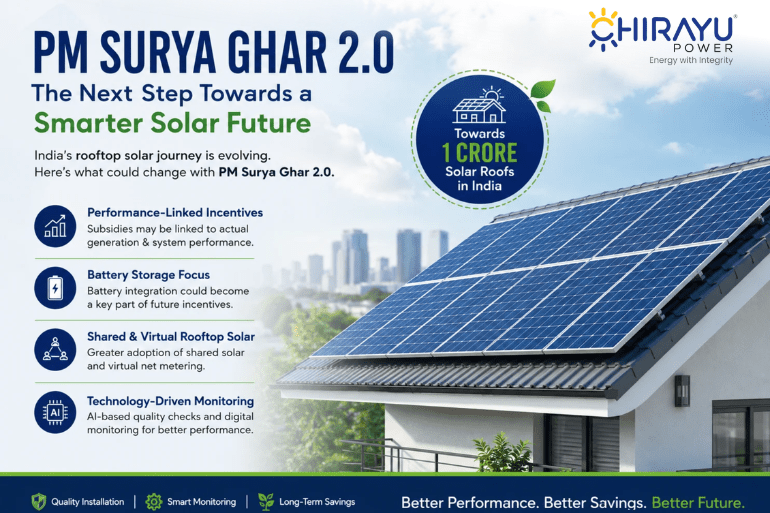
These are the gaps that PM Surya Ghar 2.0 is reportedly trying to close. While nothing has been formally notified yet, media reports and industry commentary point to a few likely shifts:

1. Performance-Based Incentives

Instead of a flat, one-time payout tied to system size, future subsidies may be linked to actual power generated and long-term system performance. The intent is simple: reward systems that keep producing electricity reliably for years, not just systems that get installed and forgotten.

2. Battery Storage Support

Officials are reportedly discussing incentives for battery energy storage systems (BESS) at both the household and community level. This would let homeowners store solar power generated during the day for use after sunset, and could also improve grid stability at scale.

3. Wider Eligibility

The redesigned framework is expected to extend benefits to households that currently sit outside the scheme’s reach — including those without a suitable independent rooftop.

4. Smarter Monitoring

Some reports mention ideas like digital “solar passports” for tracking system performance and ownership history — part of a broader push to make rooftop solar more transparent and data-driven.

It’s worth noting that industry sources also describe a related development already rolling out — often referred to as “Phase 2” or “PM Surya Ghar @ 2” — which reportedly allows hybrid inverters and battery storage systems under Central Financial Assistance for systems up to 2 kW, aligning with India’s broader goal of 500 GW of non-fossil energy capacity by 2030.


What This Means for You Right Now

If you’re considering rooftop solar for your home, here’s the practical takeaway: the current PM Surya Ghar scheme is very much active today, with the ₹78,000 subsidy for 3 kW systems, 60%/40% cost coverage, and free electricity benefits already available through the national portal. PM Surya Ghar 2.0, as of now, is a set of proposed changes under discussion — not a confirmed policy.

At Chirayu Power, our recommendation is straightforward:

  • Don’t wait on unconfirmed changes. If your rooftop and consumption pattern make solar viable today, the current subsidy structure already delivers strong savings.
  • Verify everything through official channels. Subsidy amounts, eligibility, and application steps should always be checked against the PM Surya Ghar National Portal before you commit.
  • Plan for storage anyway. Even if battery incentives aren’t finalised yet, designing your system to be battery-ready means you won’t need a costly retrofit later.

How Chirayu Power Can Help

Navigating subsidy paperwork, net metering approvals, and vendor selection can be confusing — especially with a scheme this large and still evolving. Our team helps households:

  • Assess rooftop suitability and right-size the system (2 kW, 3 kW, or beyond)
  • Handle end-to-end registration on the PM Surya Ghar National Portal
  • Manage discom coordination, net meter installation, and inspection
  • Design systems that are ready for future battery integration

As PM Surya Ghar 2.0 moves from discussion to policy, we’ll keep updating our customers with verified information — no speculation, no misinformation, just what’s actually been notified by the government.

Ready to go solar? Get in touch with Chirayu Power for a free rooftop assessment and subsidy eligibility check.


ALMM List-II Deadline Pushed Again: What MNRE’s July 18 Order Really Means for Your Pipeline

If you’ve been sitting on a stack of net-metering or open access projects, watching the ALMM List-II clock tick down, you can exhale for now. MNRE just bought the industry another six months.

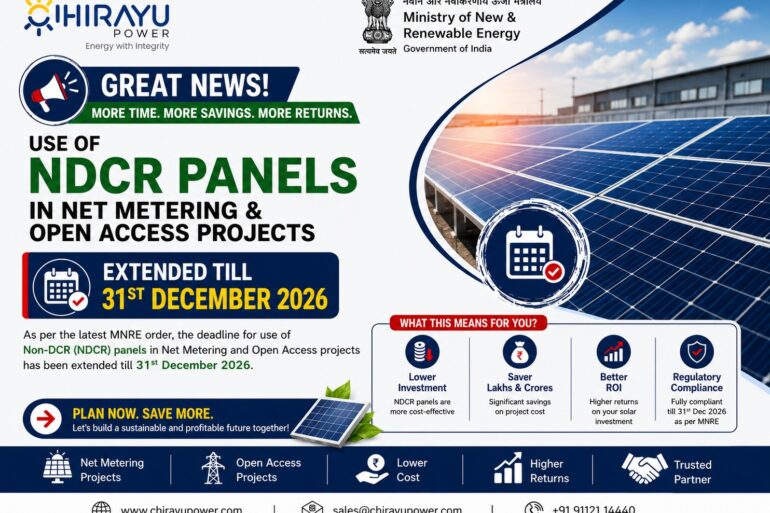
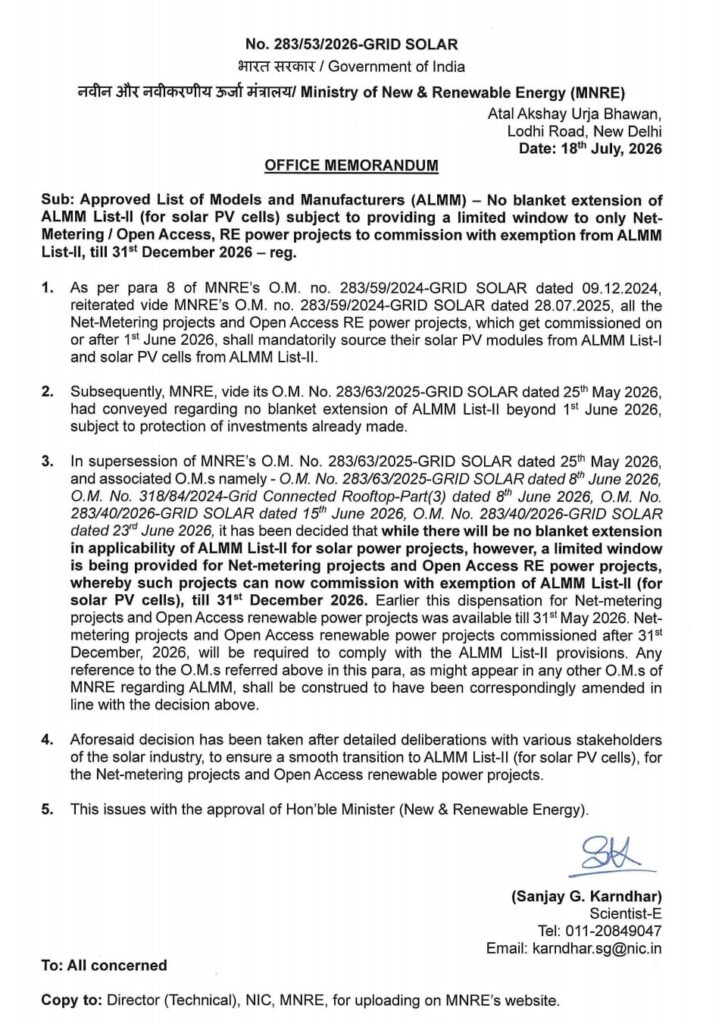
On 18th July 2026, the Ministry of New & Renewable Energy quietly dropped Office Memorandum No. 283/53/2026-GRID SOLAR, and it’s the kind of order that developers will want pinned to the top of their inbox. In short, the exemption from ALMM List-II for solar PV cells, previously set to lapse on 31st May 2026, has been extended to 31st December 2026 for net-metering and open-access RE projects.

That’s a real, practical extension. Not a policy reversal, not a permanent carve-out, but breathing room that many pipelines badly needed.

Why This Order Exists

Anyone who’s been tracking ALMM knows this space has been a moving target all year. A quick timeline, because the paper trail matters here:

  • Dec 2024 / reiterated July 2025: MNRE first laid down the rule that any net-metering or open access project commissioning on or after 1st June 2026 would have to source modules from ALMM List-I and cells from ALMM List-II. No exceptions flagged at the time.
  • 25th May 2026: With the deadline a week away, MNRE signalled there’d be no blanket extension, but investments already committed would be protected. Cue a scramble across the industry to figure out exactly what “protected” meant in practice.
  • Late May through June 2026: A flurry of follow-up O.M.s tried to patch the gaps, one specifically for rooftop, others tweaking dates. If you were tracking compliance during this window, you know how confusing it got.
  • 18th July 2026: This latest order supersedes all of that. Every earlier O.M. referencing ALMM compliance dates is now read in line with this one. One clean deadline, replacing a mess of overlapping ones.

MNRE Notice

What Actually Changed

Here’s the part that matters for your project timeline: domestic solar cell manufacturing capacity still hasn’t caught up with demand, and MNRE has effectively acknowledged that forcing the June 2026 deadline would have stalled a meaningful chunk of the net-metering and open access pipeline.

So instead of a blanket extension across all solar projects which MNRE has explicitly ruled out the relief is narrow and targeted:

  • Who gets it: Net-metering projects and Open Access RE power projects only.
  • What’s exempted: Sourcing solar PV cells from ALMM List-II. (ALMM List-I module sourcing requirements aren’t touched by this order.)
  • Until when: Projects commissioned on or before 31st December 2026 are covered.
  • What happens after: Anything commissioning from 1st January 2027 onward has to comply fully with ALMM List-II no more grace period referenced in this order.

If your project falls outside net-metering or open access say, a utility-scale IPP project this order doesn’t touch you. The “no blanket extension” line in Para 3 is doing a lot of work here, and it’s worth reading twice before assuming you’re covered.

The Real Takeaway for Developers

This isn’t the ministry backing down on domestic manufacturing goals it’s a pressure valve. MNRE says the decision came after “detailed deliberations with various stakeholders of the solar industry,” which, translated, means the industry made its case on cell availability and commissioning timelines, and the ministry listened partially.

Three things worth doing with this news right now:

  1. Re-check your commissioning date against 31st December 2026, not the old May 2026 line. If your project was going to miss the earlier deadline, it may now clear comfortably but don’t assume; confirm the classification (net-metering / open access) actually applies.
  2. Don’t treat this as a new baseline. MNRE has now extended this cutoff more than once in a matter of months. Six months is enough time to actually secure ALMM List-II compliant cells — plan sourcing now rather than waiting for the next possible extension.
  3. Track amendments closely. Para 3 of the order explicitly states that references to superseded O.M.s “in any other O.M.s of MNRE regarding ALMM” are automatically read as amended. If you’re relying on an older circular for compliance guidance, it’s worth re-verifying against this one.

MNRE isn’t walking away from ALMM it’s buying the ecosystem time to get there without stranding half-built projects. For net-metering and open access developers, 31st December 2026 is now the number to plan around. Just don’t bank on another extension after that.

The order is signed by Sanjay G. Karndhar, Scientist-E, MNRE, and issued with the approval of the Hon’ble Minister (New & Renewable Energy).

Reference: Office Memorandum No. 283/53/2026-GRID SOLAR, Ministry of New & Renewable Energy, Government of India, dated 18th July 2026.


About Chirayu Power

Navigating shifting ALMM timelines is exactly the kind of regulatory complexity Chirayu Power Pvt. Ltd. helps its clients manage every day. Founded in 2014 and headquartered in Khamgaon, Maharashtra, Chirayu Power has grown into one of India’s most trusted solar EPC companies, with 3,000+ installations completed across 10+ states covering over 150 MW of rooftop and 200 MW of ground-mounted solar capacity.

As an ISO 9001:2015 certified and MNRE-approved channel partner, Chirayu Power delivers end-to-end, turnkey EPC execution from design and engineering to installation, commissioning, and ongoing O&M for industrial, commercial, residential, and utility-scale projects. The company also specializes in open access and RESCO-based solar solutions, backed by IoT-enabled monitoring, in-house civil and electrical teams, and a track record of 100% regulatory compliance.

With regional offices in Nagpur, Pune, Mumbai, and Hyderabad alongside its Maharashtra head office, Chirayu Power stays close to developments like this ALMM order — helping clients plan commissioning timelines, sourcing, and compliance well ahead of every regulatory deadline.

Get in touch:

  • Website: www.chirayupower.com
  • Phone: +91 9112114440 / +91 7721871188
  • Email: sales@chirayupower.com


Hey everyone! If you’ve been thinking about putting solar panels on your roof, I have some awesome news to share — the rooftop solar net metering agreement has officially been waived, making the entire process faster and paperwork-free.

The government’s flagship project, PM Surya Ghar: Muft Bijli Yojana, aims to help millions of homes get rooftop solar power. But there used to be one really annoying problem holding people back: too much paperwork!

PM Surya Ghar Yojana

The Old Way

In the past, if you wanted to connect your shiny new solar panels to the electricity grid, you had to get a special physical contract printed on Rs. 200 “stamp paper.” You had to fill it out and hand it in, which wasted extra money and caused big delays.

The New Way

The electricity company (MSEDCL) just announced that they are doing away with that old rule! You do not need a physical paper agreement anymore. This great new rule applies to absolutely everyone applying for rooftop solar, whether you are getting government help (a subsidy) or paying for it yourself.

How It Works Now

Now, everything is completely digital! When you apply for your solar panels online through the Now, everything is completely digital! When you apply for your solar panels online through the PM Surya Ghar portal, the agreement is right there on the screen. You just click to accept it directly on the website — no printing, no signing, no visiting an office.

Why Is This So Great?

The main goal of this change is to get rid of boring delays and make the whole process super fast. By cutting out the physical paperwork, families can get their solar panels working and start making their own clean electricity much sooner!

Ready to Go Solar?

Thinking about going solar? Now is the easiest time ever to do it! With no stamp paper, no extra cost, and a fully digital process, there’s never been a better time to switch to clean, self-generated electricity.

Feel free to share this post with anyone who wants to switch to solar energy.


Ready to switch to solar? Contact Chirayu Power today!

Chirayu Power Pvt. Ltd


Frequently Asked Questions

Does this apply to existing solar customers?

This waiver applies to new RTS (Rooftop Solar) applications under all schemes — both subsidized and non-subsidized. Existing consumers with an already-executed agreement are not required to redo it.

Is this applicable across Maharashtra?

Yes, the directive applies to all MSEDCL O&M Circles across Maharashtra.

Do I still need to sign anything?

Yes, but only digitally. The agreement is now built into the online application form on the PM Surya Ghar and MSEDCL portals, so a simple digital acceptance replaces the old physical stamp-paper agreement.

Honestly, moments like these make you stop and think.

You think about the early mornings on project sites. The late-night calls to solve an unexpected challenge. The teams that pushed through tough timelines without ever compromising on quality. The clients who believed in us when we were still proving ourselves.

And then you realise — it was all worth it.

We are so proud and genuinely moved to share that Chirayu Power Pvt. Ltd. has been selected as a winner of five awards at the Maharashtra Urja Expo Awards 2026. Not one. Not two. Five.

This is not just a company achievement. This belongs to every single person who has been part of the Chirayu Power family.


Here’s What We Won — And What Each One Means to Us

Best Solar Installer of the Year – Commercial & Industrial (Platinum)

This one is special. The Platinum recognition in the C&I solar segment reflects years of showing up for our commercial and industrial clients — understanding their unique energy needs, delivering installations that actually perform, and building relationships that go beyond just a project.

Every rooftop we have installed, every watt we have generated for a business or a factory — that work is what this award is about.

Awards


Best Solar O&M Service Provider

Most people celebrate the day a solar plant goes live. But our O&M team? They celebrate every single day it keeps running at its best.

This award is for them — the people who quietly ensure that every solar system we have ever installed continues to deliver on its promise. They are the unsung heroes of this industry, and it feels wonderful to see them get the recognition they deserve.


Best EPC Company of the Year – Ground-Mount Solar Projects (Diamond | 25–50 MW)

Ground-mount projects at this scale are not simple. They demand precision planning, coordinated execution, and the ability to handle the unexpected without losing your footing.

Winning the Diamond award in this category tells us that the industry sees what we have been working so hard to build — a team that delivers large-scale solar projects with discipline, integrity, and care.

Maharashtra Awards

Innovation in Project Execution through Integrated Technology Solutions

We have always believed that the solar industry should not just grow — it should grow smarter. This award recognises our efforts to bring technology into the heart of how we plan and execute projects.

From smarter monitoring to more transparent processes, our teams have embraced innovation not as a trend, but as a responsibility to our clients and to the future.


Excellence in Safety Management for Solar EPC Projects

Of everything we have won, this one sits close to our heart.

Because at the end of the day, every person who works on a Chirayu Power project is someone’s family. Keeping them safe is not a compliance requirement for us — it is a promise we make every single morning. This award is a reminder that we are keeping that promise.


A Message from Our Heart

To our incredible team —

You are the reason this happened. Not the awards, not the certificates, but you — your dedication, your grit, your pride in doing the job right. We see you, and we are endlessly grateful.

To our clients and partners —

Thank you for trusting us. That trust is something we never take lightly, and we will keep working every day to be worthy of it.

To everyone who has been part of our journey —

This milestone belongs to you too.


What Comes Next

Five awards is a beautiful moment to pause and feel proud. But for us, it is also fuel.

Fuel to do better work. To reach more clients. To power more of India with clean, reliable solar energy. To keep our teams safe, our clients happy, and our commitment to sustainability strong.

We will be celebrating this achievement officially at the Maharashtra Urja Expo 2026, and we cannot wait to share this joy with the solar community in person.

Until then — thank you, Maharashtra. Thank you, India. We are just getting started. 


Chirayu Power Pvt. Ltd. — Powered by People. Built on Trust.

Want to know more about our work or explore a partnership? We would love to hear from you. Get in touch.


Vidarbha Premier League 2026 wasn’t just a cricket tournament—it was an emotion. And Chirayu Power was proud to power that emotion.

This season, Chirayu Power Pvt. Ltd. proudly joined VPL 2026 as the Official Gold Sponsor and Renewable Energy Partner, bringing our promise of “Energy With Integrity” from solar rooftops to the electrifying atmosphere of Jamtha Stadium, Nagpur.

From Solar Fields to the Cricket Field

For years, Chirayu Power has been empowering thousands of homes, industries, businesses, and MSMEs across Vidarbha, Maharashtra and Pan India with reliable solar solutions. VPL 2026 gave us an opportunity to power something equally special—the spirit and passion of our region.

Throughout the tournament, Chirayu Power’s presence was visible across the stadium. From LED perimeter boards and giant screens to presentation backdrops and match-day branding, our identity became a part of Vidarbha’s biggest cricket celebration. Every boundary, every cheer, and every memorable moment reflected the growing connection between cricket and clean energy.

Our association with VPL went far beyond branding. Every towering maximum during the tournament was celebrated as the “Energetic Six powered by Chirayu Power,” turning every six into a symbol of power and excitement. Fans also witnessed the “Energetic Moment of the Day,” presented by Chirayu Power, highlighting the most thrilling moments of each match. From spectacular catches and game-changing performances to unforgettable finishes, these initiatives made Chirayu Power an integral part of the VPL experience and reinforced our belief that great moments deserve great energy.

Leadership on the Grand Stage

One of the most memorable moments came during the Grand Finale Presentation Ceremony.

Our Managing Director, Mr. Karan Chopda, was invited onto the stage alongside esteemed dignitaries of Vidarbha cricket, including the Hon’ble President and Secretary of the Vidarbha Cricket Association, members of the VPL Governing Council, and former India and Ranji cricket legends.

Mr. Karan Chopda, also had the privilege of presenting the prestigious “Player of the Tournament” award an occasion that perfectly represented our belief:

Great performance deserves great power.

VPL 2026

More Than Sponsorship—A Commitment

For us, VPL 2026 was never just about visibility.

As the Renewable Energy Partner, our objective was to spark a larger conversation. Just as cricket demands consistency and excellence, the future of Vidarbha demands sustainable and dependable energy.

Chirayu Power is Vidarbha’s own solar company and one of India’s fastest-growing renewable energy brands. Being associated with VPL allowed us to reach every entrepreneur, industry owner, farmer, and homeowner with a simple message:

Solar is not the future anymore—it is the smart choice today.

Gold Sponser

Thank You, Vidarbha!

The love and support we received throughout the tournament were truly overwhelming. From fans cheering in the stands to the countless messages and calls we received during VPL, every gesture strengthened our connection with the people of Vidarbha.

We extend our heartfelt gratitude to the Vidarbha Cricket Association, the VPL Governing Council, and the entire organizing team for placing their trust in a homegrown brand like Chirayu Power.

The Journey Continues

We came to VPL to support cricket.

We left with an even stronger commitment to power Vidarbha with clean energy, with integrity, and with purpose.

Because this is just the beginning.

See you at VPL 2027—with even bigger energy.

The solar industry in Maharashtra has been on an emotional rollercoaster lately. For business owners, the recent MERC order regarding the new power banking mechanism felt like a “leaky bucket” scenario—no matter how much clean energy you produced, the new charges were draining the financial viability of your investment.

At Chirayu Power, we don’t just install panels; we monitor the heartbeat of energy policy. Here is our expert take on why the recent APTEL interim stay (Order dated 29 May 2026) is a massive win for the consumer and what it says about the future of solar in our state.

The “Why” Behind the Stay

The Appellate Tribunal for Electricity (APTEL) hasn’t just paused a technicality; it has acknowledged a fundamental concern of the industry. The new banking mechanism introduced by MERC threatened to significantly increase the cost of “storing” energy with the grid, making it harder for industries to see the ROIs they were promised.

Our Thought Process:

“Banking is the backbone of industrial solar. If the rules of banking change mid-game, the trust of the investor is shaken. This stay is a vital correction that protects the ‘Interests of Justice and Equity’ for every factory and commercial unit currently receiving disconnection notices or inflated bills based on the new regime.”

What This Means for Your Operations Right Now

If you are an industrial consumer feeling the heat of new banking charges, here is the immediate ground reality:

  • Status Quo Restored: Consumers are to continue paying banking charges as per the previous regime.
  • Protection Against Disconnection: The tribunal specifically protected those receiving bills or disconnection notices based on the disputed order.
  • No Future Recovery (For Now): Any recovery through future electricity bills under the new mechanism is stayed until the final decision.
  • The “Conditional” Peace: While the stay is a relief, it comes with a caveat—an undertaking that if the final decision goes against the appellants, the stayed amount must be paid within a month.


Chirayu’s Perspective: The Path Forward

We believe that for India to reach its renewable goals, policy must be predictable. This interim stay, effective until the final judgment, provides a much-needed cooling-off period.

The next hearing is set for 31 August 2026. Until then, we advise our clients and the larger industrial community to:

  1. Review your current billing: Ensure your utility is complying with the stay and billing you under the old regime.
  2. Plan for “Worst-Case” Scenarios: Keep the “undertaking” in mind; financial prudence suggests setting aside the difference in charges as a contingency until the final judgment.
  3. Don’t Pause Your Transition: Policy will always be dynamic, but the core math of solar—offsetting high grid tariffs—remains the most powerful tool for your P&L.

The verdict is clear: The industry has a voice, and for now, that voice has been heard at the highest levels of the tribunal.

Expert Analysis Provided By:

Official Branding & Contact Technical Resources
Chirayu Power Private Limited Detailed Court Order: [gen_pdf.pdf]
Web: www.chirayupower.com Project Portfolio: [brochure- 2025 (compressed).pdf]
HQ: C-1/1, MIDC, Khamgaon Policy Summary: [WhatsApp Image 2026-05-30 at 2.22.26 PM.jpeg]


Installing solar is the easy part. What happens over the next 25 years, how well you maintain it, decides whether your investment truly pays off or quietly loses efficiency year after year.

India is a tough environment for solar panels. Dust, extreme heat, monsoons, bird droppings, every bit of dirt or damage that goes unaddressed is a generation you are losing every day. This guide covers what actually matters.

Why India Is Hard on Solar Plants

  1. Dust and pollution: Even a thin layer reduces output by 15–25%. Industrial zones and highways make this worse.
  2. Extreme heat: Panel efficiency declines as temperatures rise. Summer surface temperatures can exceed 70°C.
  3. Monsoon season: Rain cleans panels but also brings humidity, water ingress risks, and post-rain algae growth.
  4. Bird droppings: A drop on one cell creates a hotspot that degrades an entire string’s performance.
  5. Regional differences: Coastal areas get salt deposits, agricultural zones face stubble smoke, and urban plants deal with smog. Maintenance must match the location.


The Basics Every Plant Owner Must Do

  1. Panel Cleaning: The single highest-impact activity. In dusty areas like Vidarbha, clean every 10–15 days in dry months. Always clean early morning or evening — cold water on hot panels causes micro-cracks. Use soft brushes or microfibre mops. At Chirayu Power, we recycle cleaning water, collected, filtered, and reused. Less wastage, same result.
  2. Visual Inspection: Walk the plant regularly. Look for cracked panels, loose wiring, bird nests, structural corrosion, and new shadows from nearby construction or tree growth.
  3. Inverter and Electrical Checks: Check error logs, ensure inverter ventilation is clear, and inspect electrical connections twice a year. Terminals loosen over time due to heat cycles.
  4. Earthing and Lightning Protection: Test earthing connections and surge protection before every monsoon season. One lightning event without proper protection can damage an entire system.

How Chirayu Power Does O&M — Beyond the Basics:

Standard maintenance keeps a plant alive. Smart maintenance keeps it performing. We have built our own O&M systems because off-the-shelf tools were not good enough.


  1. Real-Time SCADA Monitoring: Every installation is tracked continuously. The moment a string underperforms, the system flags it — before the client even notices.
  2. Drone Thermal Scanning: Thermal cameras detect hotspots — faulty cells, loose connections, failing modules — across large installations without anyone climbing the roof.
  3. Predictive Maintenance: Historical data predicts issues before they occur. The team acts early, preventing breakdowns and reducing downtime significantly.
  4. AI Task Management: Service requests are auto-assigned to the right engineer by location and priority. Clients track progress live through our O&M portal.
  5. 24/7 AI Chatbot Support: Client queries are handled round the clock — logged, routed, and resolved even outside working hours.
  6. Remote Troubleshooting: Many faults are diagnosed and resolved remotely — no waiting for a site visit, especially for plants in distant locations.

Quick Season-by-Season Checklist

Summer (March–June)
  • Increase cleaning frequency
  • Check inverter ventilation and cooling
  • Inspect wiring for heat damage
Monsoon (July–September)
  • Test earthing and surge protection before the season starts
  • Check mounting structures for rust
  • Inspect junction boxes for water ingress
Post-Monsoon / Winter (October–February)
  • Full system inspection — best window for annual checks
  • Tighten all electrical connections
  • Review performance data vs previous year
  • Schedule thermal drone scan

Mistakes That Silently Cost Plant Owners Money

  1. Cleaning midday: Cold water on hot panels causes micro-cracks. Always clean morning or evening.
  2. Ignoring one weak string: A single underperforming string drags down the whole array.
  3. Skipping post-monsoon checks: Humidity damage shows up months later — by then it is worse.
  4. No monitoring system: If you cannot see what your plant is doing, you have no idea what you are losing.
  5. Only one annual service visit: Once a year is not enough. Monthly checks are the minimum.

A well-maintained solar plant delivers strong returns for 25 years. A neglected one starts losing quietly from year two — and by the time most owners notice, a lot of generation is already gone.

At Chirayu Power, O&M is not an afterthought. From real-time SCADA monitoring and drone thermal scans to predictive maintenance and 24/7 support — our systems are built to keep your plant performing every single day, not just on commissioning day.

Want to know how your plant is actually performing? Or planning a new installation and want to do it right from day one?

Visit chirayupower.com — we are happy to have an honest conversation.


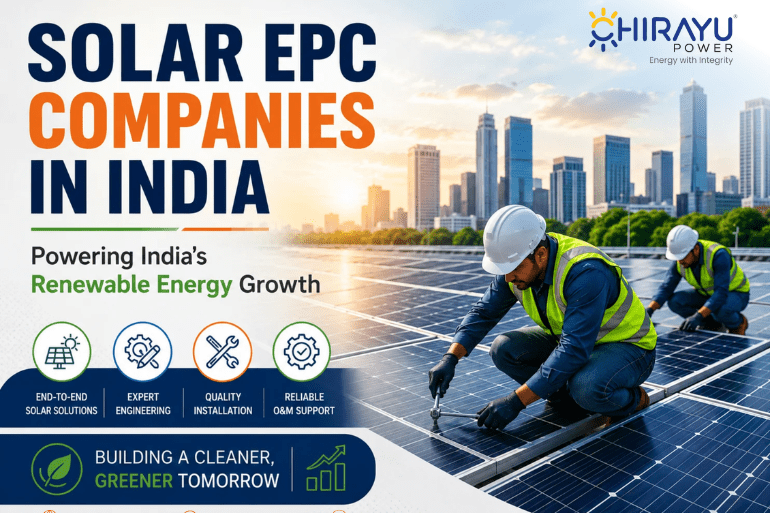
India is in the middle of an unprecedented clean energy transformation. Industries, businesses, and institutions across the country are racing to adopt solar power not just to cut costs, but to future-proof their operations. In this rapidly evolving landscape, the choice of your solar EPC (Engineering, Procurement & Construction) partner is perhaps the single most consequential decision you will make. The right partner does not merely install panels; they engineer reliability, ensure compliance, and deliver long-term value for your investment.

Chirayu Power Pvt. Ltd. has been at the forefront of this solar revolution since 2014. With over a decade of experience, 3,000+ installations, and a pan-India footprint, Chirayu Power has redefined what it means to be a trusted solar EPC partner in India.

What Does a Solar EPC Partner Actually Do?

An EPC company shoulders end-to-end responsibility for your solar project. That means handling every moving part from the drawing board to the day your system goes live under one roof. Here is what that looks like in practice:

  • Engineering: Detailed site analysis, plant layout design, structural calculations, and yield simulations to ensure maximum energy generation.
  • Procurement: Sourcing high-quality modules, inverters, mounting systems, cables, and balance-of-system components from vetted manufacturers.
  • Construction: Civil work, electrical installation, grid synchronisation, SCADA integration, and final commissioning.

At Chirayu Power, all of this happens in-house, from structural design and manufacturing to SCADA configuration and commissioning with zero dependency on subcontractors. That single-window accountability is what separates a genuine EPC partner from a project coordinator.

Why the Right EPC Choice Defines Your Project’s Success

A solar plant is a 25-year commitment. Here are the factors that truly determine whether your investment pays off:

1. Deep Engineering Capability No two project sites are identical a rooftop on an industrial shed, a ground-mounted plant, and an open-access facility each need completely different approaches. Chirayu Power’s in-house design team handles structures, electrical systems, and automation, ensuring every project is engineered for the specific site not copied from a generic template.

2. Regulatory Compliance Without the Headache India’s solar sector is governed by MNRE, state DISCOMs, and electricity regulatory commissions. Non-compliance can stall projects for months. As an MNRE-Approved Channel Partner and registered system integrator, Chirayu Power ensures approvals are secured and compliance is maintained from day one no surprises.

3. A Proven Track Record Numbers speak louder than claims. Chirayu Power has completed 3,000+ installations across 10+ states, installed 150 MW+ rooftop and 200 MW+ ground-mounted capacity, delivered 500+ RESCO rooftop projects, and executed 72 MW+ of Open Access projects across Maharashtra backed by a 200+ member team.

4. Smart Monitoring and After-Sales Support Commissioning is not the finish line it is the starting point. Chirayu Power’s IoT-enabled SCADA systems provide real-time diagnostics, predictive maintenance alerts, and string-level performance tracking, so your plant runs at its best always.

5. Financial Confidence and Risk Mitigation Partnering with a stable, award-winning company with a decade-long track record means your investment is protected. Chirayu Power’s structured project management, 100% compliance record, and performance-backed delivery model safeguard your ROI from day one.

How Chirayu Power Got Here — Year by Year

We did not become a pan-India solar EPC company overnight. It happened project by project, year by year, and that is something we are genuinely proud of.

  • 2014: Founded in Khamgaon, Maharashtra with a focus on doing solar right.
  • 2015: Commissioned first 1 MW+ rooftop and ground-mount projects.
  • 2016: Registered with MNRE as a System Integrator.
  • 2017–18: Expanded across Vidarbha; opened offices in Nagpur, Pune & Mumbai.
  • 2020: Delivered 25 MW+ Open Access projects across Maharashtra.
  • 2022: Launched SCADA-integrated ground-mounted plants.
  • 2023: Crossed 150 MW+ cumulative ground-mounted installations.
  • 2024: 500+ rooftop projects delivered under the RESCO model.
  • 2025: 3,000+ projects. 350 MW+ capacity. 200+ team members. Still growing.


Recognition That We Did Not Ask For — It Just Followed the Work

We are not going to tell you we are the best that is not really our style. But independent industry bodies have said it on our behalf, and we think it is worth sharing:

  • India 5000 Best MSME Award — 2020
  • Solar Visionary Award — 2021
  • Most Promising Unit of Vidarbha, Udyog Gaurav Award — 2022
  • Solar Quarter 40 Under 40, Indian Solar Pioneers — 2023
  • Waaree Elite Circle Silver Club Top Performer — 2023-24
  • State Leadership Award: Best Project of the Year — 2024
  • State Leadership Award: Solar EPC Company of the Year — 2024
  • Waaree Chairman Club Unstoppable Performer Award — 2024-25
  • SolarEdge C&I Champion: West Zone’s Biggest C&I Player, Across India — 2025

The latest and perhaps most significant is the SolarEdge C&I Champion Award 2025, recognising Chirayu Power as the biggest Commercial & Industrial solar player in the West Zone across all SolarEdge partners in India. This is not a participation trophy. It is a direct measure of project volume, quality, and client trust.

Why Clients Choose Chirayu Power

  • MNRE-Approved Partner: Government-vetted system integrator smoother approvals, zero compliance surprises.
  • 100% In-House Execution: No subcontracting. One team, full accountability, from design to commissioning.
  • Custom Engineering: Every site is different. We engineer each plant from scratch not from a template.
  • Real-Time SCADA Monitoring: IoT-enabled visibility into your plant’s performance, 24/7. No guessing.
  • Pan-India Presence: Offices in Nagpur, Mumbai, Pune, & Hyderabad. Close to wherever you are.
  • AI Workflow Automation: Complaints are auto-assigned to the right team based on priority and location. Faster resolution, zero manual delays.
  • Intelligent O&M Portal: Our in-house portal manages the full complaint lifecycle assigned, tracked, and closed with client updates at every step.
  • AI Chatbot Support: 24/7 customer assistance. Queries logged, routed, and resolved even outside working hours.


What We Stand For

Vision: To be India’s most trusted and ethical renewable energy solutions provider empowering industries and communities with future-ready clean energy.

Mission: Transparent, reliable, engineering-driven solar solutions that deliver real long-term value while growing to Rs. 500 crore by 2027 without cutting corners.

Values: Transparency. Integrity. Innovation. Quality Excellence. Sustainability. These are not wall posters they shape every project decision we make.


Solar is a 25-year decision. The right EPC partner makes it one of the best investments your business has ever made. The wrong one makes it a lesson you will not forget.

We started in Khamgaon in 2014 with a small team and a clear commitment: do the work right, every time. Over 3,000 projects later, that commitment has not changed.

If you are planning a solar project and want a straight, honest conversation visit chirayupower.com. We are happy to help you figure out what actually makes sense for your situation.

Why Every C&I Business Needs to Know About BESS

A plain-language guide to Battery Energy Storage Systems for commercial and industrial businesses in India

If you run a factory, a manufacturing unit, a hotel, a hospital, or any other commercial or industrial (C&I) operation in India, your electricity bill is one of your biggest fixed costs. And if you already have solar installed, or are planning to, there is one more technology worth understanding before you finalise anything: BESS.

At Chirayu Power, we work exclusively with C&I clients — and we see firsthand how much money gets left on the table when BESS is not part of the energy plan. This blog is our attempt to explain why, in clear and simple language.

Let’s Start with the Basics — What is BESS?

Chirayu Power BESS

BESS stands for Battery Energy Storage System. In simple terms, it is a large-scale battery unit that connects to your solar plant. During the day, when your solar panels produce more electricity than your plant or building is consuming, BESS stores that surplus. Later — when solar generation drops in the evening and your C&I load peaks — it releases the stored energy back into your premises.

Think of it like a water overhead tank. Water (energy) is pumped in when supply is available, and drawn down when demand rises. The tank smooths out the gap between the two.

For C&I businesses, this gap between solar production hours and peak consumption hours is exactly where the most money is lost — and where BESS delivers the most value.

The C&I Problem That Solar Alone Cannot Solve

Most C&I businesses run heavy equipment, production lines, HVAC systems, and lighting — often well into the evening. Solar panels, however, stop producing by late afternoon. This mismatch creates a critical window where your demand is high but your solar is idle.

During this evening window, C&I consumers are forced to buy grid electricity — which, under the new Time-of-Day tariff rules, is significantly more expensive than daytime rates.

Solar alone saves you money from 9am to 4pm. BESS extends those savings into the 5pm to 11pm window — exactly when C&I electricity costs are highest.


How BESS Works Inside a C&I Solar Plant

A BESS setup has three working parts, each with a clear role:

  1. The Battery Bank: The actual storage units. C&I-grade BESS systems typically use lithium-ion battery technology — high energy density, long cycle life, and proven performance across thousands of industrial installations globally.
  1. The Power Conversion System (PCS): Batteries store power as DC. Your C&I equipment runs on AC. The PCS handles this conversion seamlessly and automatically — no manual switching required.
  1. The Energy Management System (EMS): The intelligent brain of the system. It continuously monitors your plant’s load demand, solar output, and real-time grid tariff rates — and automatically decides when to charge and discharge. For C&I operations with complex load profiles and shift patterns, this intelligent automation is what makes BESS genuinely practical.

Chirayu Power

Time-of-Day Tariffs — Why This Matters for C&I Consumers Specifically

India’s electricity regulators have introduced Time-of-Day (ToD) tariffs for commercial and industrial consumers. Under this pricing structure, the rate you pay for grid electricity is no longer flat — it varies based on the time of day.

Time Slot Grid Tariff BESS Impact
Daytime (solar hours) ~20% below standard BESS charges up at low cost
Evening peak hours ~20% above standard BESS discharges — no grid purchase

This is called energy arbitrage — and for C&I businesses with high evening loads, the financial impact is significant and measurable.

Four Key Advantages of BESS for C&I Operations

bess


1. Reduced peak-hour electricity charges

Evening peak hours are when C&I businesses pay the most for grid power. BESS directly eliminates a large portion of this spend by supplying stored solar energy during these high-tariff windows. For factories running second or third shifts, this saving accumulates every single day.


2. Better grid reliability for your operations

Grid outages are a real operational risk for C&I businesses — especially in industrial zones and tier-2 cities. BESS acts as an instant backup, keeping critical loads running without any interruption. Unlike diesel generators, it kicks in silently and immediately, with zero fuel cost.


3. Higher solar self-consumption

Without BESS, surplus daytime solar is exported to the grid — often at poor rates. With BESS, that surplus is captured and used by your own operations, maximising the return on your solar investment. For C&I consumers, self-consumption is always more valuable than export.


4. Less dependence on diesel generators

Many C&I facilities rely heavily on DG sets for backup power. BESS reduces DG run hours, directly cutting diesel consumption, maintenance costs, and carbon emissions. In plants where generators run for several hours daily, BESS can recover a significant portion of its cost through fuel savings alone.

Questions C&I Businesses Commonly Ask Us

BESS

Can BESS be added to my existing solar plant?

Yes. Most existing C&I solar installations can be upgraded with a BESS unit. The sizing depends on your load profile, shift timings, and how many hours of peak coverage you need. Chirayu Power assesses your specific setup before making any recommendation.

How is BESS sized for a C&I facility?

Sizing is based on three factors: your peak demand (in kW), the number of hours you want to cover without grid support, and your daily solar generation. Chirayu Power conducts a detailed energy audit before recommending a system — there is no generic formula that works for every plant.

What is the typical return on investment for a C&I BESS system?

ROI depends on your current tariff structure, peak-hour consumption, and DG usage. For C&I businesses with high evening loads, payback periods can be attractive — and the savings compound as tariffs rise over time. We provide a detailed financial projection before any project begins.

Does BESS require a lot of maintenance?

No. BESS is largely self-managing. Routine monitoring and periodic checks are all that is needed. There are no moving parts and no fuel to manage — which is a meaningful operational advantage over diesel alternatives.

Let’s Look at the Numbers for Your C&I Facility

At Chirayu Power, we specialise in solar and BESS solutions designed specifically for commercial and industrial operations. We understand C&I load profiles, shift patterns, DG dependency, and tariff structures — and we build energy systems around those realities, not generic templates.

If your evening electricity bills are eating into your margins — or if you are planning a solar installation and want to make sure you get the most out of it — talk to our team. Share your latest electricity bill and your basic load pattern, and we will show you exactly what a BESS-integrated system could mean for your facility.

The energy savings are real. The technology is proven. And with ToD tariffs now in effect across India, the financial case for C&I businesses has never been stronger.


When names like Waaree Energies, Vikram Solar, and GREW Solar are emblazoned on IPL jerseys, it’s not just branding – it’s the biggest public announcement of India’s clean energy revolution.

Something changed in IPL 2026. Solar energy brands have replaced fantasy gaming logos —Waaree Energies is on the Rajasthan Royals, Vikram Solar is on KKR’s jerseys, and GREW Solar is with the Gujarat Titans and Mumbai Indians. This isn’t just sponsorship, it’s the biggest public moment in India’s clean energy revolution.

solar project

When a cricket jersey became a solar billboard

IPL 2026 has brought a quiet revolution. For the first time in IPL history, a solar energy company— Waaree Energies —has become the title sponsor of a franchise, and that franchise is the Rajasthan Royals. When millions of fans see Cricket Teams jersey, the Waaree Energies logo normalizes solar energy in their minds.

This change didn’t come suddenly. Regulatory pressure forced fantasy gaming brands to exit IPL sponsorships in August 2025. The solar industry was ready to take their place —and it seized the opportunity.


When millions of fans see a solar company’s logo on a cricket jersey, renewable energy moves from just a policy document into everyday conversation.

— Chirayu Power 

This branding strategy speaks to a profound truth: solar energy companies are moving from the B2B world to consumer-facing brands. And there’s no platform like cricket for this.


Which Solar Company is with which IPL Team?

The lineup of solar companies for IPL 2026 is unprecedented. See the full picture here:

IPL 2026

IPL 2026


Chirayu Power and Waaree Energies relationship—not just partners, but family
Chairman Club Partner

Rajasthan Royals Branding by Waaree Energies – A Proud Moment for Chirayu Power

Chirayu Power Pvt. Ltd. is the Chairman Club Partner of Waaree Energies — under the Maharashtra Elite Circle Group. When Waaree Energies featured on the Rajasthan Royals jersey as the title sponsor in IPL 2026, it was a big moment for partners like Chirayu Power as well. We don’t just install Waaree products — we execute their mission at the ground level.

Waaree Energies is today India’s largest solar module manufacturer . The announcement of the title sponsorship with Rajasthan Royals in March 2026 was a watershed moment for the solar industry. For the first time, a solar company occupied the IPL’s most premium branding space – the chest area of ​​the team jersey.

And Chirayu Power is part of this journey. Hosting business meets with Waaree Energies in the Buldhana district, providing a platform for local EPC partners—this is the ground-level work that makes Waaree Energies a mass-market brand.


How does the message of Solar reach the common Indian through IPL branding?

Cricket is a religion in India. What government reports and policy documents fail to do, an IPL jersey does. When millions of fans see Cricket Teams with the Waaree Energies logo, or Vikram Solar on KKR’s purple jersey—solar energy becomes a normal, aspirational thing.

IPL 2026

India’s total renewable capacity reached 253.96 GW by November 2025, with solar alone accounting for 132.85 GW . These numbers aren’t just statistics—they’re the result of the work of millions of EPC companies like Chirayu Power who carry out ground-level installations.


A company started with ₹20,000 – today it has a turnover of ₹130 crore+

The story of Chirayu Power is no less exciting than an IPL match. Started in 2014 as “Karmo Solar Solutions,” this company, founded with a capital of just ₹20,000, is today one of the most trusted solar EPC companies in Maharashtra.

Today Chirayu Power has:

chirayu power journey

The increased visibility of solar brands in the IPL directly benefits companies that operate on the ground level—like Chirayu Power. When a homeowner or industrialist sees a solar logo at a cricket match and then searches for “solar plant” on Google—they end up at Chirayu Power.


Where will this combination of Solar and Cricket take India?

The entry of solar brands into the IPL isn’t a temporary trend—it ‘s a cultural moment in India’s energy transition . As awareness grows, demand will increase. And as homeowners, factories, and institutions adopt solar, the need for trusted EPC partners like Chirayu Power will only increase.

Where India is heading:

The journey from 253.96 GW of renewable capacity to 500 GW – India’s target for 2030. This means millions more solar installations, and this will require trusted, local, experienced EPC companies.

Chirayu Power is working on this mission in Maharashtra and beyond – whether it’s a homeowner’s 4 KW rooftop system , a factory’s 2 MW solar plant , or open-access solutions for government institutions.


With IPL signaling that solar energy is now mainstream – Chirayu Power is already there, ready for you.

Mr. Karan Chopda

     Managing Director
    Chirayu Power Pvt. Ltd., Khamgaon, Maharashtra
Facebook Twitter Instagram LinkedIn youtube