Union Budget 2026 Renewable Energy Highlights Solar, Storage & Infrastructure
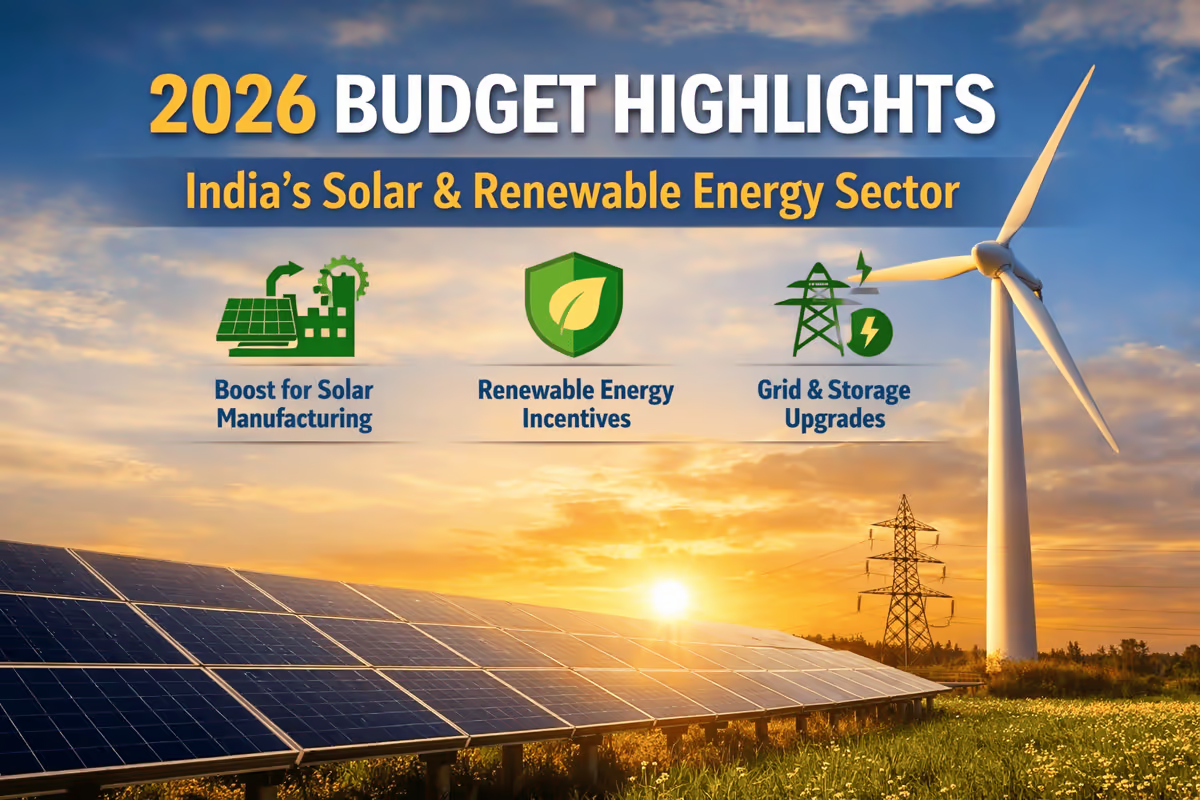
- Ensuring long-term energy stability through diversified clean energy sources
- Reduced dependency on critical imports
- Continued emphasis on renewable energy as a strategic national priority
- Exemption of Basic Customs Duty (BCD) on sodium antimonate , a key input used in the manufacture of solar glass
Overview
The Union Budget 2026 sends a strong and clear signal: India’s clean energy transition is moving from intent to execution. With a focused push on energy security, domestic manufacturing, and long-term sustainability, the budget creates multiple growth opportunities for the solar EPC ecosystem, manufacturers, and investors.
Below are the key solar and renewable energy highlights from the Union Budget 2026 and what they mean for businesses and consumers.
Key highlights:
This creates a stable policy environment for large-scale solar adoption across industrial, commercial, and utility-scale projects.
To strengthen domestic manufacturing, the budget introduces critical customs duty exemptions that directly support the solar value chain.
Solar-specific incentives include:
These steps will lower production costs, improve supply-chain resilience, and support India’s vision of becoming a global solar manufacturing hub.
Recognizing that renewable energy growth must be supported by storage solutions, the budget continues incentives for battery infrastructure.
Key announcement:
This is a crucial move for enabling round-the-clock solar power and improving grid reliability.
The government has reinforced its commitment to infrastructure-led growth with record public capital expenditure.
What this means for solar:
To accelerate clean energy investments, the budget proposes:
This improves access to affordable financing for solar EPC players and project developers.
Union Budget 2026 aligns renewable energy with the broader vision of Viksit Bharat, focusing on:
Solar energy is no longer just a cost-saving option—it is now a strategic growth engine for India’s economy.
For EPC companies:
For consumers:
Union Budget 2026 clearly positions solar energy at the heart of India’s energy and infrastructure roadmap. With manufacturing incentives, storage support, and strong policy backing, the coming years present a powerful opportunity for businesses and consumers to transition toward clean, reliable, and future-ready solar power.
At Chirayu Power Pvt. Ltd., we see this budget as a catalyst for accelerated solar adoption and long-term value creation across India’s renewable energy landscape.
Looking to invest in solar or upgrade your existing system? This is the right time to act.
At Chirayu Power, our team of 100+ people is ready to help you join this “Solar Revolution.”
Are you ready to stop paying for power and start making it?
Karan Chopda
Director, Chirayu Power Private Limited
Office: C-1/1, MIDC, Near Law College, Khamgaon
- Ensuring long-term energy stability through diversified clean energy sources
- Reduced dependency on critical imports
- Continued emphasis on renewable energy as a strategic national priority
- Exemption of Basic Customs Duty (BCD) on sodium antimonate , a key input used in the manufacture of solar glass
- Exemption of BCD on capital goods required for processing critical minerals in India
- Extension of BCD exemption on capital goods used for manufacturing Lithium-Ion cells for batteries used in Battery Energy Storage Systems (BESS)
- Higher demand for solar installations in industrial corridors, smart cities, logistics hubs, and public infrastructure
- Increased scope for rooftop solar on government and institutional buildings
- Faster execution of large renewable projects supported by improved transmission and logistics networks
- Infrastructure Risk Guarantee Fund to provide partial credit guarantees to lenders
- Continued restructuring and strengthening of Power Finance Corporation (PFC) and Rural Electrification Corporation (REC)
- Sustainable growth
- Climate resilience
- Job creation through green manufacturing
- Technological self-reliance
- Lower equipment costs due to duty exemptions
- Stronger domestic supply chains
- Better financing options for projects
- More affordable solar systems
- Improved reliability with energy storage integration
- Faster adoption across residential, commercial, and industrial segments

Comments & Discussion
0Enjoyed this article? Share your thoughts, ask a question, or join the conversation.
No comments yet
Be the first to share your thoughts, engineering questions, or feedback on "Union Budget 2026 Renewable Energy Highlights Solar, Storage & Infrastructure"!