
Author: chirayu team

17 posts

On 13 February 2026, MSEDCL silently capped rooftop solar capacity for every consumer in Maharashtra — no gazette notification, no industry consultation, no warning. At Chirayu Power Pvt. Ltd., we believe you deserve to know what this means for India’s clean energy future.


— THE ISSUE —

A Policy Change That No One Announced

At Chirayu Power Pvt. Ltd., we install rooftop solar systems for homes and businesses across Khamgaon and Buldhana districts. Every day, we work with families making one of the most forward-thinking financial decisions of their lives — going solar. And every day since 13 February 2026, we have watched that decision get quietly, systematically blocked.

Maharashtra State Electricity Distribution Company Limited (MSEDCL) has implemented a sweeping change to how rooftop solar capacity is approved under the PM Surya Ghar – Muft Bijli Yojana scheme. Under the new system, a consumer’s permitted solar capacity is no longer based on what they need — it is based on what they consumed in the past twelve months.

No gazette notification. No official circular. No industry consultation. This change was applied directly through the online approval portal — silently, overnight, without a single word of warning to consumers, vendors or installers.

Previously, a consumer planning a 5 KW system — to power their home, charge an EV and run an AC — could simply request that capacity. Today, MSEDCL’s portal calculates their average monthly consumption from the past year and caps their solar system accordingly. If they were conserving power before going solar (as most do, because Maharashtra’s electricity tariffs are high), they get a smaller system than they actually need.


— THE CORE PROBLEM —

Punished for Being Responsible — The Paradox at the Heart of This Policy

There is a fundamental truth about rooftop solar that this policy ignores: electricity consumption naturally rises after solar installation.

Before going solar, families in Maharashtra actively suppress their energy use. They skip the AC on hot days. They delay buying an electric vehicle. They avoid the induction cooker, the washing machine, and the microwave — because every unit costs money. Once solar is installed, those constraints disappear. They live more freely, more comfortably, more modernly.

This is not recklessness — this is India’s electrification story, the very story PM Surya Ghar was designed to accelerate. MSEDCL’s formula punishes families for being energy-responsible before they go solar, and then denies them the system they actually need after they commit to it.

The groups hit hardest:

● New homeowners — A family with only 100 units of prior consumption now qualifies for just 1 KW. Between 15–20% of solar bookings come from new homes. All of them are now blocked.

● Housing societies — A society needing 80 KW was approved for just 10 KW because the portal assessed only a single meter’s 12-month history. This is now the norm.

● EV and appliance buyers — Families planning to buy an EV or install an AC cannot get the solar capacity to support those plans. The policy freezes them in their past.

● 50–60% of all residential consumers in Maharashtra are adversely affected. Over 60% of already-booked orders are at risk.

— SIDE BY SIDE —

Article content

One portal change. Thousands affected.

This Is Not Just Unfair — It May Be Unlawful

Sections 7 and 9 of the Electricity Act 2003 explicitly exempt power generation from licensing requirements. MERC Regulation 6.2 protects a consumer’s right to determine their own solar capacity. No formal amendment has been made. No gazette notification has been issued. A fundamental consumer right has been erased through a silent web portal change — and that is not how a rule-of-law-governed utility is permitted to operate.


— FOLLOW THE INCENTIVE —

Who Actually Benefits From This Restriction?

It is worth asking: if solar consumers are harmed, who gains? When a rooftop solar consumer generates surplus electricity, it flows back into the MSEDCL grid. MSEDCL banks those units and compensates the consumer at a feed-in tariff that is often a fraction — sometimes one-quarter — of what MSEDCL charges for the same unit. That arrangement already tilts heavily in MSEDCL’s favour. By restricting solar capacity, MSEDCL compounds those advantages:

Zero infrastructure investment — consumers bear all capital costs; MSEDCL benefits from the output.

No interest cost on banked consumer-generated units accumulated across the year.

No transmission losses on locally generated, locally consumed rooftop power.

Below-cost energy procurement — rooftop solar acquired at rates lower than MSEDCL’s own purchase price.

Free RPO credits — additional Renewable Purchase Obligation compliance at zero cost.

Despite all of these advantages, MSEDCL has moved to restrict the very installations that deliver them — ostensibly citing grid stability, without a single data point or technical report to support that claim.


— LEGAL STANDING —

This Is Not Just Unfair — It May Be Unlawful

Sections 7 and 9 of the Electricity Act 2003 explicitly exempt power generation from licensing requirements. MERC Regulation 6.2 protects a consumer’s right to determine their own solar capacity. No formal amendment has been made. No gazette notification has been issued. A fundamental consumer right has been erased through a silent web portal change — and that is not how a rule-of-law-governed utility is permitted to operate.


— WHAT WE DID —

Standing Up: The Delegation at Khamgaon

On 21 February 2026, Chirayu Power Pvt. Ltd. joined the Buldhana District Solar Vendors Association at the BJP Office, Khamgaon, for a formal delegation meeting with Hon. Labour Minister Shri Akashdada Fundkar (Maharashtra). We placed five clear demands before the Minister:

1. Immediately and unconditionally withdraw the new solar capacity restrictions under PM Surya Ghar – Muft Bijli Yojana.

2. Reinstate the previous framework, allowing consumers to choose capacity based on actual requirements.

3. Issue a clear, gazette-notified policy — and suspend all changes made without industry consultation.

4. Process all orders booked before 13 February 2026 under the original rules in place at the time of booking.

5. Ensure full compliance with the Electricity Act 2003 and all applicable MERC Regulations.


Outcome

Hon. Labour Minister Shri Akashdada Fundkar(Maharashtra). received the delegation with seriousness and extended his personal assurance of direct intervention with MSEDCL and the Maharashtra Government.

The All India Renewable Energy Association (AIREA) has independently warned that if MSEDCL does not reverse this policy within the week, a state-wide agitation will be launched across Maharashtra.

“The families who booked solar to charge their EV, to run the AC, to light their child’s study room at night — they were not being greedy. They were being forward-thinking. We entered this business because we believed clean energy belonged on every rooftop. These restrictions don’t just hurt our orders — they break the trust of every family that made a life decision based on a government promise. We are asking Maharashtra to act. Not tomorrow. Now.”

Chirayu Power Pvt. Ltd. & Buldhana District Solar Vendors Association, Khamgaon · 21 February 2026


— OUR POSITION —

We Are Not Against the System. We Are Fighting for It.

At Chirayu Power Pvt. Ltd., we are committed to clean energy — not as a business proposition, but as a conviction. Maharashtra is India’s single largest rooftop solar market. It has the potential to lead the country’s energy transition. That potential is now being quietly, methodically dismantled by a portal change that nobody voted for, nobody approved, and nobody can officially point to.

We call on MSEDCL, MERC and the Maharashtra Government to place the consumer’s interest, India’s clean energy future and the Electricity Act 2003 at the centre of this conversation — and to act before more families, more businesses and more of India’s renewable potential are left in the dark.

If you are a solar consumer, vendor, industry professional or policy researcher who has been affected by this change, we would like to hear your story. Share it — the more voices that speak, the harder this is to ignore.


About Chirayu Power Pvt. Ltd.

We are a PM Surya Ghar authorised solar energy solutions provider based in Khamgaon, Buldhana, Maharashtra. We help homes and businesses across Pan India transition to clean, affordable solar energy — and we advocate for the policies and regulatory frameworks that make that transition possible for everyone.

Conclusion

MSEDCL’s unannounced policy change is not just a regulatory hurdle — it is a direct contradiction of PM Surya Ghar’s promise and a potential violation of the Electricity Act 2003. Thousands of families across Maharashtra are paying the price for a decision made without a single word of public notice.

At Chirayu Power Pvt. Ltd., we will not stand by while that happens. We have raised our voice, submitted our representation, and we will continue fighting until every consumer gets back the right to choose their own solar future.

If you have been affected — or are planning to go solar and want clarity on how these changes impact you — our team of 100+ solar experts is ready to help.

The sun is not going anywhere. Neither are we.

Karan Chopda

Director, Chirayu Power Pvt. Ltd.

🌐 www.chirayupower.com

📍 C-1/1, MIDC, Near Law College, Khamgaon, Buldhana, Maharashtra

Khamgaon · Buldhana · Maharashtra  |  Solar Energy Solutions  |  PM Surya Ghar Authorised Vendor
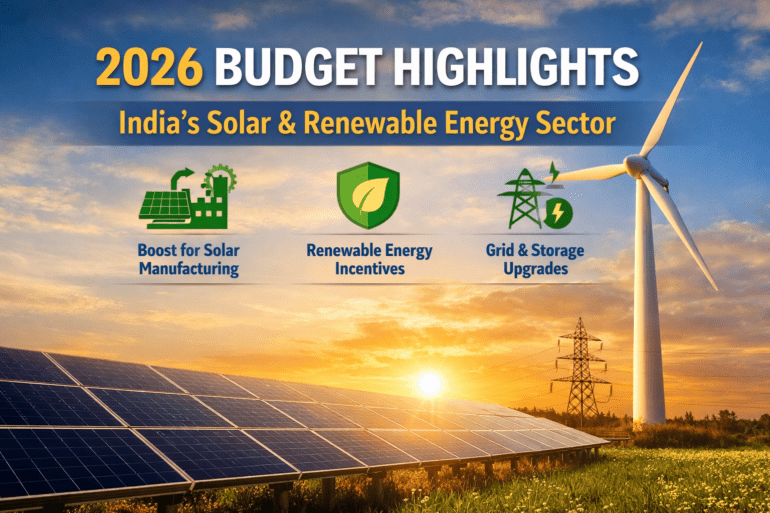
Union Budget 2026 Highlights for the Solar & Renewable Energy Sector

The Union Budget 2026 sends a strong and clear signal: India’s clean energy transition is moving from intent to execution. With a focused push on energy security, domestic manufacturing, and long-term sustainability, the budget creates multiple growth opportunities for the solar EPC ecosystem, manufacturers, and investors.

Below are the key solar and renewable energy highlights from the Union Budget 2026 and what they mean for businesses and consumers.

1. Strong Focus on Long-Term Energy Security
Energy security has been identified as a core pillar of India’s growth strategy. The government has announced multiple policy measures aimed at reducing import dependency and strengthening domestic clean energy infrastructure.

Key highlights:

  • Ensuring long-term energy stability through diversified clean energy sources
  • Reduced dependency on critical imports
  • Continued emphasis on renewable energy as a strategic national priority

This creates a stable policy environment for large-scale solar adoption across industrial, commercial, and utility-scale projects.

2. Major Boost to Solar Manufacturing Ecosystem

To strengthen domestic manufacturing, the budget introduces critical customs duty exemptions that directly support the solar value chain.

Solar-specific incentives include:

  • Exemption of Basic Customs Duty (BCD) on sodium antimonate, a key input used in the manufacture of solar glass
  • Exemption of BCD on capital goods required for processing critical minerals in India

These steps will lower production costs, improve supply-chain resilience, and support India’s vision of becoming a global solar manufacturing hub.

3. Support for Energy Storage & Grid Stability

Recognizing that renewable energy growth must be supported by storage solutions, the budget continues incentives for battery infrastructure.

Key announcement:

  • Extension of BCD exemption on capital goods used for manufacturing Lithium-Ion cells for batteries used in Battery Energy Storage Systems (BESS)

This is a crucial move for enabling round-the-clock solar power and improving grid reliability.

4. Large-Scale Public Investment in Infrastructure

The government has reinforced its commitment to infrastructure-led growth with record public capital expenditure.

What this means for solar:

  • Higher demand for solar installations in industrial corridors, smart cities, logistics hubs, and public infrastructure
  • Increased scope for rooftop solar on government and institutional buildings
  • Faster execution of large renewable projects supported by improved transmission and logistics networks
5. Financing & Risk Support for Infrastructure Projects

To accelerate clean energy investments, the budget proposes:

  • Infrastructure Risk Guarantee Fund to provide partial credit guarantees to lenders
  • Continued restructuring and strengthening of Power Finance Corporation (PFC) and Rural Electrification Corporation (REC)

This improves access to affordable financing for solar EPC players and project developers.

6. Alignment with India’s Viksit Bharat 2047 Vision

Union Budget 2026 aligns renewable energy with the broader vision of Viksit Bharat, focusing on:

  • Sustainable growth
  • Climate resilience
  • Job creation through green manufacturing
  • Technological self-reliance

Solar energy is no longer just a cost-saving option—it is now a strategic growth engine for India’s economy.

What This Means for Solar EPC Companies & Consumers

For EPC companies:

  • Lower equipment costs due to duty exemptions
  • Stronger domestic supply chains
  • Better financing options for projects

For consumers:

  • More affordable solar systems
  • Improved reliability with energy storage integration
  • Faster adoption across residential, commercial, and industrial segments
Conclusion

Union Budget 2026 clearly positions solar energy at the heart of India’s energy and infrastructure roadmap. With manufacturing incentives, storage support, and strong policy backing, the coming years present a powerful opportunity for businesses and consumers to transition toward clean, reliable, and future-ready solar power.

At Chirayu Power Pvt. Ltd., we see this budget as a catalyst for accelerated solar adoption and long-term value creation across India’s renewable energy landscape.

Looking to invest in solar or upgrade your existing system? This is the right time to act.

At Chirayu Power, our team of 100+ people is ready to help you join this “Solar Revolution.”

Are you ready to stop paying for power and start making it?

Karan Chopda

Director, Chirayu Power Private Limited

www.chirayupower.com

Office: C-1/1, MIDC, Near Law College, Khamgaon

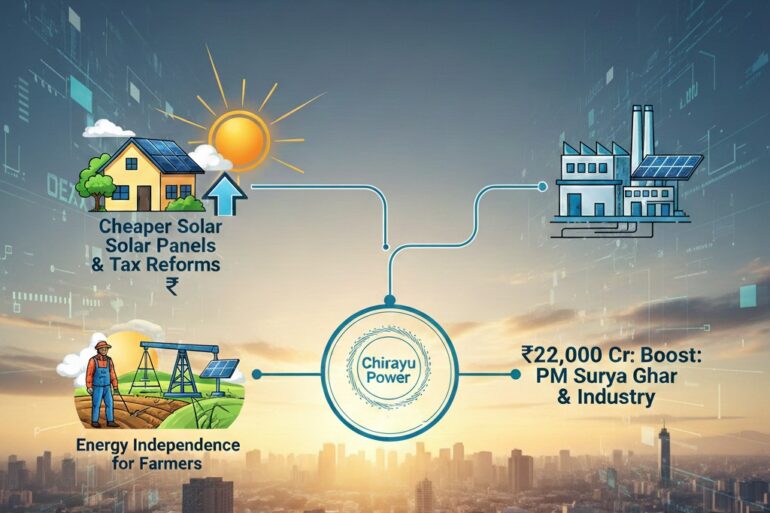
Today, the government shared its big plan for the next year, and if there’s one thing they love, it’s the sun! As the Director of Chirayu Power, I’ve been helping people switch to solar since 2014. We’ve finished over 1,000 projects, and I can tell you—this is the most exciting news we’ve had in a long time.

Think of solar energy like a giant, free battery in the sky. This budget makes it easier and cheaper for everyone to use that battery. Here is the simple breakdown of what’s changing.

1. The “Ingredients” for Solar are Getting Cheaper

Did you know solar panels use a special kind of glass? To make this glass, you need something called “sodium antimonate.” Before today, it was expensive to bring this into India because of taxes. Now, those taxes are gone!

What this means: When the ingredients for solar glass get cheaper, the whole panel gets cheaper. This helps Indian factories make great panels that don’t cost a fortune.

2. A Change in “Import Fees” (Customs Duty) 

The government has changed how much tax is paid when solar parts come into India.

  • Solar Cells & Modules: The main tax (BCD) was dropped to 20%.
  • The “Cess” Part: They added a new fee called AIDC (7.5% for cells and 20% for modules).
  • The Result: Even though it sounds confusing, the total tax on modules is now roughly 40% (it used to be 44%). This small drop helps keep solar prices stable even while we build more factories in India.
3. Free Power for 1 Crore Homes 

The government is putting ₹22,000 crore into the PM Surya Ghar plan. They want to help 1 crore (10 million) families put solar on their roofs.

What this means: If you’re a homeowner, the government is basically saying, “We will help you pay for your solar so you can stop paying electricity bills.” It’s a win-win!

4. What it Means for Big Factories (Industrial Customers) 

If you run a factory or a big business, this budget has a special gift for you too:

  • Simpler Rules: The government is giving extra money to states that make it easier for you to use solar power. This means things like “net-metering” (where you get credit for the extra power you make) should become much faster and simpler.
  • Buying Green Power: It’s becoming easier for big companies to buy solar power from a big “solar farm” far away. This is what we call Open Access, and the budget makes this path smoother and more reliable.
5. What it Means for the Solar Experts (EPC Players like us!) 

EPC stands for the people who actually come to your house or factory to install the panels (that’s us!).

  • No More Waiting: With the new National Manufacturing Mission, we won’t have to wait for months for panels to arrive from other countries. We can get high-quality “Made in India” parts right here.
  • Better Batteries: The budget makes it cheaper to make big batteries. This means we can soon offer you “Solar + Battery” systems that keep your lights on even when the sun goes down!
6. Help for Our Farmers (PM-KUSUM) 

The government has allocated ₹5,000 crore for farmers—nearly double from before!

What this means: Farmers can buy solar water pumps and save money on diesel. They can water their crops during the day using the sun, making farming much easier and cheaper.

My Prediction: The Future is Bright! 

We are moving to a world where we don’t just “buy” electricity from a big company; we “make” it ourselves on our own roofs. Whether you have a small house, a big farm, or a giant factory, the sun is ready to work for you.

At Chirayu Power, our team of 100+ people is ready to help you join this “Solar Revolution.”


Are you ready to stop paying for power and start making it?

Karan Chopda

Director, Chirayu Power Private Limited

www.chirayupower.com

Office: C-1/1, MIDC, Near Law College, Khamgaon

Waaree Energies Achieves Historic 1 GW Monthly Solar Module Output — A New Benchmark for India’s Solar Future

India’s solar manufacturing landscape has reached a major breakthrough. In November 2025, Waaree Energies became the first Indian solar module manufacturer to achieve 1 GW of monthly solar module output, a milestone celebrated across global renewable energy platforms.

This remarkable achievement was first reported by The Economic Times, highlighting how Waaree crossed this record production level and strengthened India’s position as a global solar leader.

Why This Milestone Matters for India

Reaching 1 GW/month is not just a manufacturing number — it is a symbol of India’s rising dominance in clean energy production. As The Hindu Business Line reported, Waaree is now the first Indian company to deliver this scale of output, supported by advanced, fully automated production lines and world-class quality control processes.

Key takeaways:

  • Massive domestic capability: India can now produce high-quality modules at a global scale.

  • Stronger supply chain: Faster availability of Tier-1 modules for EPC players and developers.

  • Boost to national solar targets: Supports India’s renewable capacity ambitions for 2030 & beyond.

What This Means for Chirayu Power Pvt. Ltd.

As an Elite Circle Chairman Partner of Waaree Energies, Chirayu Power Pvt. Ltd. is proud to celebrate this landmark achievement. This milestone directly enhances our EPC strength:

1. Faster Delivery & Project Execution

High-scale production ensures reliable, timely module availability for industrial, commercial, and rooftop installations.

2. Premium Tier-1 Quality for Every Client

Waaree’s advanced production processes help us deliver world-class solar performance with higher efficiency and long-term reliability.

3. Confidence for Large-Scale Solar Projects

Whether it’s a factory, warehouse, commercial setup, or utility-scale project — increased manufacturing capacity empowers us to execute faster.

As PV Magazine India also highlighted, this growth is aligned with India’s transition to energy independence and the rising global demand for high-efficiency modules.

Strengthening India’s Solar Future — Together

At Chirayu Power Pvt. Ltd., we believe milestones like these are not just achievements of one company — they are achievements for the entire renewable ecosystem of India. As proud partners of Waaree Energies, we are committed to:

  • Delivering high-performance solar EPC solutions

  • Ensuring cutting-edge technology and global-standard engineering

  • Supporting customers with transparent documentation and reliable service

  • Contributing to India’s clean energy mission with sustainable, impactful projects

Our Commitment
“With Waaree’s extraordinary 1 GW output milestone, we are even more determined to power India’s solar revolution with trust, technology, and top-tier quality.”

Whether you are exploring rooftop solar, industrial projects, or large-scale installations — Chirayu Power Pvt. Ltd. is your trusted EPC partner.

India to Launch Dedicated Small-Hydro Policy for North-East

The Ministry of New and Renewable Energy (MNRE) is set to roll out a special Small-Hydro Policy aimed at accelerating renewable energy growth in India’s North-Eastern region, announced Pralhad Joshi.

Harnessing the North-East’s Hydro Potential

Speaking at a regional renewable-energy workshop in Guwahati, Joshi highlighted that the North-East has an estimated renewable-energy potential of 122 GW, yet only about 5.1 GW has been installed so far.

The new policy will specifically target the region’s hilly terrain and rich network of rivers — ideal for small-hydro development.

Why This Policy Matters
  • It signals a shift beyond just solar and wind — adding more focus on small-hydro to diversify the renewable mix.

  • It opens new opportunities for regional states (such as Assam, Arunachal Pradesh, Meghalaya, Nagaland, Sikkim, and Tripura) to play a larger role in national targets.

  • It strengthens India’s push towards energy access and security in regions that sometimes face challenges in large-scale grid connectivity.

What’s Next for the Region

The workshop included discussions on green hydrogen, decentralised renewable systems, financing models and collaboration between the Centre, state governments and industry stakeholders.
The MNRE reiterated its commitment to providing policy and financial support to the North-East’s clean-energy ambitions.

Implications for the Renewable Sector

For companies and EPC players in the renewable space, especially those focused on hydro-electric and small-scale generation:

  • This policy could unlock new project pipelines in the North-East where hydro-resources are under-utilised.

  • Financing models and central support may make small-hydro projects more viable and quicker to deploy.

  • Integrating solar, hydro, biomass and other renewables in regional systems will become more important.

Looking Ahead

With the launch of the Small-Hydro Policy, India is broadening its renewable energy strategy — moving beyond solar and wind to fully tap regional resources. The North-East stands to become a key frontier of growth in the country’s renewable energy story.

India has taken yet another significant stride in its clean-energy journey with the opening of the REI Expo 2025 on October 30 at the India Expo Mart, Greater Noida.

International Collaboration Meets Indian Ambition

The 18th edition of REI Expo is being held in tandem with The Battery Show India (TBSI), drawing more than 1,000 exhibitors and 1,400 global brands with over 55,000 professionals expected to attend.

This dual-event approach underlines the growing convergence of renewable power generation, energy storage and e-mobility as India accelerates its decarbonisation agenda.

Big Moves in Clean-Energy Infrastructure

Key announcements at the expo include:

  • The Ministry of Power has approved a ₹5,400 crore viability gap funding scheme to support 30 GWh of battery energy storage projects, in addition to the 13.2 GWh already under development.

  • Expected investment of around ₹33,000 crore by 2028 in energy-storage infrastructure.

  • Participation from country pavilions including Germany, Belgium, China, Japan and Korea, backed by the European Union’s Cluster Collaboration Platform.

  • A specialised Bio-Energy Pavilion featuring 65 companies, underlining India’s push into diversified renewable technologies.

What It Means for the Solar Sector

For companies operating in the solar EPC space, this expo confirms several major trends:

  • Energy-storage solutions are becoming increasingly integral to solar deployments — the support for large-scale battery systems will enhance grid stability and solar integration.

  • Domestic manufacturing, global collaboration and technology exchange are gaining momentum, which implies solar EPC firms should keep an eye on evolving supply-chains and partnerships.

  • With clear signals on investment and policy backing, the solar market in India is reinforcing a long-term growth trajectory.

Looking Ahead

As India races toward its ambitious renewable targets, events like REI Expo 2025 serve both as milestones and catalysts. For the solar EPC industry, the takeaway is clear: aligning with energy-storage, diversifying into new tech and leveraging global innovation will be critical.

In this landscape, the solar sector isn’t just expanding — it’s transforming into a full-fledged ecosystem of generation, storage, manufacturing and smart deployment..

India Becomes the World’s 3rd Largest Solar Power Producer

India has achieved a remarkable milestone in renewable energy, officially becoming the third-largest solar power producer in the world. According to recent global energy reports, India generated 1,08,494 GWh of solar energy in 2023, surpassing Japan and reinforcing its commitment to a sustainable future.

A Decade of Solar Transformation

Over the past decade, India has transformed from a developing solar market into a global clean energy leader. Strategic government initiatives such as the National Solar Mission, Make in India, and the Production Linked Incentive (PLI) scheme have accelerated solar adoption nationwide.

Massive solar parks, decentralised rooftop installations, and a growing focus on energy storage solutions have all contributed to this rapid rise in solar capacity.

A Proud Moment for Bharat

This achievement is more than just a number — it reflects India’s determination to build a cleaner, greener economy. Solar energy is playing a pivotal role in reducing the nation’s dependence on fossil fuels, cutting carbon emissions, and creating thousands of green jobs across the country.

A Global Shift Toward Clean Energy

India now stands proudly alongside China and the United States, the world’s top solar energy producers. This milestone strengthens India’s position in the global renewable energy landscape and brings the nation a step closer to its goal of achieving net-zero emissions by 2070.

Powering the Future

With continuous advancements in solar technology, policy support, and private sector participation, India’s solar journey is poised to grow even stronger. The focus ahead will be on expanding grid infrastructure, promoting domestic manufacturing, and ensuring reliable, sustainable power for every citizen.

As the sun continues to shine brighter on India’s energy future, the world watches a new era of clean power unfold.

Facebook Twitter Instagram LinkedIn youtube