Category: News and Blog

45 posts
When names like Waaree Energies, Vikram Solar, and GREW Solar are emblazoned on IPL jerseys, it’s not just branding – it’s the biggest public announcement of India’s clean energy revolution.

Something changed in IPL 2026. Solar energy brands have replaced fantasy gaming logos —Waaree Energies is on the Rajasthan Royals, Vikram Solar is on KKR’s jerseys, and GREW Solar is with the Gujarat Titans and Mumbai Indians. This isn’t just sponsorship, it’s the biggest public moment in India’s clean energy revolution.

solar project

When a cricket jersey became a solar billboard

IPL 2026 has brought a quiet revolution. For the first time in IPL history, a solar energy company— Waaree Energies —has become the title sponsor of a franchise, and that franchise is the Rajasthan Royals. When millions of fans see Cricket Teams jersey, the Waaree Energies logo normalizes solar energy in their minds.

This change didn’t come suddenly. Regulatory pressure forced fantasy gaming brands to exit IPL sponsorships in August 2025. The solar industry was ready to take their place —and it seized the opportunity.


When millions of fans see a solar company’s logo on a cricket jersey, renewable energy moves from just a policy document into everyday conversation.

— Chirayu Power 

This branding strategy speaks to a profound truth: solar energy companies are moving from the B2B world to consumer-facing brands. And there’s no platform like cricket for this.


Which Solar Company is with which IPL Team?

The lineup of solar companies for IPL 2026 is unprecedented. See the full picture here:

IPL 2026

IPL 2026


Chirayu Power and Waaree Energies relationship—not just partners, but family
Chairman Club Partner

Rajasthan Royals Branding by Waaree Energies – A Proud Moment for Chirayu Power

Chirayu Power Pvt. Ltd. is the Chairman Club Partner of Waaree Energies — under the Maharashtra Elite Circle Group. When Waaree Energies featured on the Rajasthan Royals jersey as the title sponsor in IPL 2026, it was a big moment for partners like Chirayu Power as well. We don’t just install Waaree products — we execute their mission at the ground level.

Waaree Energies is today India’s largest solar module manufacturer . The announcement of the title sponsorship with Rajasthan Royals in March 2026 was a watershed moment for the solar industry. For the first time, a solar company occupied the IPL’s most premium branding space – the chest area of ​​the team jersey.

And Chirayu Power is part of this journey. Hosting business meets with Waaree Energies in the Buldhana district, providing a platform for local EPC partners—this is the ground-level work that makes Waaree Energies a mass-market brand.


How does the message of Solar reach the common Indian through IPL branding?

Cricket is a religion in India. What government reports and policy documents fail to do, an IPL jersey does. When millions of fans see Cricket Teams with the Waaree Energies logo, or Vikram Solar on KKR’s purple jersey—solar energy becomes a normal, aspirational thing.

IPL 2026

India’s total renewable capacity reached 253.96 GW by November 2025, with solar alone accounting for 132.85 GW . These numbers aren’t just statistics—they’re the result of the work of millions of EPC companies like Chirayu Power who carry out ground-level installations.


A company started with ₹20,000 – today it has a turnover of ₹130 crore+

The story of Chirayu Power is no less exciting than an IPL match. Started in 2014 as “Karmo Solar Solutions,” this company, founded with a capital of just ₹20,000, is today one of the most trusted solar EPC companies in Maharashtra.

Today Chirayu Power has:

chirayu power journey

The increased visibility of solar brands in the IPL directly benefits companies that operate on the ground level—like Chirayu Power. When a homeowner or industrialist sees a solar logo at a cricket match and then searches for “solar plant” on Google—they end up at Chirayu Power.


Where will this combination of Solar and Cricket take India?

The entry of solar brands into the IPL isn’t a temporary trend—it ‘s a cultural moment in India’s energy transition . As awareness grows, demand will increase. And as homeowners, factories, and institutions adopt solar, the need for trusted EPC partners like Chirayu Power will only increase.

Where India is heading:

The journey from 253.96 GW of renewable capacity to 500 GW – India’s target for 2030. This means millions more solar installations, and this will require trusted, local, experienced EPC companies.

Chirayu Power is working on this mission in Maharashtra and beyond – whether it’s a homeowner’s 4 KW rooftop system , a factory’s 2 MW solar plant , or open-access solutions for government institutions.


With IPL signaling that solar energy is now mainstream – Chirayu Power is already there, ready for you.

Mr. Karan Chopda

     Managing Director
    Chirayu Power Pvt. Ltd., Khamgaon, Maharashtra

If you’ve been following India’s solar push for farmers, you already know PM-KUSUM was a big deal. But rolling out a scheme this massive across every corner of the country? That’s never simple. MNRE recently set a new deadline for the program — March 31, 2027 — and we think it’s a decision worth understanding properly.

A quick background on PM-KUSUM

Launched back in 2019, PM-KUSUM was built around one core idea — give Indian farmers access to affordable solar power so they aren’t dependent on diesel pumps or expensive grid electricity. The scheme covers three things: solar-powered water pumps for irrigation, small solar plants on uncultivated land that farmers can lease out, and solarising existing grid-connected pumps. Done right, it means lower costs, a steady extra income, and real energy independence for farmers.

2019

When it all started

2027

Revised completion year

3 crore+

Pumps in the target
Why was an extension needed?

In short, the ground reality was tougher than the plan on paper. A handful of connected problems kept slowing things down across states:

  1. State-level execution lagged behind: Approvals, tenders, and local infrastructure readiness varied wildly from state to state. Some moved fast, many didn’t.
  1. The message didn’t reach far enough: In many rural pockets, farmers had never even heard of the scheme — let alone knew how to register or apply for it.
  1. Upfront cost remained a barrier: The subsidy helps a lot, but farmers still need to arrange their own contribution. For many smallholders, that’s genuinely difficult.
  1. Equipment didn’t always show up on time: Solar modules, pumps, and trained installation crews weren’t always available when and where they were needed.
  1. Too many cooks in the kitchen: Getting DISCOMs, government bodies, and private vendors to move together in sync proved harder than expected in practice.
  1. COVID threw a long shadow: Two years of pandemic disruption set back field operations, manpower, and logistics in ways that took a long time to recover from.
What the extra time is meant to fix

The extension isn’t just buying time — it’s meant to address the actual gaps. The focus now shifts to completing installations that stalled midway, reaching farmers who were missed in the first wave, building stronger local awareness, and tightening coordination between agencies. The endgame is fewer diesel pumps, less strain on state electricity subsidies, and a bigger dent in India’s rural carbon footprint.

Who stands to gain?

For Farmers

  • A real second chance to apply and benefit
  • Meaningful cut in irrigation running costs
  • Option to earn by feeding power back to the grid
  • Less dependency on monsoons and power cuts

For the Solar Industry

  • Extended demand for panels, pumps, and EPC work
  • Deeper reach into underserved rural markets
  • More stable project pipelines to plan around
  • Room to build trust and presence at ground level
The bigger picture

India’s renewable energy ambitions are large, and they only work if the benefits reach down to the last farmer in the last village. PM-KUSUM is one of the most direct ways to make that happen. Giving it more runway isn’t admitting failure — it’s being realistic about how long genuine change takes, and making sure the investment already put in actually delivers results.


At Chirayu Power, we see the PM-KUSUM extension as a positive signal.

The government is choosing to get it right over getting it done fast. For farmers, that means a genuine opportunity is still very much on the table. For the solar industry, it means continued momentum in a market that matters. If you’re a farmer looking to understand your options under this scheme, or a business exploring rural solar projects, now is a good time to act.

RE & BESS Policy 2025–36: Targets, Rules & What It Means for You

New Policy Solar


OVERVIEW

So, What Just Happened?

On 18th March 2026, the Maharashtra government released a policy that’s going to change how the entire state thinks about electricity. It’s called the Renewable Energy & Energy Storage Policy 2025–36, and it’s a big deal.

Think of it like this — for the last few years, Maharashtra has been slowly shifting towards solar and wind energy. This policy basically says: “No more slowly. We’re going all in.”

It covers everything — from the rooftop solar panel on your house, to massive 100 GW wind farms, to how the government is going to manage land, transmission lines, and energy storage over the next 10 years.

Whether you own a factory, run a small shop, or just pay an electricity bill every month — this policy touches your life. Let’s break it down.


The government has made one thing crystal clear: every single unit of extra electricity needed between now and 2035 will come from renewable energy — not coal, not gas. That’s a commitment nobody has made before at this scale.

THE BIG NUMBERS

solar


STRATEGY

6 Ideas That Drive This Entire Policy
The policy isn’t just a list of numbers. It’s built on six clear ideas:
1

Big, Long-Term Targets

Investors need certainty. So the government has set clear 10-year targets — 50% RE by 2029-30, and 65% by 2035-36. No surprises.

2

Storage with Every Project

Solar and wind alone aren’t enough. Every major new RE project must now come paired with battery storage. That’s non-negotiable.

3

Land & Grid Made Easy

Government land available at almost no cost. Ready-made RE Industrial Zones across the state. Upgraded transmission network. The infrastructure is being set up first.

4

More Choice for Consumers

Whether you’re a homeowner with rooftop solar or a factory owner buying bulk power — you now have more options, more transparency, and more say.

5

Less Paperwork

One portal for everything. All approvals online. No more running from office to office. Smaller projects (up to 5 MW) get an even simpler process.

6

Stronger Institutions

New R&D centres, reformed agencies, skilled workforce, better data. The government knows that good policy needs good institutions to back it up.

ENERGY STORAGE RULES

The Battery Rule — This Is the Big One

If there’s one thing that makes this policy different from anything before it, it’s this: battery storage is no longer optional.

Here’s exactly what the rules say:

  • If you’re building a new solar or wind project and want it ready by FY 2029-30 — you need to add batteries that can store at least 50% of your project’s capacity, for a minimum of 2 hours. So if your solar plant is 100 MW, you need at least 50 MW / 100 MWh of storage.
  • After FY 2030-31, the bar goes higher. Same 50% capacity rule, but now you need 4 hours of storage instead of 2. The longer the storage, the more useful it is for the grid.
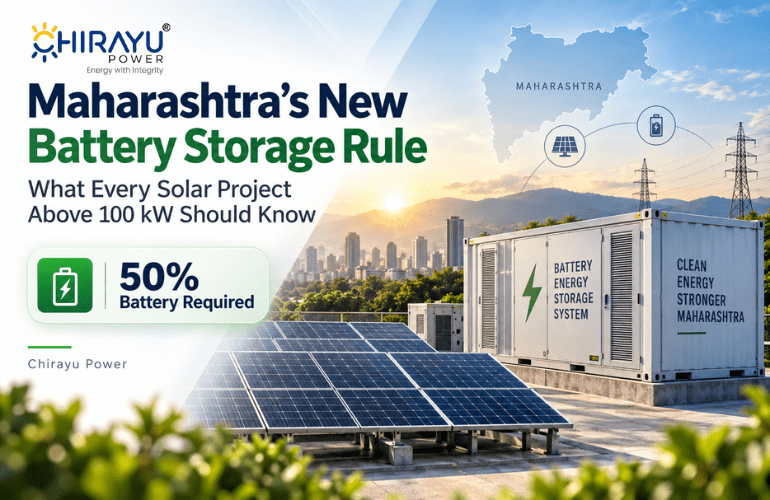
  • Even rooftop solar systems above 100 kW must come with storage from April 2026 onwards. 50% capacity, 2 hours. This will be reviewed every 2 years as costs change.
  • Power distribution companies (DISCOMs) themselves must build or buy storage equal to 10% of the electricity they supply — by 2035-36. And at least 85% of what goes into that storage must come from renewable energy.
  • Good news for storage developers: when a battery system draws power from the grid to charge itself, it won’t be charged transmission fees — as long as that stored energy stays within Maharashtra.
  • Standalone battery projects are fully allowed. You can build BESS independently — not attached to any solar or wind farm — and sell storage as a service to the grid.

LAND POLICY

Getting Land for RE Projects Just Got Easier

Land has always been the trickiest part of building renewable energy projects in India. Too many owners, too much bureaucracy, too many delays. This policy tries to fix that.

All land is now sorted into three types, and each type has its own clear rules:


  • Type 1 — Government Institution Land: Universities, government boards, PSUs, Gram Panchayats, Zilla Parishads — all of these can now lease their land for solar or wind projects. Up to 15 acres can be handled at the Gram Panchayat level itself. No need to go higher.
  • Type 2 — Revenue Department Land: Land under the Revenue Department can be leased at just ₹1 per year for 30 years. District Collectors can help consolidate scattered land parcels to make projects easier to set up.
  • Type 3 — Private Land: If you’re leasing private land, the minimum annual rent is the higher of ₹1.25 lakh per hectare or 6% of the registered land value. And this rent goes up 3% every year, so landowners benefit too.

REIZ PARKS

RE Industrial Zones — Plug-and-Play for Developers

Imagine if a developer could walk into a zone that already has land cleared, roads built, and a power transmission line waiting — all they need to do is install the panels or turbines. That’s what a Renewable Energy Industrial Zone (REIZ) is.

The government plans to build at least 10 of these zones by 2029-30 and 15 by 2035-36. Each zone will be at least 100 MW. A ₹500 crore fund has already been set aside to get this started.

Also, the NA (Non-Agricultural) tax that developers had to pay when converting farmland for RE use? Fully waived. The Revenue Department will officially notify this within 3 months.


“Maharashtra’s electricity demand is going to hit 350–360 BU by 2035-36. That’s nearly double what it is today. And every extra unit of that demand? It’s coming from green energy.”

FOR CONSUMERS

What Does This Mean for You?

This is the part most people want to know — how does this policy affect my electricity bill, my rooftop solar, or my business? The answer depends on how much electricity you use.

If you use up to 3 kW — Most homeowners

You get the best deal: Concessional Net Metering

Your rooftop solar feeds into the grid and you get credit for it. You can bank that credit across the whole year and across different times of the day. And there’s no extra banking charge. If you still have surplus electricity left at the end of the year, the DISCOM buys it from you at market rates. You also don’t need to install batteries.

If you use 3–10 kW — Small shops, bigger homes

Net Metering with a small Grid Support Charge

You can still bank your solar credits each month. But you’ll pay a small Grid Support Charge (GSC) per kW of solar you have. This is basically a fee for using the grid as your ‘backup’. Your credits are settled from cheapest to most expensive time slots.

If you use 10–100 kW — MSMEs, small factories

Net-Billing or Green Open Access — your choice

Banking is allowed only within the same time slot each month. You’ll pay a banking charge linked to storage costs. The good news? MSEDCL is going to bulk-buy 10–100 kW BESS systems to bring down costs for businesses like yours. Group captive arrangements are also possible.

If you use above 100 kW — Large industries & corporates

Long-Term Green Open Access — now much easier to access

Big change here: the minimum threshold for Green Open Access has dropped from 1 MW to 100 kW. That means thousands more businesses can now directly buy green power. Energy is tracked every 15 minutes. And if your project includes 4 hours of battery storage, you get a 10-year exemption from Electricity Duty. That’s a significant saving.

If you’re a large company with ESG or export commitments

100% Verified Green Power — block by block

International buyers, carbon taxes like CBAM, and ESG ratings are pushing companies to prove their electricity is actually green — not just on paper. DISCOMs will now offer special tariffs for verified 100% renewable electricity, tracked per time block, not just averaged over the year.


EASE OF DOING BUSINESS

Less Paperwork, More Action

One of the biggest complaints from RE developers has always been: too many approvals, too many offices, too much waiting. This policy directly tackles that.

  • One Portal for Everything: A single online portal managed by MEDA will handle every step — from project registration to final approval. No more offline visits to the Electrical Inspectorate or DISCOM offices. Everything moves online.
  • Green OA Simplified: The entire Green OA application and approval process will be simplified and made time-bound within 3 months. A public dashboard will show the status of every application, so there’s full transparency.
  • Help Desk for MSMEs: Every DISCOM zone must assign a dedicated officer (minimum Superintendent Engineer rank) whose only job is to help MSMEs get through the Green OA process.
  • Projects up to 5 MW get an even simpler registration process. Less documentation, faster approvals.
  • REIZ guidelines will be out within 3 months so developers can start planning immediately.

INSTITUTIONAL REFORMS

The Government Is Also Changing How It Works

Good policy needs good institutions. The government knows this — and this section of the policy is about fixing the machinery that runs the energy sector.

  • Grid Independence: MSETCL (the state transmission company) will be restructured within 12 months. The grid planning body (STU) and the load despatch centre (MSLDC) will be made more independent so their decisions aren’t influenced by political or commercial pressures.
  • MEDA Gets a Makeover: MEDA, which used to focus on awareness and small pilot projects, is being redesigned for the new era of large-scale RE. An expert committee has 3 months to propose a restructuring plan.
  • Coal Company Goes Green: MSPGCL, Maharashtra’s state power generation company, has 6 months to submit a plan for transforming from a coal-heavy company into a clean energy player. Old thermal plant land will be repurposed for solar and hybrid energy parks.
  • New R&D Centre: A brand new R&D and Innovation Centre for renewable energy will be set up with ₹100 crore per year for 3 years. It will support startups, agri-solar research, vehicle-to-grid pilots, AI-based energy management and more.
  • Skill Building: Every government energy agency must spend at least 2.5% of its salary budget on training staff in new technologies. The energy transition needs skilled people — and the government is committing to build that capacity.

TIMELINE

Key Deadlines to Watch

solar

CONCLUSION 

Maharashtra is clearly moving towards clean energy — and it’s happening faster than ever.

For you, it simply means this:
If you start early, you save more and benefit more.

Whether it’s rooftop solar or buying green power, now is a good time to think about your next step.

Don’t wait too long — early movers will always have the advantage.

The 2026 Solar Mandate: Why Your Delayed Decision Could Cost You Lakhs

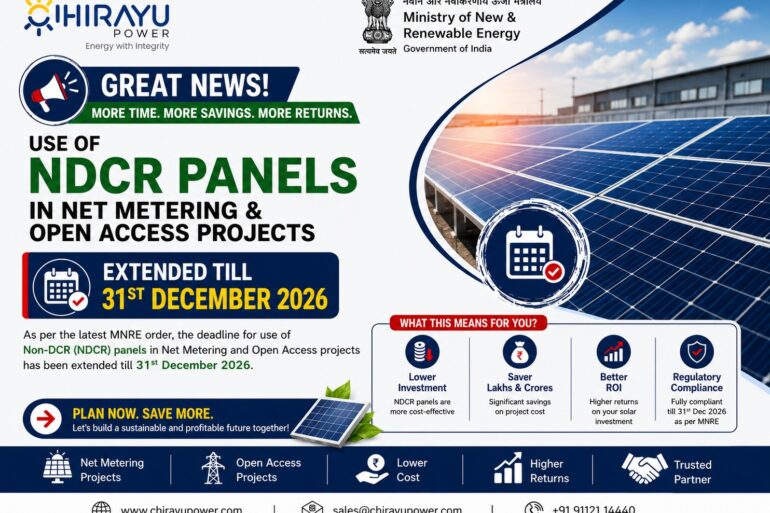
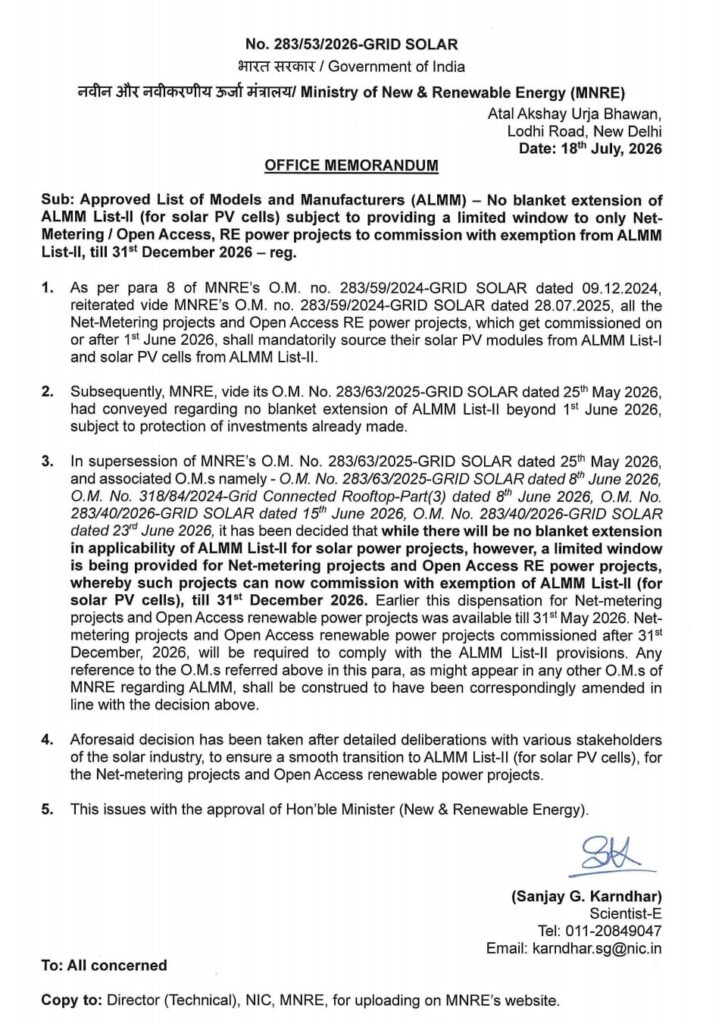
The Indian solar landscape is about to go through its biggest regulatory shift yet. The Ministry of New and Renewable Energy (MNRE) has made it clear that, from June 1, 2026, using DCR (Domestic Content Requirement) solar modules will be mandatory for all projects, including industrial and commercial ones.

At Chirayu Power, we work with businesses every day who are planning their solar journey. And right now, the single most important thing we are telling every client is this: the clock is ticking, and the decision you make today could either save you lakhs — or cost you lakhs.

Here is everything you need to know to protect your investment.

Understanding the Basics: DCR vs. Non-DCR

To the naked eye, these two types of solar panels look identical. But the difference is in their DNA — the supply chain behind them.


FeatureDCR Panels ✓Non-DCR Panels ✗
Manufacturing100% Made in India. Cells + modules manufactured locally.Modules are assembled in India, but solar cells are imported (mostly from China).
ComponentsCells, frames, and glass are domestically sourced.High-tech cells sourced globally for lower costs.
Policy StatusMandatory for all C&I projects from June 1, 2026.Currently standard for private/commercial projects due to lower costs.


DCR
A side-by-side look at what sets DCR and Non-DCR panels apart

The key distinction is simple: DCR panels are fully manufactured in India — from the solar cell to the final module. Non-DCR panels are assembled in India, but the cells — the most critical component — are imported, mostly from China. That is exactly what the new mandate aims to change.

The Price of ‘Made in India’

We are big supporters of the Atmanirbhar Bharat vision, and this mandate is a strong step in that direction. But we also believe in being transparent with our clients — and the truth is, building a fully domestic solar supply chain takes time and scale. Right now, DCR panels cost more than Non-DCR ones.

The Math: What You Lose by Waiting

Let us put this in plain numbers. Suppose you are planning a 100 kW industrial solar project and you delay installation until after the June 2026 mandate kicks in.

Extra Cost Calculation:


  • Project Size: 100 kW
  • Additional DCR Cost (optimistic estimate): ₹8,000 per kW
  • Total Extra Spend: 100 kW × ₹8,000 = ₹8,00,000 
  • Bottom Line: You lose ₹8 Lakhs simply by choosing a later installation date.
The ‘Safe Zone’ Timeline — Do Not Assume You Have Time

This is the part that catches most people off guard. You cannot simply decide in May 2026 that you want to install solar before the deadline and expect it to work out. Solar project commissioning involves technical approvals, grid synchronisation, and physical installation — all of which take time.

Crucial Deadline from Chirayu Power:

To stay on the safe side, you should make a decision and initiate the installation process now.

Starting early will give your project enough time to be completed and commissioned before the June 1st deadline. Any delay may put you at serious risk of missing this window and could result in higher costs due to DCR module pricing.

DCR

At Chirayu Power, we have already started receiving a higher volume of enquiries from businesses who are aware of this deadline. Lead times for equipment, approvals, and installation are tightening. The sooner you start, the smoother your experience will be.

Conclusion: Act Now or Pay Later

The transition to DCR is inevitable. We at Chirayu Power fully support the direction India is heading — building a robust, self-reliant solar manufacturing ecosystem is a long-term win for everyone.

But in the short term, if you have been planning a solar project and have not yet moved forward, now is the time. By securing your project approvals and initiating installation now, you can still take advantage of more affordable Non-DCR technology and lock in better returns.

Don’t let a ‘later’ mindset turn into an ₹8 Lakh penalty.

Reach out to Chirayu Power today. Our team will guide you through every step — from initial site assessment to grid commissioning — so you can make the most of the window that is still open.

About Chirayu Power

Chirayu Power is a leading solar energy solutions provider helping residential, commercial, and industrial clients across Maharashtra harness the power of the sun. From consultation to commissioning, we are with you at every step of your solar journey.

During the Waaree Energies Business Meet, an important part of the event was the address delivered by Karan Chopda, Director of Chirayu Power Pvt. Ltd..

The session focused on sharing the journey of Chirayu Power, introducing new opportunities in the solar sector, and highlighting how EPC partners and vendors can participate in larger solar projects through collaboration.

karan chopda chirayu power
Karan Chopda, Director — Chirayu Power Pvt. Ltd. addressing EPC partners at the Waaree Business Meet

— INTRODUCING CHIRAYU POWER —

The session began with a brief introduction by Karan Chopda, where he shared the journey and growth of Chirayu Power Pvt. Ltd. in the renewable energy sector.

Over the years, Chirayu Power has successfully executed more than 350 MW of solar projects, demonstrating its experience and technical capability in the solar industry.

Chirayu Power has expanded beyond India, with solar projects and collaborations underway in more than 10+ States, reflecting its growing international presence in renewable energy.

Karan chopda about chirayu power
Karan Chopda presenting Chirayu Power’s achievements — 350MW+, 10+ states, MNRE registered

— UNDERSTANDING OPEN ACCESS PROJECTS —

Another important topic discussed during the session was Open Access (Utility Scale) solar projects.

Many vendors and EPC partners present at the event were not fully familiar with this segment of the solar market. The discussion provided a clear overview of how open access projects operate and how they create opportunities for larger solar installations.

Understanding utility-scale projects helps EPC companies explore new business possibilities beyond traditional rooftop systems.


— RESCO MODEL & NEW BUSINESS OPPORTUNITIES —

The session also covered the RESCO (Renewable Energy Service Company) model, which is becoming increasingly popular in the commercial and industrial solar market.

Under the RESCO model, solar systems are installed and maintained by a service provider, while the customer pays only for the electricity generated. This model allows businesses to adopt solar energy without making large upfront investments.

For many EPC partners and vendors present at the event, this discussion highlighted an important and rapidly growing segment of the solar industry.


— INTRODUCING BESS TECHNOLOGY —

The discussion also introduced BESS (Battery Energy Storage Systems), an emerging technology that is playing a significant role in modern renewable energy infrastructure.

Energy storage systems allow solar power to be stored and used when required, improving the efficiency and reliability of solar installations. As solar capacity continues to grow, technologies like BESS are expected to become increasingly important in future energy systems.


— OPPORTUNITIES FOR EPC PARTNERS & VENDORS —

A key message shared during the address was the importance of collaboration within the solar ecosystem.

Vendors and EPC partners were encouraged to share potential project opportunities with Chirayu Power. For projects such as utility-scale installations, RESCO projects, or other large solar developments, Chirayu Power and Waaree Energies can collaborate with EPC partners to work together on such opportunities.

This approach highlights the importance of partnerships in expanding the reach of renewable energy projects.

Waaree Business Meet
EPC partners and solar vendors from across Buldhana district — engaged and ready to grow


— SPECIAL OFFER FOR EVENT PARTICIPANTS —

The session concluded with an announcement for the EPC partners and vendors attending the event.

As a special initiative for participants of the Business Meet, Waaree solar panels were offered at a special discounted rate exclusively for vendors and EPC partners present at the event.

A limited-time deadline was also shared for availing the discounted pricing, encouraging participants to take advantage of this opportunity.

Special Offer by karana chopda
Karan Chopda presenting exclusive event pricing for Waaree solar panels — available only to Business Meet participants

THE REAL WORK BEGINS AFTER THE EVENT

Events like this Business Meet create a spark — but the real work happens after. It happens in the conversations, the follow-ups, the partnerships that get formed, and the projects that get built.

For Chirayu Power Pvt. Ltd., this is exactly what drives us. We do not just organize events — we build relationships. And it is those relationships that will power the solar future of this region.

“Every great solar project starts with a handshake. And that handshake starts with trust.”

Karan Chopda Chirayu Power
Karan Chopda connecting with EPC partners after the session — building partnerships that last

— CONCLUSION —

The address by Karan Chopda highlighted several important aspects of the evolving solar industry, including open access projects, the RESCO model, and energy storage solutions.

For many EPC partners and vendors, the session provided valuable insights into new business opportunities and emerging technologies in the renewable energy sector.

At Chirayu Power Pvt. Ltd., such initiatives are part of a broader effort to encourage collaboration, knowledge sharing, and the continued growth of the solar ecosystem.

Watch Full Insights

🌐 www.chirayupower.com

📍 C-1/1, MIDC, Near Law College, Khamgaon, Buldhana, Maharashtra

Khamgaon · Buldhana · Maharashtra

The Waaree Energies Business Meet, hosted in association with Chirayu Power Pvt. Ltd., provided an excellent opportunity for EPC partners and solar vendors to gain valuable insights about the rapidly growing renewable energy sector.

The event brought together professionals who are actively working in the solar industry. Apart from networking and business discussions, the meet also focused on sharing practical knowledge about the solar market, industry trends, and upcoming opportunities for EPC partners and vendors.

Representatives from Waaree Energies addressed the audience and explained how the solar industry is expanding across India and how local EPC companies can benefit from the increasing demand for solar energy solutions.

— INDUSTRY GUIDANCE FROM WAAREE LEADERSHIP —

One of the most valuable parts of the Business Meet was the informative sessions conducted by experienced leaders from Waaree Energies.

The speakers included:

  • Mr. Pankaj Jadhav, Franchise Manager – Nagpur Region
  • Mr. Satish Shahpure, State Head – Maharashtra
  • Mr. Nitin Bhojne, State Head – Solfin

Each of them shared their experience and knowledge with the audience and spoke about different aspects of the solar industry.

— REGIONAL SOLAR MARKET OPPORTUNITIES —

Mr. Pankaj Jadhav, Franchise Manager for the Nagpur region, spoke about the increasing demand for solar installations in the Vidarbha region and surrounding districts.

He explained how solar energy adoption is growing steadily in residential homes, commercial establishments, and industrial sectors. According to him, the coming years will bring even more opportunities for EPC companies and vendors who are actively working in the renewable energy sector.

His session helped attendees understand how the solar market is evolving and how EPC partners can position themselves to take advantage of this growing demand.

Waaree Event in Buldhana
Mr. Pankaj Jadhav (Franchise Manager, Nagpur Region) addressing EPC partners and solar vendors

— WAAREE ENERGIES: A LEADING SOLAR BRAND —

Mr. Satish Shahpure, State Head – Maharashtra, shared his views on the rising demand for solar energy across the state.

He explained how businesses, industries, and households are increasingly installing solar systems to reduce electricity costs and move toward cleaner energy sources.

During his session, he also spoke in detail about Waaree Energies and its journey in the solar industry.

Waaree Energies is one of India’s leading solar panel manufacturing companies with its headquarters in Mumbai. Over the years, the company has developed a strong manufacturing network in India with several solar panel production facilities.

Major manufacturing plants are located in Gujarat, including Surat, Nandigram, and Chikhli, along with other facilities in locations such as Noida. Together, these plants contribute to a solar module manufacturing capacity of more than 20 GW, making Waaree Energies one of the largest solar module manufacturers in India.

He also explained that Waaree Energies has expanded its reach beyond India and now supplies solar modules and renewable energy solutions to customers in more than 25 countries, including markets in the United States, Europe, and Southeast Asia.

In addition to solar panel manufacturing, the company is also involved in EPC services, solar project development, and other renewable energy solutions.

For the EPC partners and vendors attending the Business Meet, this session provided a better understanding of the scale and capabilities of Waaree Energies and the opportunities available in working with such a globally recognized solar brand.

Waaree Event in Buldhana
Mr. Satish Shahpure (State Head, Maharashtra) presenting Waaree Energies’ vision and capabilities

— FINANCIAL SUPPORT FOR SOLAR PROJECTS —

Mr. Nitin Bhojne, Solfin State Head, addressed the audience and spoke about the financial aspects of solar projects.

He explained how proper financial planning and the availability of financing solutions can help businesses and EPC partners implement solar projects more efficiently.

His session helped attendees understand how financial partnerships and structured funding options can support the growth of solar installations across residential, commercial, and industrial sectors.

Waaree Event in Buldhana
Mr. Nitin Bhojne (State Head, Solfin) speaking on solar project financing and funding solutions

— CONCLUSION —

The insights shared by the leadership team of Waaree Energies gave EPC partners and vendors a clearer understanding of the current solar market and the opportunities ahead in the renewable energy sector.

For Chirayu Power Pvt. Ltd., hosting this Business Meet was not only about bringing industry professionals together but also about creating a platform for knowledge sharing and meaningful discussions around the future of solar energy.

We believe that such interactions help strengthen partnerships within the solar ecosystem and support the continued growth of renewable energy adoption across the region.

— ABOUT CHIRAYU POWER —

Chirayu Power Pvt. Ltd. is a solar energy solutions provider based in Khamgaon, Buldhana, committed to promoting clean and sustainable energy solutions across the region.

The company is proud to be associated with Waaree Energies as a Chairman Club Partner under the Maharashtra Elite Circle Group, reflecting its commitment to delivering reliable solar solutions and supporting the growth of renewable energy adoption.

🌐 www.chirayupower.com

📍 C-1/1, MIDC, Near Law College, Khamgaon, Buldhana, Maharashtra

Khamgaon · Buldhana · Maharashtra


Waaree Energies Business Meet Successfully Hosted in Buldhana District
Waaree Business Meet
Waaree Energies – Business Partners Meet | Buldhana District


The renewable energy sector is growing steadily across India, and collaboration between EPC partners, vendors, and industry leaders plays an important role in this growth. With this vision, Chirayu Power Pvt. Ltd. had the opportunity to host a Business Meet in association with Waaree Energies in Buldhana district.

The event brought together several EPC companies and solar vendors from different parts of the district. Their presence made the event meaningful and created a great environment for discussions around solar business opportunities and the future of renewable energy in the region.

For many participants, the meet was a valuable opportunity to connect with other professionals from the solar industry and learn about the latest developments in the renewable energy sector.

Waaree Event
Stage setup with Waaree Business Meet and Product Display


— A FIRST FOR BULDHANA DISTRICT —

One of the most important highlights of this event was that Waaree Energies organized such a Business Meet in Buldhana district for the first time.

For EPC partners and solar vendors working in the district, this was a special moment. Many of them got the opportunity to directly interact with representatives from Waaree Energies and understand more about the company’s work, products, and vision for the solar industry.

Events like this help bridge the gap between large solar manufacturers and local EPC partners who are actively working on ground-level installations.

Waaree Business Meet
Lamp lighting ceremony during inauguration of the Business Meet


— PARTICIPATION FROM EPC PARTNERS & VENDORS —

The Business Meet saw participation from multiple EPC companies and solar vendors from across the district. These professionals are already working in the renewable energy sector and are contributing to the adoption of solar energy in homes, commercial establishments, and industries.

During the event, participants had the opportunity to interact with each other, share their experiences, and discuss challenges and opportunities within the solar business.

Such discussions are extremely valuable for local EPC partners because they allow them to learn from each other and explore possibilities for collaboration on future solar projects.

Waaree Business Meet
EPC partners and solar vendors attending the Business Meet session
Waaree Business Meet
Attendees engaged during the business presentations
Waaree Business Meet
Participants from across Buldhana district at the event

— BUILDING A STRONGER SOLAR COMMUNITY —

Another important aspect of the event was the opportunity it created for networking within the solar ecosystem.

Solar vendors, EPC companies, and industry representatives were able to exchange ideas and build new professional connections. These interactions often lead to new partnerships and collaborations that help the solar industry grow stronger at the regional level.

For us at Chirayu Power, it was encouraging to see the level of interest and participation from the local solar community. The positive response clearly showed that the renewable energy sector in Buldhana district is steadily moving forward.


— CONCLUSION —

The Waaree Energies Business Meet turned out to be an important step toward bringing together solar professionals from across the district.

By creating a platform where EPC partners, vendors, and industry experts could interact and exchange knowledge, the event helped strengthen the local solar ecosystem.

At Chirayu Power Pvt. Ltd., we are grateful to all the participants who joined the event and contributed to making it a meaningful gathering for the renewable energy community.

We look forward to organizing more such initiatives in the future that support the growth of solar energy and encourage stronger partnerships within the industry.


Powering the Future with Trusted Partnerships

As a Chairman Club Partner of Waaree Energies in the Maharashtra Elite Circle Group, Chirayu Power Pvt. Ltd. continues to work towards bringing reliable and efficient solar energy solutions to homes, businesses, and industries across the region.

🌐 www.chirayupower.com

📍 Khamgaon, Buldhana, Maharashtra

Business Meet Highlights

On 13 February 2026, MSEDCL silently capped rooftop solar capacity for every consumer in Maharashtra — no gazette notification, no industry consultation, no warning. At Chirayu Power Pvt. Ltd., we believe you deserve to know what this means for India’s clean energy future.


— THE ISSUE —

A Policy Change That No One Announced

At Chirayu Power Pvt. Ltd., we install rooftop solar systems for homes and businesses across Khamgaon and Buldhana districts. Every day, we work with families making one of the most forward-thinking financial decisions of their lives — going solar. And every day since 13 February 2026, we have watched that decision get quietly, systematically blocked.

Maharashtra State Electricity Distribution Company Limited (MSEDCL) has implemented a sweeping change to how rooftop solar capacity is approved under the PM Surya Ghar – Muft Bijli Yojana scheme. Under the new system, a consumer’s permitted solar capacity is no longer based on what they need — it is based on what they consumed in the past twelve months.

No gazette notification. No official circular. No industry consultation. This change was applied directly through the online approval portal — silently, overnight, without a single word of warning to consumers, vendors or installers.

Previously, a consumer planning a 5 KW system — to power their home, charge an EV and run an AC — could simply request that capacity. Today, MSEDCL’s portal calculates their average monthly consumption from the past year and caps their solar system accordingly. If they were conserving power before going solar (as most do, because Maharashtra’s electricity tariffs are high), they get a smaller system than they actually need.


— THE CORE PROBLEM —

Punished for Being Responsible — The Paradox at the Heart of This Policy

There is a fundamental truth about rooftop solar that this policy ignores: electricity consumption naturally rises after solar installation.

Before going solar, families in Maharashtra actively suppress their energy use. They skip the AC on hot days. They delay buying an electric vehicle. They avoid the induction cooker, the washing machine, and the microwave — because every unit costs money. Once solar is installed, those constraints disappear. They live more freely, more comfortably, more modernly.

This is not recklessness — this is India’s electrification story, the very story PM Surya Ghar was designed to accelerate. MSEDCL’s formula punishes families for being energy-responsible before they go solar, and then denies them the system they actually need after they commit to it.

The groups hit hardest:

● New homeowners — A family with only 100 units of prior consumption now qualifies for just 1 KW. Between 15–20% of solar bookings come from new homes. All of them are now blocked.

● Housing societies — A society needing 80 KW was approved for just 10 KW because the portal assessed only a single meter’s 12-month history. This is now the norm.

● EV and appliance buyers — Families planning to buy an EV or install an AC cannot get the solar capacity to support those plans. The policy freezes them in their past.

● 50–60% of all residential consumers in Maharashtra are adversely affected. Over 60% of already-booked orders are at risk.

— SIDE BY SIDE —

Article content

One portal change. Thousands affected.

This Is Not Just Unfair — It May Be Unlawful

Sections 7 and 9 of the Electricity Act 2003 explicitly exempt power generation from licensing requirements. MERC Regulation 6.2 protects a consumer’s right to determine their own solar capacity. No formal amendment has been made. No gazette notification has been issued. A fundamental consumer right has been erased through a silent web portal change — and that is not how a rule-of-law-governed utility is permitted to operate.


— FOLLOW THE INCENTIVE —

Who Actually Benefits From This Restriction?

It is worth asking: if solar consumers are harmed, who gains? When a rooftop solar consumer generates surplus electricity, it flows back into the MSEDCL grid. MSEDCL banks those units and compensates the consumer at a feed-in tariff that is often a fraction — sometimes one-quarter — of what MSEDCL charges for the same unit. That arrangement already tilts heavily in MSEDCL’s favour. By restricting solar capacity, MSEDCL compounds those advantages:

Zero infrastructure investment — consumers bear all capital costs; MSEDCL benefits from the output.

No interest cost on banked consumer-generated units accumulated across the year.

No transmission losses on locally generated, locally consumed rooftop power.

Below-cost energy procurement — rooftop solar acquired at rates lower than MSEDCL’s own purchase price.

Free RPO credits — additional Renewable Purchase Obligation compliance at zero cost.

Despite all of these advantages, MSEDCL has moved to restrict the very installations that deliver them — ostensibly citing grid stability, without a single data point or technical report to support that claim.


— LEGAL STANDING —

This Is Not Just Unfair — It May Be Unlawful

Sections 7 and 9 of the Electricity Act 2003 explicitly exempt power generation from licensing requirements. MERC Regulation 6.2 protects a consumer’s right to determine their own solar capacity. No formal amendment has been made. No gazette notification has been issued. A fundamental consumer right has been erased through a silent web portal change — and that is not how a rule-of-law-governed utility is permitted to operate.


— WHAT WE DID —

Standing Up: The Delegation at Khamgaon

On 21 February 2026, Chirayu Power Pvt. Ltd. joined the Buldhana District Solar Vendors Association at the BJP Office, Khamgaon, for a formal delegation meeting with Hon. Labour Minister Shri Akashdada Fundkar (Maharashtra). We placed five clear demands before the Minister:

1. Immediately and unconditionally withdraw the new solar capacity restrictions under PM Surya Ghar – Muft Bijli Yojana.

2. Reinstate the previous framework, allowing consumers to choose capacity based on actual requirements.

3. Issue a clear, gazette-notified policy — and suspend all changes made without industry consultation.

4. Process all orders booked before 13 February 2026 under the original rules in place at the time of booking.

5. Ensure full compliance with the Electricity Act 2003 and all applicable MERC Regulations.


Outcome

Hon. Labour Minister Shri Akashdada Fundkar(Maharashtra). received the delegation with seriousness and extended his personal assurance of direct intervention with MSEDCL and the Maharashtra Government.

The All India Renewable Energy Association (AIREA) has independently warned that if MSEDCL does not reverse this policy within the week, a state-wide agitation will be launched across Maharashtra.

“The families who booked solar to charge their EV, to run the AC, to light their child’s study room at night — they were not being greedy. They were being forward-thinking. We entered this business because we believed clean energy belonged on every rooftop. These restrictions don’t just hurt our orders — they break the trust of every family that made a life decision based on a government promise. We are asking Maharashtra to act. Not tomorrow. Now.”

Chirayu Power Pvt. Ltd. & Buldhana District Solar Vendors Association, Khamgaon · 21 February 2026


— OUR POSITION —

We Are Not Against the System. We Are Fighting for It.

At Chirayu Power Pvt. Ltd., we are committed to clean energy — not as a business proposition, but as a conviction. Maharashtra is India’s single largest rooftop solar market. It has the potential to lead the country’s energy transition. That potential is now being quietly, methodically dismantled by a portal change that nobody voted for, nobody approved, and nobody can officially point to.

We call on MSEDCL, MERC and the Maharashtra Government to place the consumer’s interest, India’s clean energy future and the Electricity Act 2003 at the centre of this conversation — and to act before more families, more businesses and more of India’s renewable potential are left in the dark.

If you are a solar consumer, vendor, industry professional or policy researcher who has been affected by this change, we would like to hear your story. Share it — the more voices that speak, the harder this is to ignore.


About Chirayu Power Pvt. Ltd.

We are a PM Surya Ghar authorised solar energy solutions provider based in Khamgaon, Buldhana, Maharashtra. We help homes and businesses across Pan India transition to clean, affordable solar energy — and we advocate for the policies and regulatory frameworks that make that transition possible for everyone.

Conclusion

MSEDCL’s unannounced policy change is not just a regulatory hurdle — it is a direct contradiction of PM Surya Ghar’s promise and a potential violation of the Electricity Act 2003. Thousands of families across Maharashtra are paying the price for a decision made without a single word of public notice.

At Chirayu Power Pvt. Ltd., we will not stand by while that happens. We have raised our voice, submitted our representation, and we will continue fighting until every consumer gets back the right to choose their own solar future.

If you have been affected — or are planning to go solar and want clarity on how these changes impact you — our team of 100+ solar experts is ready to help.

The sun is not going anywhere. Neither are we.

Karan Chopda

Director, Chirayu Power Pvt. Ltd.

🌐 www.chirayupower.com

📍 C-1/1, MIDC, Near Law College, Khamgaon, Buldhana, Maharashtra

Khamgaon · Buldhana · Maharashtra  |  Solar Energy Solutions  |  PM Surya Ghar Authorised Vendor

Union Budget 2026 Highlights for the Solar & Renewable Energy Sector

The Union Budget 2026 sends a strong and clear signal: India’s clean energy transition is moving from intent to execution. With a focused push on energy security, domestic manufacturing, and long-term sustainability, the budget creates multiple growth opportunities for the solar EPC ecosystem, manufacturers, and investors.

Below are the key solar and renewable energy highlights from the Union Budget 2026 and what they mean for businesses and consumers.

1. Strong Focus on Long-Term Energy Security
Energy security has been identified as a core pillar of India’s growth strategy. The government has announced multiple policy measures aimed at reducing import dependency and strengthening domestic clean energy infrastructure.

Key highlights:

  • Ensuring long-term energy stability through diversified clean energy sources
  • Reduced dependency on critical imports
  • Continued emphasis on renewable energy as a strategic national priority

This creates a stable policy environment for large-scale solar adoption across industrial, commercial, and utility-scale projects.

2. Major Boost to Solar Manufacturing Ecosystem

To strengthen domestic manufacturing, the budget introduces critical customs duty exemptions that directly support the solar value chain.

Solar-specific incentives include:

  • Exemption of Basic Customs Duty (BCD) on sodium antimonate, a key input used in the manufacture of solar glass
  • Exemption of BCD on capital goods required for processing critical minerals in India

These steps will lower production costs, improve supply-chain resilience, and support India’s vision of becoming a global solar manufacturing hub.

3. Support for Energy Storage & Grid Stability

Recognizing that renewable energy growth must be supported by storage solutions, the budget continues incentives for battery infrastructure.

Key announcement:

  • Extension of BCD exemption on capital goods used for manufacturing Lithium-Ion cells for batteries used in Battery Energy Storage Systems (BESS)

This is a crucial move for enabling round-the-clock solar power and improving grid reliability.

4. Large-Scale Public Investment in Infrastructure

The government has reinforced its commitment to infrastructure-led growth with record public capital expenditure.

What this means for solar:

  • Higher demand for solar installations in industrial corridors, smart cities, logistics hubs, and public infrastructure
  • Increased scope for rooftop solar on government and institutional buildings
  • Faster execution of large renewable projects supported by improved transmission and logistics networks
5. Financing & Risk Support for Infrastructure Projects

To accelerate clean energy investments, the budget proposes:

  • Infrastructure Risk Guarantee Fund to provide partial credit guarantees to lenders
  • Continued restructuring and strengthening of Power Finance Corporation (PFC) and Rural Electrification Corporation (REC)

This improves access to affordable financing for solar EPC players and project developers.

6. Alignment with India’s Viksit Bharat 2047 Vision

Union Budget 2026 aligns renewable energy with the broader vision of Viksit Bharat, focusing on:

  • Sustainable growth
  • Climate resilience
  • Job creation through green manufacturing
  • Technological self-reliance

Solar energy is no longer just a cost-saving option—it is now a strategic growth engine for India’s economy.

What This Means for Solar EPC Companies & Consumers

For EPC companies:

  • Lower equipment costs due to duty exemptions
  • Stronger domestic supply chains
  • Better financing options for projects

For consumers:

  • More affordable solar systems
  • Improved reliability with energy storage integration
  • Faster adoption across residential, commercial, and industrial segments
Conclusion

Union Budget 2026 clearly positions solar energy at the heart of India’s energy and infrastructure roadmap. With manufacturing incentives, storage support, and strong policy backing, the coming years present a powerful opportunity for businesses and consumers to transition toward clean, reliable, and future-ready solar power.

At Chirayu Power Pvt. Ltd., we see this budget as a catalyst for accelerated solar adoption and long-term value creation across India’s renewable energy landscape.

Looking to invest in solar or upgrade your existing system? This is the right time to act.

At Chirayu Power, our team of 100+ people is ready to help you join this “Solar Revolution.”

Are you ready to stop paying for power and start making it?

Karan Chopda

Director, Chirayu Power Private Limited

www.chirayupower.com

Office: C-1/1, MIDC, Near Law College, Khamgaon

Today, the government shared its big plan for the next year, and if there’s one thing they love, it’s the sun! As the Director of Chirayu Power, I’ve been helping people switch to solar since 2014. We’ve finished over 1,000 projects, and I can tell you—this is the most exciting news we’ve had in a long time.

Think of solar energy like a giant, free battery in the sky. This budget makes it easier and cheaper for everyone to use that battery. Here is the simple breakdown of what’s changing.

1. The “Ingredients” for Solar are Getting Cheaper

Did you know solar panels use a special kind of glass? To make this glass, you need something called “sodium antimonate.” Before today, it was expensive to bring this into India because of taxes. Now, those taxes are gone!

What this means: When the ingredients for solar glass get cheaper, the whole panel gets cheaper. This helps Indian factories make great panels that don’t cost a fortune.

2. A Change in “Import Fees” (Customs Duty) 

The government has changed how much tax is paid when solar parts come into India.

  • Solar Cells & Modules: The main tax (BCD) was dropped to 20%.
  • The “Cess” Part: They added a new fee called AIDC (7.5% for cells and 20% for modules).
  • The Result: Even though it sounds confusing, the total tax on modules is now roughly 40% (it used to be 44%). This small drop helps keep solar prices stable even while we build more factories in India.
3. Free Power for 1 Crore Homes 

The government is putting ₹22,000 crore into the PM Surya Ghar plan. They want to help 1 crore (10 million) families put solar on their roofs.

What this means: If you’re a homeowner, the government is basically saying, “We will help you pay for your solar so you can stop paying electricity bills.” It’s a win-win!

4. What it Means for Big Factories (Industrial Customers) 

If you run a factory or a big business, this budget has a special gift for you too:

  • Simpler Rules: The government is giving extra money to states that make it easier for you to use solar power. This means things like “net-metering” (where you get credit for the extra power you make) should become much faster and simpler.
  • Buying Green Power: It’s becoming easier for big companies to buy solar power from a big “solar farm” far away. This is what we call Open Access, and the budget makes this path smoother and more reliable.
5. What it Means for the Solar Experts (EPC Players like us!) 

EPC stands for the people who actually come to your house or factory to install the panels (that’s us!).

  • No More Waiting: With the new National Manufacturing Mission, we won’t have to wait for months for panels to arrive from other countries. We can get high-quality “Made in India” parts right here.
  • Better Batteries: The budget makes it cheaper to make big batteries. This means we can soon offer you “Solar + Battery” systems that keep your lights on even when the sun goes down!
6. Help for Our Farmers (PM-KUSUM) 

The government has allocated ₹5,000 crore for farmers—nearly double from before!

What this means: Farmers can buy solar water pumps and save money on diesel. They can water their crops during the day using the sun, making farming much easier and cheaper.

My Prediction: The Future is Bright! 

We are moving to a world where we don’t just “buy” electricity from a big company; we “make” it ourselves on our own roofs. Whether you have a small house, a big farm, or a giant factory, the sun is ready to work for you.

At Chirayu Power, our team of 100+ people is ready to help you join this “Solar Revolution.”


Are you ready to stop paying for power and start making it?

Karan Chopda

Director, Chirayu Power Private Limited

www.chirayupower.com

Office: C-1/1, MIDC, Near Law College, Khamgaon

Facebook Twitter Instagram LinkedIn youtube