
RE & BESS Policy 2025–36: Targets, Rules & What It Means for You
OVERVIEW
So, What Just Happened?
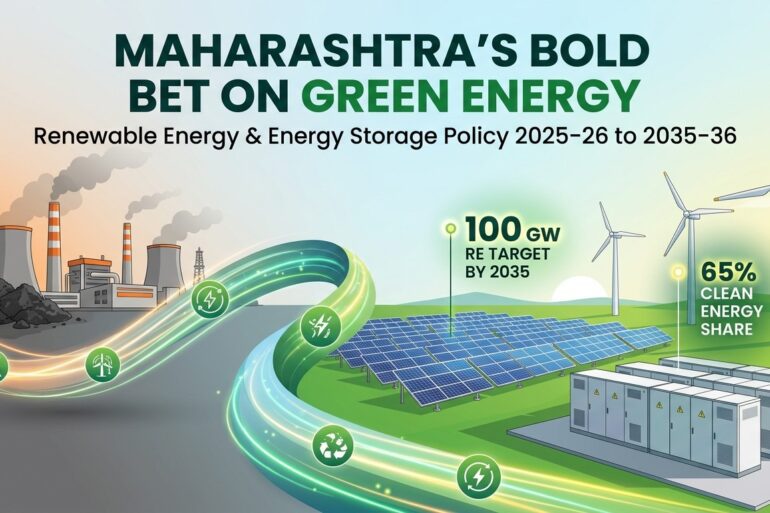
On 18th March 2026, the Maharashtra government released a policy that’s going to change how the entire state thinks about electricity. It’s called the Renewable Energy & Energy Storage Policy 2025–36, and it’s a big deal.
Think of it like this — for the last few years, Maharashtra has been slowly shifting towards solar and wind energy. This policy basically says: “No more slowly. We’re going all in.”
It covers everything — from the rooftop solar panel on your house, to massive 100 GW wind farms, to how the government is going to manage land, transmission lines, and energy storage over the next 10 years.
Whether you own a factory, run a small shop, or just pay an electricity bill every month — this policy touches your life. Let’s break it down.
| The government has made one thing crystal clear: every single unit of extra electricity needed between now and 2035 will come from renewable energy — not coal, not gas. That’s a commitment nobody has made before at this scale. |
THE BIG NUMBERS
STRATEGY
6 Ideas That Drive This Entire Policy
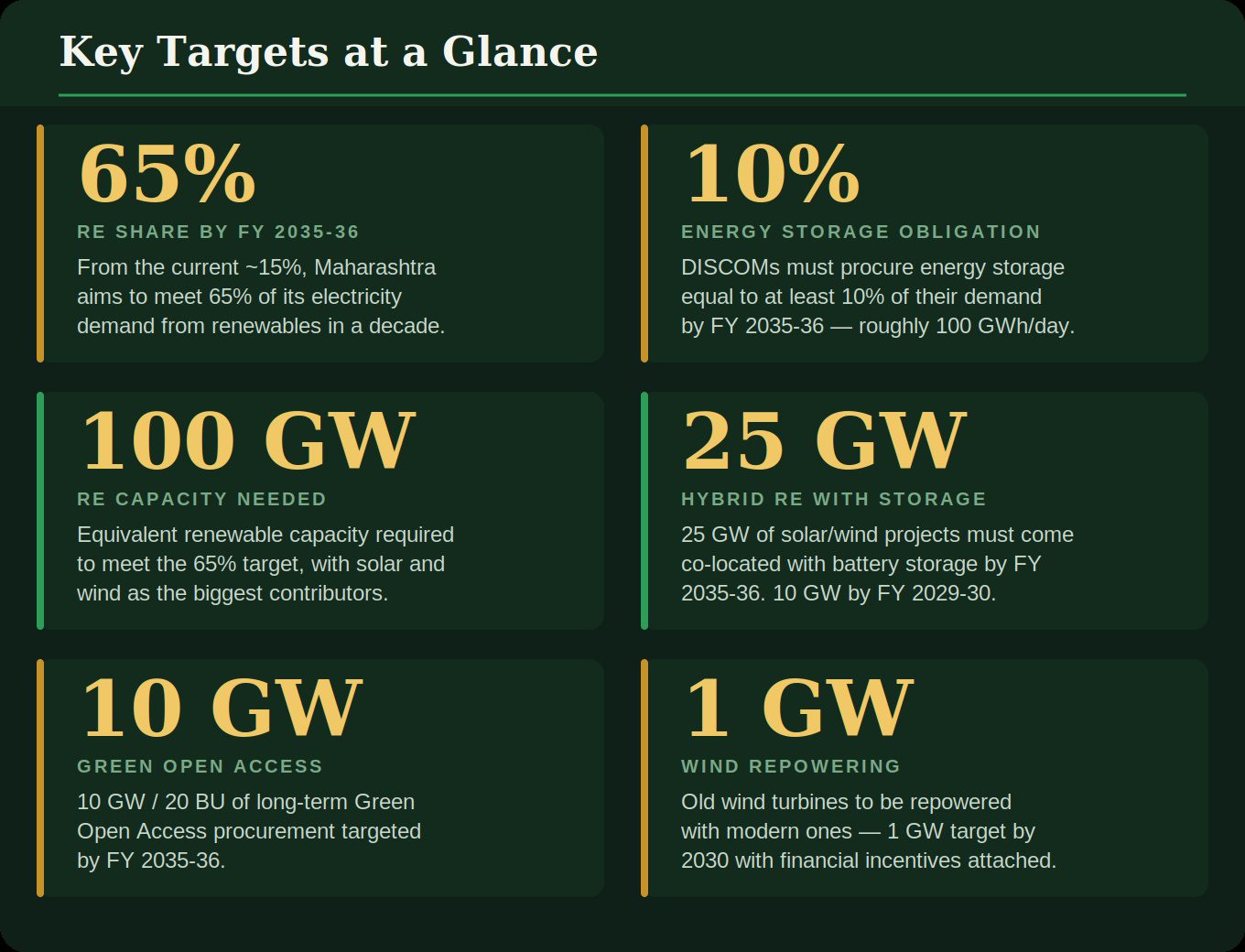
The policy isn’t just a list of numbers. It’s built on six clear ideas:
| 1
Big, Long-Term Targets Investors need certainty. So the government has set clear 10-year targets — 50% RE by 2029-30, and 65% by 2035-36. No surprises. |
2
Storage with Every Project Solar and wind alone aren’t enough. Every major new RE project must now come paired with battery storage. That’s non-negotiable. |
3
Land & Grid Made Easy Government land available at almost no cost. Ready-made RE Industrial Zones across the state. Upgraded transmission network. The infrastructure is being set up first. |
| 4
More Choice for Consumers Whether you’re a homeowner with rooftop solar or a factory owner buying bulk power — you now have more options, more transparency, and more say. |
5
Less Paperwork One portal for everything. All approvals online. No more running from office to office. Smaller projects (up to 5 MW) get an even simpler process. |
6
Stronger Institutions New R&D centres, reformed agencies, skilled workforce, better data. The government knows that good policy needs good institutions to back it up. |
ENERGY STORAGE RULES
The Battery Rule — This Is the Big One
If there’s one thing that makes this policy different from anything before it, it’s this: battery storage is no longer optional.
Here’s exactly what the rules say:
- If you’re building a new solar or wind project and want it ready by FY 2029-30 — you need to add batteries that can store at least 50% of your project’s capacity, for a minimum of 2 hours. So if your solar plant is 100 MW, you need at least 50 MW / 100 MWh of storage.
- After FY 2030-31, the bar goes higher. Same 50% capacity rule, but now you need 4 hours of storage instead of 2. The longer the storage, the more useful it is for the grid.
- Even rooftop solar systems above 100 kW must come with storage from April 2026 onwards. 50% capacity, 2 hours. This will be reviewed every 2 years as costs change.
- Power distribution companies (DISCOMs) themselves must build or buy storage equal to 10% of the electricity they supply — by 2035-36. And at least 85% of what goes into that storage must come from renewable energy.
- Good news for storage developers: when a battery system draws power from the grid to charge itself, it won’t be charged transmission fees — as long as that stored energy stays within Maharashtra.
- Standalone battery projects are fully allowed. You can build BESS independently — not attached to any solar or wind farm — and sell storage as a service to the grid.
LAND POLICY
Getting Land for RE Projects Just Got Easier
Land has always been the trickiest part of building renewable energy projects in India. Too many owners, too much bureaucracy, too many delays. This policy tries to fix that.
All land is now sorted into three types, and each type has its own clear rules:
- Type 1 — Government Institution Land: Universities, government boards, PSUs, Gram Panchayats, Zilla Parishads — all of these can now lease their land for solar or wind projects. Up to 15 acres can be handled at the Gram Panchayat level itself. No need to go higher.
- Type 2 — Revenue Department Land: Land under the Revenue Department can be leased at just ₹1 per year for 30 years. District Collectors can help consolidate scattered land parcels to make projects easier to set up.
- Type 3 — Private Land: If you’re leasing private land, the minimum annual rent is the higher of ₹1.25 lakh per hectare or 6% of the registered land value. And this rent goes up 3% every year, so landowners benefit too.
REIZ PARKS
RE Industrial Zones — Plug-and-Play for Developers
Imagine if a developer could walk into a zone that already has land cleared, roads built, and a power transmission line waiting — all they need to do is install the panels or turbines. That’s what a Renewable Energy Industrial Zone (REIZ) is.
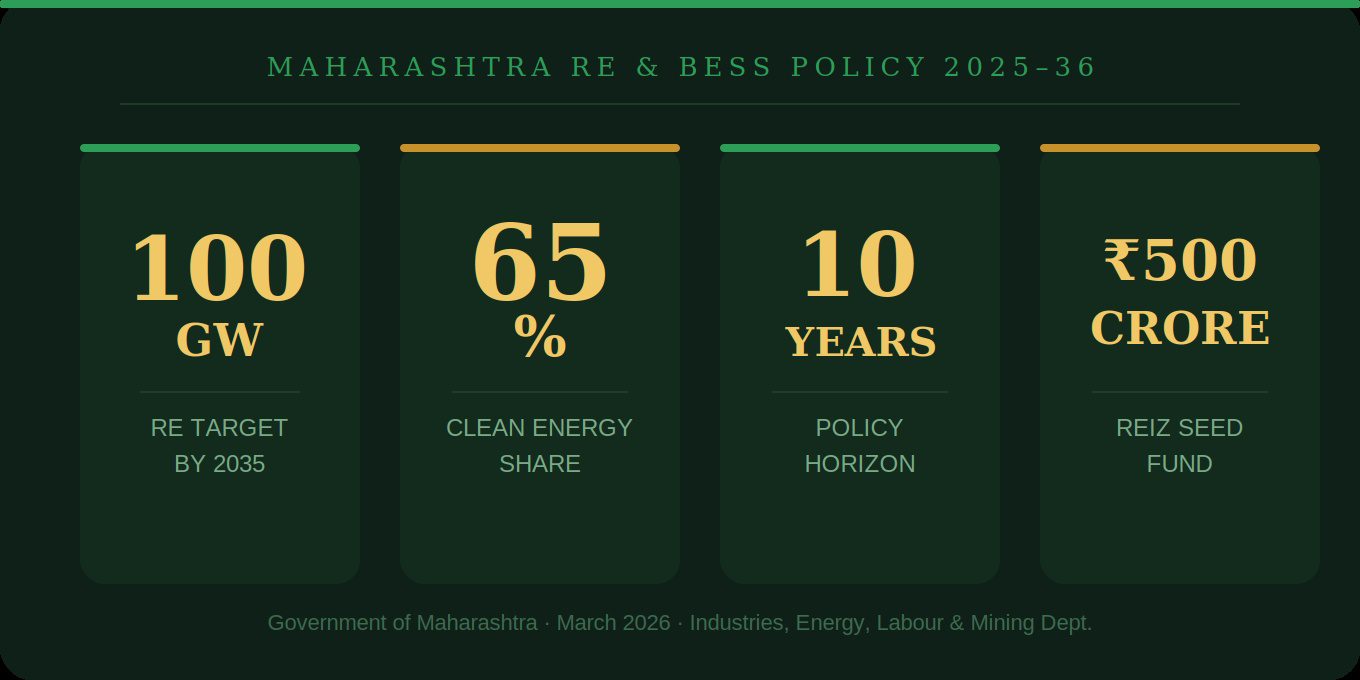
The government plans to build at least 10 of these zones by 2029-30 and 15 by 2035-36. Each zone will be at least 100 MW. A ₹500 crore fund has already been set aside to get this started.
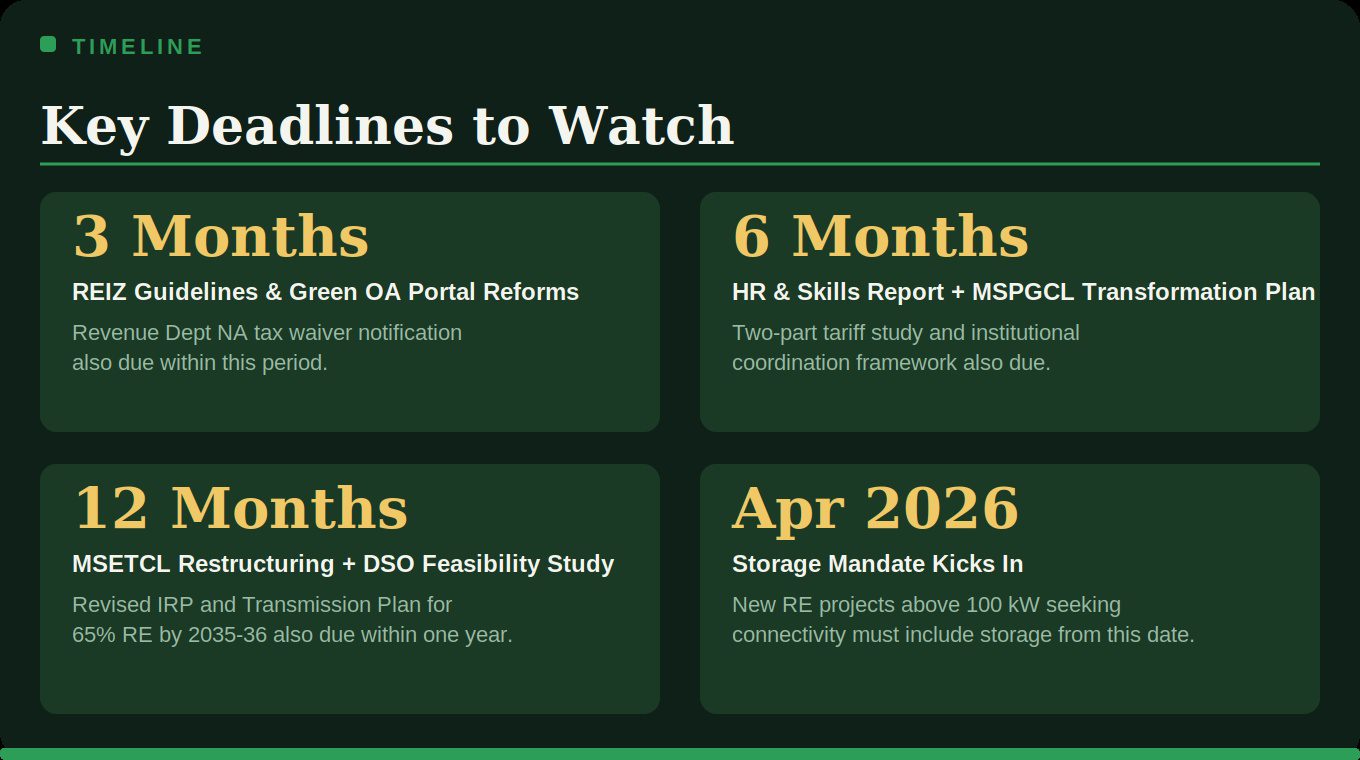
Also, the NA (Non-Agricultural) tax that developers had to pay when converting farmland for RE use? Fully waived. The Revenue Department will officially notify this within 3 months.
| “Maharashtra’s electricity demand is going to hit 350–360 BU by 2035-36. That’s nearly double what it is today. And every extra unit of that demand? It’s coming from green energy.” |
FOR CONSUMERS
What Does This Mean for You?
This is the part most people want to know — how does this policy affect my electricity bill, my rooftop solar, or my business? The answer depends on how much electricity you use.
If you use up to 3 kW — Most homeowners
You get the best deal: Concessional Net Metering
Your rooftop solar feeds into the grid and you get credit for it. You can bank that credit across the whole year and across different times of the day. And there’s no extra banking charge. If you still have surplus electricity left at the end of the year, the DISCOM buys it from you at market rates. You also don’t need to install batteries.
If you use 3–10 kW — Small shops, bigger homes
Net Metering with a small Grid Support Charge
You can still bank your solar credits each month. But you’ll pay a small Grid Support Charge (GSC) per kW of solar you have. This is basically a fee for using the grid as your ‘backup’. Your credits are settled from cheapest to most expensive time slots.
If you use 10–100 kW — MSMEs, small factories
Net-Billing or Green Open Access — your choice
Banking is allowed only within the same time slot each month. You’ll pay a banking charge linked to storage costs. The good news? MSEDCL is going to bulk-buy 10–100 kW BESS systems to bring down costs for businesses like yours. Group captive arrangements are also possible.
If you use above 100 kW — Large industries & corporates
Long-Term Green Open Access — now much easier to access
Big change here: the minimum threshold for Green Open Access has dropped from 1 MW to 100 kW. That means thousands more businesses can now directly buy green power. Energy is tracked every 15 minutes. And if your project includes 4 hours of battery storage, you get a 10-year exemption from Electricity Duty. That’s a significant saving.
If you’re a large company with ESG or export commitments
100% Verified Green Power — block by block
International buyers, carbon taxes like CBAM, and ESG ratings are pushing companies to prove their electricity is actually green — not just on paper. DISCOMs will now offer special tariffs for verified 100% renewable electricity, tracked per time block, not just averaged over the year.
EASE OF DOING BUSINESS
Less Paperwork, More Action
One of the biggest complaints from RE developers has always been: too many approvals, too many offices, too much waiting. This policy directly tackles that.
- One Portal for Everything: A single online portal managed by MEDA will handle every step — from project registration to final approval. No more offline visits to the Electrical Inspectorate or DISCOM offices. Everything moves online.
- Green OA Simplified: The entire Green OA application and approval process will be simplified and made time-bound within 3 months. A public dashboard will show the status of every application, so there’s full transparency.
- Help Desk for MSMEs: Every DISCOM zone must assign a dedicated officer (minimum Superintendent Engineer rank) whose only job is to help MSMEs get through the Green OA process.
- Projects up to 5 MW get an even simpler registration process. Less documentation, faster approvals.
- REIZ guidelines will be out within 3 months so developers can start planning immediately.
INSTITUTIONAL REFORMS
The Government Is Also Changing How It Works
Good policy needs good institutions. The government knows this — and this section of the policy is about fixing the machinery that runs the energy sector.
- Grid Independence: MSETCL (the state transmission company) will be restructured within 12 months. The grid planning body (STU) and the load despatch centre (MSLDC) will be made more independent so their decisions aren’t influenced by political or commercial pressures.
- MEDA Gets a Makeover: MEDA, which used to focus on awareness and small pilot projects, is being redesigned for the new era of large-scale RE. An expert committee has 3 months to propose a restructuring plan.
- Coal Company Goes Green: MSPGCL, Maharashtra’s state power generation company, has 6 months to submit a plan for transforming from a coal-heavy company into a clean energy player. Old thermal plant land will be repurposed for solar and hybrid energy parks.
- New R&D Centre: A brand new R&D and Innovation Centre for renewable energy will be set up with ₹100 crore per year for 3 years. It will support startups, agri-solar research, vehicle-to-grid pilots, AI-based energy management and more.
- Skill Building: Every government energy agency must spend at least 2.5% of its salary budget on training staff in new technologies. The energy transition needs skilled people — and the government is committing to build that capacity.
TIMELINE
Key Deadlines to Watch
CONCLUSION
Maharashtra is clearly moving towards clean energy — and it’s happening faster than ever.
For you, it simply means this:
If you start early, you save more and benefit more.
Whether it’s rooftop solar or buying green power, now is a good time to think about your next step.
Don’t wait too long — early movers will always have the advantage.