
Why Every C&I Business Needs to Know About BESS
A plain-language guide to Battery Energy Storage Systems for commercial and industrial businesses in India
If you run a factory, a manufacturing unit, a hotel, a hospital, or any other commercial or industrial (C&I) operation in India, your electricity bill is one of your biggest fixed costs. And if you already have solar installed, or are planning to, there is one more technology worth understanding before you finalise anything: BESS.
At Chirayu Power, we work exclusively with C&I clients — and we see firsthand how much money gets left on the table when BESS is not part of the energy plan. This blog is our attempt to explain why, in clear and simple language.
Let’s Start with the Basics — What is BESS?
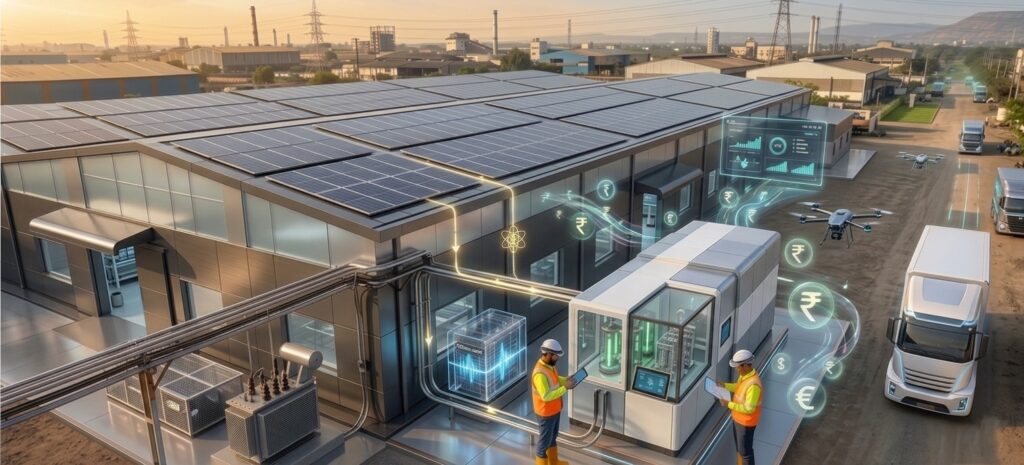
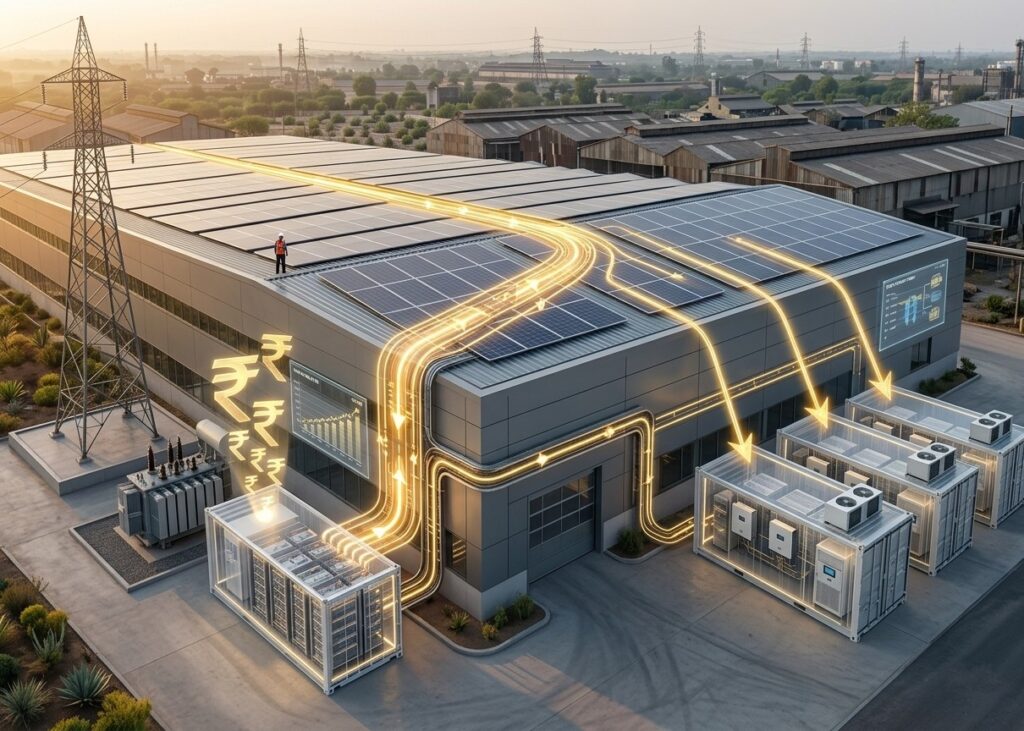
BESS stands for Battery Energy Storage System. In simple terms, it is a large-scale battery unit that connects to your solar plant. During the day, when your solar panels produce more electricity than your plant or building is consuming, BESS stores that surplus. Later — when solar generation drops in the evening and your C&I load peaks — it releases the stored energy back into your premises.
Think of it like a water overhead tank. Water (energy) is pumped in when supply is available, and drawn down when demand rises. The tank smooths out the gap between the two.
For C&I businesses, this gap between solar production hours and peak consumption hours is exactly where the most money is lost — and where BESS delivers the most value.
The C&I Problem That Solar Alone Cannot Solve
Most C&I businesses run heavy equipment, production lines, HVAC systems, and lighting — often well into the evening. Solar panels, however, stop producing by late afternoon. This mismatch creates a critical window where your demand is high but your solar is idle.
During this evening window, C&I consumers are forced to buy grid electricity — which, under the new Time-of-Day tariff rules, is significantly more expensive than daytime rates.
Solar alone saves you money from 9am to 4pm. BESS extends those savings into the 5pm to 11pm window — exactly when C&I electricity costs are highest.
How BESS Works Inside a C&I Solar Plant
A BESS setup has three working parts, each with a clear role:
- The Battery Bank: The actual storage units. C&I-grade BESS systems typically use lithium-ion battery technology — high energy density, long cycle life, and proven performance across thousands of industrial installations globally.
- The Power Conversion System (PCS): Batteries store power as DC. Your C&I equipment runs on AC. The PCS handles this conversion seamlessly and automatically — no manual switching required.
- The Energy Management System (EMS): The intelligent brain of the system. It continuously monitors your plant’s load demand, solar output, and real-time grid tariff rates — and automatically decides when to charge and discharge. For C&I operations with complex load profiles and shift patterns, this intelligent automation is what makes BESS genuinely practical.
Time-of-Day Tariffs — Why This Matters for C&I Consumers Specifically
India’s electricity regulators have introduced Time-of-Day (ToD) tariffs for commercial and industrial consumers. Under this pricing structure, the rate you pay for grid electricity is no longer flat — it varies based on the time of day.
| Time Slot | Grid Tariff | BESS Impact |
| Daytime (solar hours) | ~20% below standard | BESS charges up at low cost |
| Evening peak hours | ~20% above standard | BESS discharges — no grid purchase |
This is called energy arbitrage — and for C&I businesses with high evening loads, the financial impact is significant and measurable.
Four Key Advantages of BESS for C&I Operations
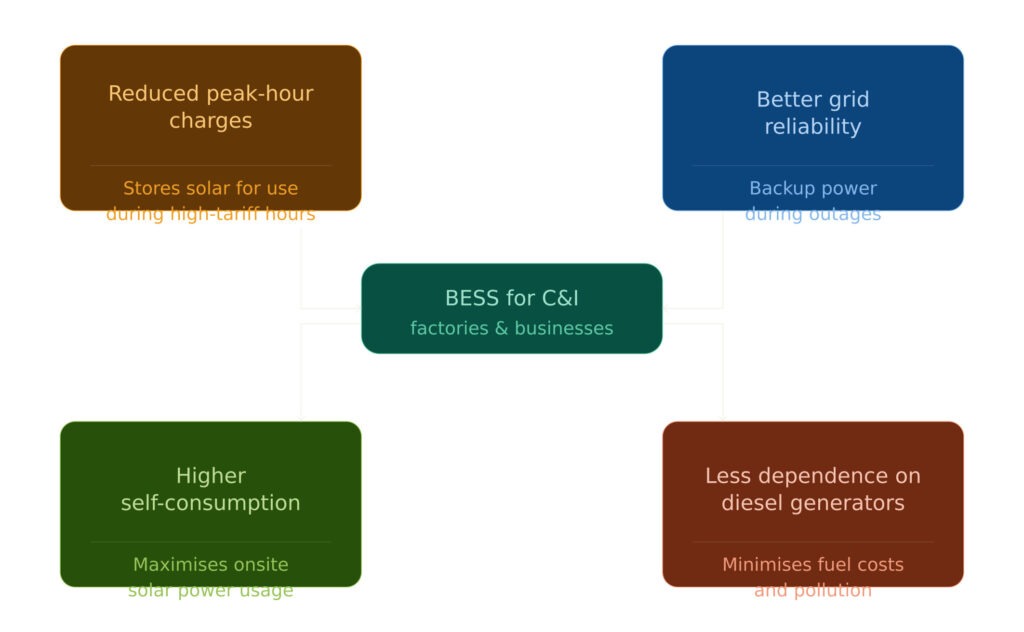
1. Reduced peak-hour electricity charges
Evening peak hours are when C&I businesses pay the most for grid power. BESS directly eliminates a large portion of this spend by supplying stored solar energy during these high-tariff windows. For factories running second or third shifts, this saving accumulates every single day.
2. Better grid reliability for your operations
Grid outages are a real operational risk for C&I businesses — especially in industrial zones and tier-2 cities. BESS acts as an instant backup, keeping critical loads running without any interruption. Unlike diesel generators, it kicks in silently and immediately, with zero fuel cost.
3. Higher solar self-consumption
Without BESS, surplus daytime solar is exported to the grid — often at poor rates. With BESS, that surplus is captured and used by your own operations, maximising the return on your solar investment. For C&I consumers, self-consumption is always more valuable than export.
4. Less dependence on diesel generators
Many C&I facilities rely heavily on DG sets for backup power. BESS reduces DG run hours, directly cutting diesel consumption, maintenance costs, and carbon emissions. In plants where generators run for several hours daily, BESS can recover a significant portion of its cost through fuel savings alone.
Questions C&I Businesses Commonly Ask Us
Can BESS be added to my existing solar plant?
Yes. Most existing C&I solar installations can be upgraded with a BESS unit. The sizing depends on your load profile, shift timings, and how many hours of peak coverage you need. Chirayu Power assesses your specific setup before making any recommendation.
How is BESS sized for a C&I facility?
Sizing is based on three factors: your peak demand (in kW), the number of hours you want to cover without grid support, and your daily solar generation. Chirayu Power conducts a detailed energy audit before recommending a system — there is no generic formula that works for every plant.
What is the typical return on investment for a C&I BESS system?
ROI depends on your current tariff structure, peak-hour consumption, and DG usage. For C&I businesses with high evening loads, payback periods can be attractive — and the savings compound as tariffs rise over time. We provide a detailed financial projection before any project begins.
Does BESS require a lot of maintenance?
No. BESS is largely self-managing. Routine monitoring and periodic checks are all that is needed. There are no moving parts and no fuel to manage — which is a meaningful operational advantage over diesel alternatives.
Let’s Look at the Numbers for Your C&I Facility
At Chirayu Power, we specialise in solar and BESS solutions designed specifically for commercial and industrial operations. We understand C&I load profiles, shift patterns, DG dependency, and tariff structures — and we build energy systems around those realities, not generic templates.
If your evening electricity bills are eating into your margins — or if you are planning a solar installation and want to make sure you get the most out of it — talk to our team. Share your latest electricity bill and your basic load pattern, and we will show you exactly what a BESS-integrated system could mean for your facility.
The energy savings are real. The technology is proven. And with ToD tariffs now in effect across India, the financial case for C&I businesses has never been stronger.