
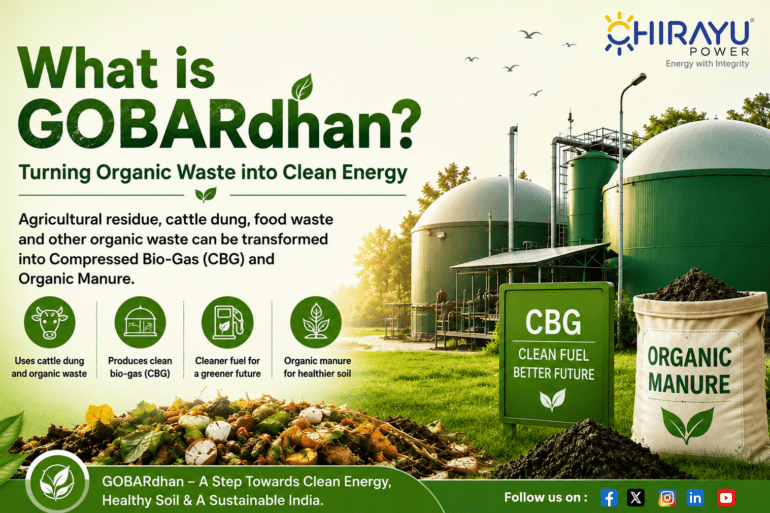
GOBARdhan: Turning Organic Waste into Clean Energy and Rural Growth
India is taking a major step towards a cleaner and more sustainable energy future with GOBARdhan – India’s National Circular Bioenergy Scheme.
Approved by the Union Cabinet, the scheme has a total outlay of ₹23,731 crore and will be implemented from FY 2026-27 to FY 2035-36. Its objective is to convert cattle dung, agricultural residue, press mud, municipal organic waste and other biomass into Compressed Biogas (CBG), organic manure and economic value.
From Waste to Energy
GOBARdhan aims to transform organic waste from an environmental challenge into a valuable energy resource. By promoting scientific processing of biomass, the scheme can simultaneously support clean fuel production, better waste management, sustainable agriculture and rural economic development.
The Government aims to drive nearly ten-fold growth in domestic CBG production, making CBG an important part of India’s future energy mix.
Six Growth Engines under GOBARdhan
1. Assured CBG Offtake
A dedicated CBG Offtake Assurance framework will provide producers with a more reliable and predictable market. CBG obligations for CNG transport and PNG domestic segments are set at 3% in FY 2026-27, 4% in FY 2027-28 and 5% from FY 2028-29 onwards.
This long-term demand signal can improve project bankability, capacity utilisation and investor confidence.
2. Stable CBG Pricing Framework
GOBARdhan provides an administered CBG price of ₹2,110 per MMBTU, supported by a government-backed pricing framework with a minimum 10-year horizon.
This offers producers greater revenue visibility and can strengthen the business case for investment and capacity expansion.
3. Capital Assistance
Eligible greenfield CBG projects can receive capital assistance of up to ₹2 crore per TPD of installed CBG capacity.
Support also covers important value-chain infrastructure such as feedstock aggregation, organic manure processing and value addition. Brownfield projects expanding their CBG capacity are also eligible.
4. Pipeline Infrastructure
The scheme supports cluster-based and standalone pipeline infrastructure connecting CBG plants with trunk pipelines and City Gas Distribution networks.
Improved connectivity can reduce evacuation costs, expand market access and increase utilisation of domestically produced CBG.
5. Credit Guarantee Support
A dedicated Credit Guarantee mechanism will help improve institutional credit access for eligible MSME-based CBG projects.
By reducing lending risks, the mechanism can encourage participation from MSMEs, women entrepreneurs and first-time developers.
6. CBG Ecosystem Challenge Fund
The CBG Ecosystem Challenge Fund will strengthen district-level CBG development through feedstock mapping, aggregation infrastructure, district-level planning, technology adoption, process improvement, organic manure value addition, capacity building and stakeholder awareness.
Together, these six growth engines are designed to create a stronger and more commercially viable CBG ecosystem across India.
Supporting Farmers and Rural India
The impact of GOBARdhan goes beyond energy production. Agricultural residue and cattle dung can gain additional economic value, while CBG projects can create opportunities for farmers, biomass suppliers, rural entrepreneurs, MSMEs, cooperatives and logistics operators.
The production of organic manure can also support nutrient recycling and sustainable agricultural practices.
Building a Circular Bioeconomy
GOBARdhan represents India’s move towards a circular bioeconomy—where organic waste is converted into clean energy, valuable by-products are returned to agriculture, and local resources generate new economic opportunities.
The initiative can contribute to better waste management, cleaner energy, rural employment and stronger domestic energy security.
Chirayu Power’s Perspective
At Chirayu Power, the development of clean and sustainable energy solutions represents an important opportunity for India’s future.
GOBARdhan demonstrates how waste management, clean energy, agriculture and rural development can come together to build a more resilient and sustainable energy ecosystem.
Waste can become Energy
Energy can create Opportunity.
And Opportunity can drive a Greener India.