
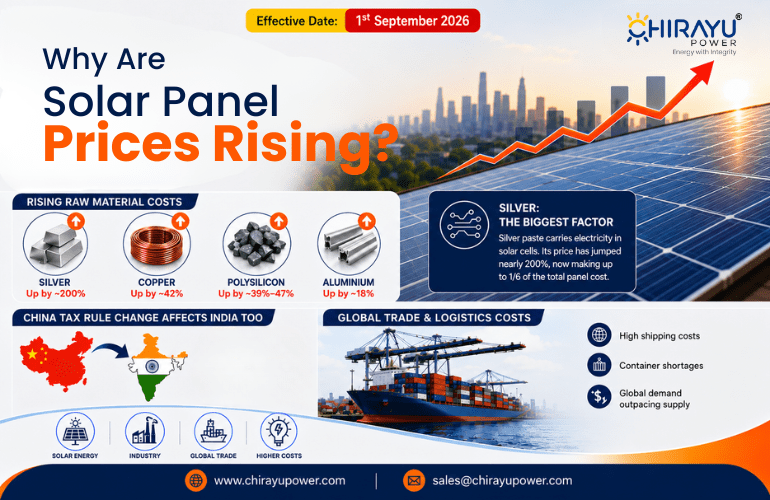
Effective Date: 1st September 2026
If you work in the solar industry or you’re just thinking about putting panels on your roof, you’ve probably noticed something strange lately. Prices are going up. And it’s not some small, unknown supplier trying to make extra money. It’s the biggest solar panel maker in the country, the one company you’d expect to be the most stable on price.
So what’s really going on? Let’s explain it in simple and easy words.
It Really Comes Down to One Word: Silver
Most people think solar panels are all about silicon, the dark blue material that soaks up sunlight. Silicon does matter. But there’s another material working quietly behind the scenes: silver.
Silver paste is what carries electricity out of the solar cell so it can actually be used. Without it, the cell simply doesn’t work. And over the last year, silver prices have shot up so fast that silver now makes up close to one-sixth of the total cost of a panel, sometimes almost a third of the cost of the cell alone.
Think about that. A material that used to be a small cost is now the single biggest cost in the whole panel. When that happens, no manufacturer, no matter how big, can just ignore it.
It’s Not Only Silver — Other Materials Went Up Too
Silver is the biggest story, but it’s not the only one. Polysilicon (the base material used to make solar cells), aluminium (used for the panel frame), and copper (used for the wiring) have all become more expensive too. On their own, none of these would cause a huge price jump. But when they all rise together, month after month, they slowly eat into a manufacturer’s profit until raising prices becomes the only choice left.
Here’s a simple table that shows how much each material has gone up, and why:
Material |
How Much It Rose |
Main Reason |
| Silver | About 200% (roughly tripled) | Huge demand for solar cells, and not enough silver being mined to keep up |
| Copper | About 42% in a single year | Fear of new import taxes in the US, plus buyers stocking up early |
| Polysilicon | About 39% to 47% | Chinese factories cut back production and agreed on minimum prices |
| Aluminium | About 18% (yearly average) | Steady, ongoing demand across many industries, not one big shock |
As you can see, silver is by far the biggest jump on this list and the main reason companies keep pointing to raw material costs. The other three materials add extra pressure, but silver alone is big enough to push prices up on its own.
China Changed a Tax Rule — And It Affected India Too
Here’s something a lot of people don’t know. China recently removed a 9% tax refund it used to give on solar parts it exports, things like modules, wafers, and cell materials. That refund used to make Chinese solar parts cheaper for buyers around the world.
Even though India is building up its own solar factories, big Indian companies still buy a good amount of their raw cells and wafers from China. So when China removes that tax refund, it doesn’t stay a “China problem.” It becomes a problem for anyone buying from China, including Indian manufacturers. This one change alone is estimated to have added about 8% to 10% to their buying costs.
New Technology Is Also Adding to the Cost — At the Worst Time
There’s one more thing happening in the background. The solar industry is moving from older panels (called Mono-PERC) to newer, more powerful panels called N-Type TOPCon. These new panels produce more electricity from the same amount of sunlight, which is good news for buyers in the long run.
But here’s the catch: TOPCon panels currently need more silver per watt of power, not less. So right when silver prices are already high, the whole industry is switching to a technology that uses even more of it. Over time, companies will find ways to use less silver in these cells. But that takes time, and for now, it’s adding more fuel to an already expensive fire.
So Why Does the Biggest Company Raise Prices First?
Shouldn’t the biggest manufacturer, with the most buying power, be the one company that keeps prices stable?
In real life, being big only helps so much. Even a company making panels by the gigawatt still buys silver, polysilicon, and imported cells at roughly the same price as everyone else. Silver doesn’t get cheaper just because you’re the biggest buyer.
A company can absorb rising costs for a while by cutting into its own profit. But that can’t go on forever. At some point, the extra cost has to move down the chain to distributors, installers, and finally the customer.
When the biggest company moves first on price, it’s usually because they’re the first one to reach the point where absorbing the cost no longer makes sense. That’s also why you’ll see other manufacturers announce similar price hikes, usually around ₹1.5 to ₹2 per watt around the same time.
What Does This Mean for You?
Let’s make this simple with real numbers, because percentages alone don’t mean much.
1 – If you’re a homeowner planning a typical 3kW to 5kW rooftop system, a ₹2 per watt price hike adds about ₹6,000 to ₹10,000 to your total bill. If you qualify for a government subsidy scheme, the fixed subsidy amount will reduce the pain a little, but you’ll still pay somewhat more out of your own pocket.
2 – If you run a business and are looking at a bigger system, say 100kW for commercial or industrial use, the numbers get bigger too. A ₹2 per watt hike adds around ₹2 lakh to your upfront cost. For a project that usually costs ₹35 to ₹48 lakh, that’s about a 4% to 5% jump in total spending.
3 – Right now, in the short term, expect a rush of orders. Buyers who were already planning to buy will try to place their orders before the price hike starts on 1st September 2026, so they can lock in today’s lower price. If you were thinking about buying solar panels soon, this is usually the best time to act right before a price hike is often when suppliers are most open to giving you a good deal.
Final Thoughts
This price hike isn’t a company trying to squeeze more money out of customers. It’s a natural result of several things happening together: expensive silver, rising raw material costs, a tax rule change in China, and a technology shift that costs more before it starts saving money.
If solar is something you’re planning, whether for your home or business, the smart move is to move fast if you were already planning to buy, and keep a little extra budget in mind.
Beat the Price Hike with Chirayu Power
Don’t let rising raw material costs increase your solar investment. Book your order with Chirayu Power today and lock in current pricing before the hike takes effect on 1st September 2026.
Why Choose Chirayu Power?
- Ready stock available for immediate Dispatch
- Authorised Waaree Franchisee
- Competitive pricing before the market-wide hike
Book Now Before Prices Rise Further — Contact Chirayu Power Today
For Orders & Enquiries:
📞 +91 70289 98965
📞 +91 80100 75053
📞 +91 90280 72633
📍 Chirayu Power Pvt. Ltd. (Authorised Waaree Franchisee)
Frequently Asked Questions (FAQ)
Q1. Why are solar panel prices increasing right now?
Mainly because of a sharp rise in silver prices, along with higher costs for polysilicon, copper, and aluminium, the core materials used to make solar panels.
Q2. Why is the biggest manufacturer raising prices instead of absorbing the cost?
Even large manufacturers buy raw materials at global market prices. Scale doesn’t make silver or polysilicon cheaper, so rising input costs eventually have to be passed on.
Q3. Will other solar companies also increase their prices?
Yes, most manufacturers are facing the same raw material and import cost pressures, so similar price hikes across the industry are expected.
Q4. How much extra will I have to pay for a home solar system?
For a typical 3kW to 5kW rooftop system, expect an increase of roughly ₹6,000 to ₹10,000, depending on your system size and panel type.
Q5. Should I book my solar order now or wait?
If you were already planning to install solar, booking before the price hike takes effect will help you lock in the current, lower price.
Q6. Will this price hike last forever?
Not necessarily. Raw material prices, especially silver and polysilicon, are known to fluctuate, so prices could stabilise or ease later depending on global supply conditions.