
Author: chirayu team

41 posts

Factory Solar Under MERC’s Draft 2026 Rules: What Industrial Units Should Plan For

On 22 September 2026, MERC released draft rooftop solar rules. For factories and process plants, the key message is that generation, shift demand, and storage now need to be planned together. These are proposed rules, not a final notification, but they are worth understanding before you commit to a project.

Existing solar and new applications

If your system is already installed, the earlier rules generally continue to apply to your existing agreement. Expanding or switching routes can bring it under the new rules, and pending applications will be subject to the new rules once notified. Before you expand or change anything, have your agreement and application dates checked.

Banked units may expire every month

For systems above 3 kW, unused banked units would expire at month-end. If 80 units are left after all eligible bill adjustments, none carry into the next month. Size your solar around monthly consumption. Renewable Energy Certificates may be available for lapsed units, but cash recovery is not guaranteed.

System size, time slots and charges

For billing, the draft adds up all the renewable power you generate and contract to buy, including rooftop solar and open access or off-site captive power. Battery capacity is not counted.

The larger your total capacity, the more time-of-day blocks are used to adjust your credits: none up to 10 kW, 4 blocks a day up to 100 kW, 8 up to 1 MW, 12 up to 5 MW and 24 above that. Above 10 kW, the draft also proposes a monthly capacity-based charge and a charge on eligible credits used across slots. The rupee rates have not been specified yet.

Solar peaks at noon, but your shift may not

Solar output peaks in the middle of the day, while factory demand follows shifts, shutdowns and seasonal production. That mismatch decides how much solar you use directly, how much you bank and how much expires. Use interval load data to test daytime use, night demand and storage dispatch before finalising a design.

Storage is part of the plan

Up to 2030, minimum battery energy is solar capacity (AC) × 50% × 2 hours. For a new 200 kW system, that means 200 kWh, which can be met as 100 kW for 2 hours or 50 kW for 4 hours. After 2030, the minimum rises to 2 kWh per kW.

Larger plants and grid limits

The 2023 net-metering cap was 5 MW. The 2026 draft links system size to sanctioned load or contract demand instead, opening the door to larger projects, subject to your approved load and grid capacity. The normal shared transformer or feeder limit remains 70%.

Meters, fees and agreements

You pay for the net-meter replacement and solar generation meter, and systems above 20 kW need a check meter. Zero-export systems of 1 kW and above must still notify the utility before installation. Application fees are Rs 500 for LT up to 20 kW (plus Rs 100 per further 20 kW or part) and Rs 5,000 for HT.

Each agreement runs 20 years, with a 1-year lock-in and 2 permitted route switches. Switching triggers the new rules, and old banked credits are settled under the old route. Above 5 MW, banking is capped at 10% of consumption in each slot.

Before you approve your factory’s capex

Ask your solar provider for a forecast that follows the proposed billing rules, covering self-use, expiry, slot-wise savings, battery ageing, lifetime cost and grid limits.

Chirayu Power can help you review your bill and plan the right solar and storage size for your plant.

Visit chirayupower.com to get started.

Disclaimer: Based on MERC’s draft rooftop rules (Public Notice, 22 September 2026). Provisions are proposed and may change before notification.


FAQs

1. Do the MERC draft rooftop solar rules apply to my existing solar system?
Earlier rules generally continue for your existing agreement. Expanding or switching routes can bring your system under the new rules.

2. Will unused solar units expire?
Under the draft, for systems above 3 kW, unused banked units would expire at month-end. Systems up to 3 kW keep annual banking.

3. Is battery storage mandatory for factory solar?
For new systems above 100 kW, the draft requires storage. Up to 2030, minimum battery energy is solar capacity (AC) × 50% × 2 hours.

4. Can factories install more than 5 MW of rooftop solar?
The 2026 draft links system size to sanctioned load or contract demand, with no separate 5 MW cap. It is still subject to your approved load and grid capacity.

5. What are the application fees?
LT: Rs 500 for up to 20 kW, plus Rs 100 for each further 20 kW or part. HT: Rs 5,000.

6. Are these rules final?
No. These are proposed rules and may change before notification. Comments close on 12 October 2026.


 

If you’re planning a rooftop solar or Open Access project above 100 kW in Maharashtra, here’s something to know before you go any further—solar panels alone won’t be enough anymore. A battery now needs to be part of the plan too.

The rule itself isn’t new. The Maharashtra government announced it on 27 March 2026 as part of its Renewable Energy and Energy Storage Policy, effective 1 April 2026 for new projects.

What’s changed more recently is how it’s being applied on the ground. From 1 September 2026, MSEDCL has been factoring this storage requirement into the solar PV application process itself, without a separate circular spelling it out in advance. In practice, this means some applicants have only come across the requirement while registering their project — rather than knowing about it beforehand. If that’s happened to you, this article walks through exactly what’s required and how to plan around it.

So what does the rule actually say?

Strip away the policy language, and it comes down to this: any new solar or renewable project above 100 kW applying for grid connection on or after 1 April 2026 needs a battery alongside it, sized to at least 50% of the solar plant’s capacity.

Take a 200 kW solar plant as an example. You’d need at least a 100 kW battery sitting alongside your panels.

Worth noting: this only applies to new projects. If you already have rooftop solar up and running, you’re not obligated to retrofit a battery, even though the state would like you to. And it’s not just rooftop solar either. Open Access projects going through the transmission network from April 2026 fall under the same rule.

Why bring this in now?

Truthfully, this has been building for a while. Maharashtra’s renewable capacity crossed 31.3 GW by January 2026, with rooftop solar alone past the 5 GW mark. That’s a lot of power flooding into the grid during daylight hours and very little of it available once the sun goes down. Batteries are the state’s way of smoothing that mismatch out, storing the daytime surplus so it can be drawn on later when demand is still high, but generation has dropped off.

Why it actually matters to your business

Most businesses that go solar factories, warehouses, hospitals, hotels, offices aren’t running only in daylight hours. Solar helps during the day, but the moment the sun sets, you’re back on the grid, paying full price again.

A battery changes that equation. It banks the extra solar you generate in the afternoon and lets you draw on it in the evening instead of buying grid power at that hour. Whether that translates into meaningful savings for you specifically depends on a few things your load pattern, your tariff structure, how much solar you’re actually generating, and whether the battery is sized correctly for your use case. There’s no one-size-fits-all number here, which is exactly why a proper assessment matters more than a rule-of-thumb estimate.

Planning a solar project just got a layer more complicated

It used to be fairly straightforward figure out your rooftop space, pick a panel capacity, done. Now there’s more to juggle.

Start with your actual consumption, not your rooftop space, when deciding how much solar to install — oversizing or undersizing either way eats into your returns. Once that’s settled, the battery isn’t sized off your annual generation figures; it’s tied directly to your solar capacity and the mandated backup window, so getting that number right matters more than people initially assume. Then there’s everything the battery brings with it inverters, safety systems, transformers, metering, and enough ventilation and fire-safety planning to keep the whole setup compliant and safe. And finally, before you commit to any of it, check your grid connectivity requirements, particularly if you’re routing through Open Access, since this storage mandate is tied directly to your transmission approval.

Does this push up your project cost? Yes but that’s not the whole story

There’s no getting around it: adding a battery raises your upfront investment compared to a solar-only setup. But treating that purely as an added expense misses the point.

A properly sized battery lets you use more of the solar power you’re already generating, shifts your consumption away from the costliest grid hours, and gives you a more dependable supply overall. And battery prices have been on a downward trend as the technology matures, so the economics here aren’t static — they’re improving.

The more useful question isn’t “how much extra will this cost me,” but “how much value will this battery actually generate for my business.” And that answer only comes from looking closely at your consumption pattern, your tariff, and your operating hours not from a generic estimate.

A quick checklist before you move forward
  • Pull together at least 12 months of electricity bills, and hourly consumption data if you can get it
  • Size your solar system around actual usage, not just available rooftop space
  • Confirm whether your project crosses the 100 kW threshold
  • Build battery sizing into your design from day one, not as a late addition
  • Run the numbers on battery cost against your specific tariff and usage pattern
  • Sort out your grid connection and Open Access requirements early in the process
  • Look at total project cost, not just the solar panel price tag
  • Work with an EPC partner who can handle solar, storage, and electrical work as one integrated project

Where Chirayu Power fits in

At Chirayu Power, we help you work out the right solar and battery sizing based on your actual usage — fitting both the new state rules and your budget, while looking at the complete picture: capacity, storage, electrical setup, and long-term savings. Planning a project above 100 kW or exploring Green Open Access? Now’s the time to check your plans against this rule.

A Few Questions We Keep Getting Asked

Does this apply to every solar project in Maharashtra?

No only new solar and renewable projects above 100 kW that need grid or Open Access connectivity. Anything below that threshold follows different rules.


I already have rooftop solar. Do I need to add a battery now?

No, existing systems aren’t required to retrofit storage, though the state is encouraging it. This mandate is for new projects going forward.


How much battery backup would a 200 kW solar plant need?

Around 100 kW of battery capacity.


Does this cover Green Open Access projects too?

Yes. Any new renewable project above 100 kW seeking Open Access transmission connectivity from 1 April 2026 falls under the same 50% storage rule.


Will the 50% requirement always stay the same?

Not necessarily. It’s up for review every two years, so expect it to evolve.


Will a battery actually save me money?

It depends entirely on your usage and tariff — there’s no flat answer here. A proper feasibility study will tell you your real numbers.


Should I hold off on my solar project because of this?

No reason to wait. Just make sure storage is part of the plan from the outset that’s what keeps you from redesigning everything halfway through, and gives you a clearer picture of your actual costs and savings.


Ready to Plan Your Solar + Battery Project?

Chirayu Power helps businesses across Maharashtra design solar and battery storage systems that meet the new state rules — without overspending or overbuilding.

Talk to Our Solar Experts

Get a free consultation on your solar and battery storage requirements tailored to your load, tariff, and site.

Get in Touch with Chirayu Power Today

Don’t let the new storage rule catch your project off guard plan it right, the first time.

A heads-up before you plan your next solar project


There’s some news going around that’s worth your attention if you’re planning a solar system anytime soon. Starting 15th September 2026, prices of electrical goods across India are going up anywhere between 5% and 14%. This was reported by Daily Business News on 29th August, and it’s already the talk of the industry.

The reason is pretty simple: copper. Copper prices have shot up globally over the last few weeks, and copper is what goes into wires, cables, switchgear, motors basically the stuff every electrical product is built from. When the raw material gets expensive, the finished product does too. Manufacturers say it’s a temporary spike, but a real one, and they’ve been left with no choice but to raise prices.

Now, why are we talking about this on a solar company’s blog? Because we’re a Solar EPC company, we design and build solar plants, and almost everything on that price-hike list is something we use every single day. Cables, switchgear, junction boxes, earthing kits, monitoring systems it’s all part of a solar setup. So when these prices go up, it doesn’t just stay in the news. It shows up in your project cost too.

Here’s What’s Going Up, and By How Much
Product
Price Increase
Wires 12%
Lighting Products 12%
Switchgear 14%
Pumps & Appliances 12%
Automation Products 12%

(These are approximate figures — actual increases may vary a little by brand and product.)

Why This Hits Solar Projects Harder Than You’d Think

Think about what actually goes into a solar plant, whether it’s on your rooftop or spread across a field:

  • Wires and cables connect every panel to the inverter, and the inverter to your home or the grid. This is one of the biggest cost items in any solar quote and it’s copper-heavy.
  • Switchgear keeps the whole system safe your DCDBs, ACDBs, and protection panels all fall under this, and it’s seeing the highest jump at 14%.
  • Automation and monitoring gear is now standard in most commercial and industrial solar setups, and that’s going up too.

Put these together, and a 12–14% jump isn’t a small thing. It can genuinely change the total cost of your solar project if you finalize things after 15th September.

What Does This Mean If You Already Have an Order With Us?

If you’ve already placed and confirmed your order, you’re in good shape you won’t be affected by this hike. It only applies going forward.

But if you’re still deciding, or planning to place your order after 15th September, you’ll be looking at the new, higher prices.

So, What Should You Do?

Honestly, it’s simple if you’ve been thinking about going solar, this is a good nudge to stop thinking and start moving. Whether it’s for your home, your business, a factory, or a farm, locking in your project before 15th September could save you a real amount of money.

At Chirayu Power, we’ll keep giving you honest quotes, help you source materials on time, and guide you through the whole process without any pressure tactics — we just want you to make an informed decision, and make it before prices climb.

If you’ve got a solar project in mind, now’s a good time to talk to us. Reach out and let’s get your order locked in before the price hike kicks in.


Contact Us

Chirayu Power Pvt. Ltd.
Sales Offices: Mumbai (Thane), Pune, Nagpur, Hyderabad
Call: +91 9112114440 | +91 7721871188
Email: sales@chirayupower.com | purchase@chirayupower.com
Website: chirayupower.com

Have questions about your Chirayu Power solar installation, or want to lock in your project before the price hike? Reach out to our team — we’ll help you find the right setup for your needs.

FAQs
  1. Why are electrical goods getting more expensive?

Mainly because of copper. Copper prices have risen sharply worldwide, and copper goes into wires, cables, switchgear, and motors — so when it costs more, the finished products do too.

  1. From when will the new prices apply?

The revised prices come into effect from 15th September 2026.

  1. Will this affect the solar project I’ve already booked with Chirayu Power?

No. If your order is already placed and confirmed, you’re protected from this price hike. It only applies to new orders placed after the revision date.

  1. How much more will a solar project cost after 15th September?

It depends on the size and design of your system, but since wires, switchgear, and automation products are all going up by 12–14%, you can expect a noticeable increase in the overall project cost.

  1. What should I do if I’m planning to go solar soon?

Try to finalize and confirm your order before 15th September. This locks in the current, lower material costs before the price revision takes effect.

  1. Is this price increase permanent?

Industry experts have called the copper price surge “temporary but significant.” Prices could ease later, but there’s no fixed timeline for that, so it’s safer to plan around the increase for now.


Why Every Home With Solar Panels Needs Insurance

Think about it this way. You save up, you plan carefully, and you put solar panels on your roof. It feels good, right? Lower electricity bills, clean energy, and a sense that you’ve made a smart choice for your home.

But here’s something most people don’t think about until it actually happens. What if a heavy storm blows off your panels? What if lightning strikes and damages your inverter? What if there’s a fire, a flood, or even a theft? Suddenly, that smart investment you made turns into a big, unplanned expense.

This is exactly why solar insurance matters so much. It’s not an extra cost you can skip; it’s a safety net for something you’ve spent real money on. A small yearly premium can save you from paying lakhs of rupees out of your own pocket if something goes wrong. No one can predict when bad weather or an accident will strike, so it’s worth taking a few minutes to protect the system that’s saving you money every month.


What Can Actually Go Wrong on an Indian Rooftop

A rooftop solar system sits outdoors for 25 years, through every monsoon, hailstorm, and heatwave. Some of that risk belongs to your warranty. Some belongs to insurance.

  • Storms and cyclones – Coastal states like Gujarat, Odisha, West Bengal, and Tamil Nadu see winds strong enough to damage poorly anchored structures.
  • Hailstorms – Common in Punjab, Haryana, and parts of Madhya Pradesh. A single cracked panel can affect an entire string’s output.
  • Fire and lightning – Degraded DC connectors can cause fires, and lightning surges can destroy an inverter even when panels survive.
  • Theft – Panels and copper cabling are common targets, especially on accessible rooftops or ground-mounted systems.
  • Falling objects – Tree branches, water tank overflows, or construction debris.
  • Inverter failure – The most common failure point, usually a warranty matter rather than insurance.

The first five are external events, insurance territory. The last one is typically covered by your equipment warranty.


Warranty vs. Insurance: Don’t Confuse the Two

This is the biggest misunderstanding among solar owners in India.

  • Warranty covers manufacturing defects and underperformance — a panel degrading faster than promised, or an inverter failing due to a factory fault. It comes free from your manufacturer or installer.
  • Insurance covers external, unpredictable events — fire, lightning, storms, floods, theft, and accidental damage. It’s a policy you pay for annually.

In short: warranty protects you from the manufacturer’s mistakes. Insurance protects you from the world’s mistakes. You genuinely need both.


What Does Solar Insurance Cover?

A good policy protects your entire system — not just the panels:

  • Solar panels/modules
  • Inverter and charge controllers
  • Battery storage (if installed)
  • Mounting structures, wiring, and connectors

And it typically covers these risks:

  • Fire, lightning, and explosion
  • Storms, cyclones, hail, and floods
  • Theft and burglary (cable-only theft is usually excluded)
  • Accidental damage — falling branches, construction mishaps
  • Inverter breakdown, in comprehensive plans

What it won’t cover: normal wear and tear, gradual degradation, manufacturing defects, or damage from poor installation. Those remain the responsibility of your warranty and installer.


How to Get Covered
  1. Home Insurance Add-On — The simplest and cheapest option for most residential owners. Your solar system is added as a rider to your existing home policy, treated like any other permanent fixture. Works well for systems up to about 10 kW.
    Important: most home policies don’t automatically cover solar panels just because they’re installed. You need to formally declare the system to your insurer and get it added to your policy schedule in writing otherwise a claim can get rejected later.
  1. Standalone Solar Policy — A dedicated policy independent of home insurance, better suited for commercial systems, larger residential installations, or anyone who wants clearly defined coverage rather than relying on how a home policy interprets “fixtures.”
  2. All-Risk Cover with Breakdown — Adds accidental damage and inverter/equipment breakdown on top of standard fire-and-theft cover. Useful for larger homes and small commercial setups, though it can overlap with a strong inverter warranty so check your warranty terms before paying extra for this.


What Does It Cost?

System Size
Approx. Annual Cost
3 kW ₹1,500 – ₹2,500
5 kW ₹2,500 – ₹3,500
10 kW ₹5,000 – ₹7,000
20 kW+ / Commercial 0.2% – 0.5% of system value

Basic home-insurance add-ons can cost as little as ₹125–500 per year for smaller systems. Your premium will also depend on location states with higher storm or flood risk, like Odisha, West Bengal, Kerala, Gujarat, and Maharashtra, typically see 30–35% higher premiums than lower-risk states like Rajasthan or Punjab.


Who Offers Solar Insurance in India

The Ministry of New and Renewable Energy (MNRE) recognises six insurers with specialised solar products:

  • New India Assurance – New India Solar Energy Insurance Policy
  • HDFC ERGO – Solar Panel Warranty Insurance, also offers a home-insurance add-on
  • ICICI Lombard – Photovoltaic Panel Warranty Insurance
  • Tata AIG – Weather Insurance Policy and Solar Module Warranty Insurance
  • IFFCO-Tokio – Photovoltaic Sales Policy
  • Cholamandalam MS – Chola Solar Plant Protect

For most residential customers, the simplest path is to call your existing home insurer and ask them to add your solar system to your policy.


A Quick Note on the PM Surya Ghar Subsidy

The central subsidy (up to ₹78,000) covers only the capital cost of installation not ongoing insurance. Since it protects a subsidised asset you’ve already invested in, it’s worth budgeting for separately.


Do You Actually Need It? A Quick Check
  • Already have home insurance? Just get your solar system formally declared you may already be covered for fire, storm, and theft.
  • Live in a storm-prone, flood-prone, or theft-prone area? Consider dedicated or standalone cover.
  • Have a long, full-replacement inverter warranty? You likely don’t need breakdown add-ons let insurance focus on external risks only.

Our Recommendation
  1. Declare your system with your home insurer, in writing don’t assume it’s automatically covered.
  2. Keep your paperwork ready invoices, serial numbers, and installation certificate. Claims move faster when this is in order.
  3. Match your cover to your actual risk go standalone or all-risk if you’re in a high-exposure area or have a larger system.

A solar system is a 20–25 year investment. A small annual premium to protect it against fire, theft, and weather isn’t an extra expense it’s simply good sense.


Contact Us

Chirayu Power Pvt. Ltd.

Head Office / Factory: C-1/1, M.I.D.C., Near Law College, Khamgaon – 444303 (Dist. Buldhana, Maharashtra)
Sales Offices: Mumbai (Thane), Pune, Nagpur

Call: +91 9112114440 | +91 7721871188
Email: sales@chirayupower.com | purchase@chirayupower.com
Website: chirayupower.com

Have questions about protecting your Chirayu Power solar installation? Reach out to our team we’ll help you find the right coverage for your system.


FAQs

Is solar insurance compulsory in India?
No, but it’s strongly recommended to protect against fire, storms, and theft.

Does my home insurance already cover my solar panels?
Only if you’ve declared the system in writing and it’s permanently fixed to your roof.

What’s the difference between insurance and warranty?
Warranty covers manufacturing defects, free from the manufacturer. Insurance covers external events like fire and storms, at an annual premium. You need both.

How much does solar insurance cost?
Around ₹125–800/year as a home add-on, or 0.2%–0.5% of system value for standalone policies.

Does it cover inverter failure?
Only if caused by an external event like a lightning surge — normal failure is a warranty matter.

What’s not covered?
Wear and tear, degradation, manufacturing defects, and poor installation damage.

Which insurers offer it?
MNRE recognises New India Assurance, HDFC ERGO, ICICI Lombard, Tata AIG, IFFCO-Tokio, and Cholamandalam MS.

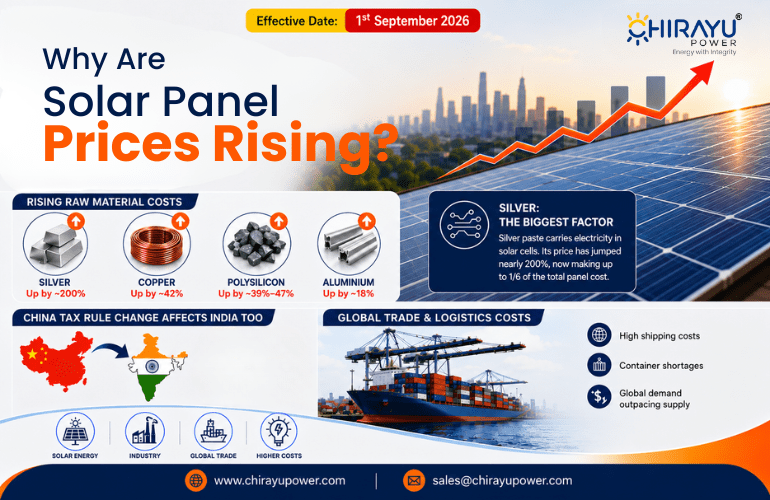
Effective Date: 1st September 2026

If you work in the solar industry or you’re just thinking about putting panels on your roof, you’ve probably noticed something strange lately. Prices are going up. And it’s not some small, unknown supplier trying to make extra money. It’s the biggest solar panel maker in the country, the one company you’d expect to be the most stable on price.

So what’s really going on? Let’s explain it in simple and easy words.

It Really Comes Down to One Word: Silver

Most people think solar panels are all about silicon, the dark blue material that soaks up sunlight. Silicon does matter. But there’s another material working quietly behind the scenes: silver.

Silver paste is what carries electricity out of the solar cell so it can actually be used. Without it, the cell simply doesn’t work. And over the last year, silver prices have shot up so fast that silver now makes up close to one-sixth of the total cost of a panel, sometimes almost a third of the cost of the cell alone.

Think about that. A material that used to be a small cost is now the single biggest cost in the whole panel. When that happens, no manufacturer, no matter how big, can just ignore it.

It’s Not Only Silver — Other Materials Went Up Too

Silver is the biggest story, but it’s not the only one. Polysilicon (the base material used to make solar cells), aluminium (used for the panel frame), and copper (used for the wiring) have all become more expensive too. On their own, none of these would cause a huge price jump. But when they all rise together, month after month, they slowly eat into a manufacturer’s profit until raising prices becomes the only choice left.


Here’s a simple table that shows how much each material has gone up, and why:

Material
How Much It Rose
Main Reason
Silver About 200% (roughly tripled) Huge demand for solar cells, and not enough silver being mined to keep up
Copper About 42% in a single year Fear of new import taxes in the US, plus buyers stocking up early
Polysilicon About 39% to 47% Chinese factories cut back production and agreed on minimum prices
Aluminium About 18% (yearly average) Steady, ongoing demand across many industries, not one big shock

As you can see, silver is by far the biggest jump on this list and the main reason companies keep pointing to raw material costs. The other three materials add extra pressure, but silver alone is big enough to push prices up on its own.

China Changed a Tax Rule — And It Affected India Too

Here’s something a lot of people don’t know. China recently removed a 9% tax refund it used to give on solar parts it exports, things like modules, wafers, and cell materials. That refund used to make Chinese solar parts cheaper for buyers around the world.

Even though India is building up its own solar factories, big Indian companies still buy a good amount of their raw cells and wafers from China. So when China removes that tax refund, it doesn’t stay a “China problem.” It becomes a problem for anyone buying from China, including Indian manufacturers. This one change alone is estimated to have added about 8% to 10% to their buying costs.

New Technology Is Also Adding to the Cost — At the Worst Time

There’s one more thing happening in the background. The solar industry is moving from older panels (called Mono-PERC) to newer, more powerful panels called N-Type TOPCon. These new panels produce more electricity from the same amount of sunlight, which is good news for buyers in the long run.

But here’s the catch: TOPCon panels currently need more silver per watt of power, not less. So right when silver prices are already high, the whole industry is switching to a technology that uses even more of it. Over time, companies will find ways to use less silver in these cells. But that takes time, and for now, it’s adding more fuel to an already expensive fire.


So Why Does the Biggest Company Raise Prices First?

Shouldn’t the biggest manufacturer, with the most buying power, be the one company that keeps prices stable?

In real life, being big only helps so much. Even a company making panels by the gigawatt still buys silver, polysilicon, and imported cells at roughly the same price as everyone else. Silver doesn’t get cheaper just because you’re the biggest buyer.

A company can absorb rising costs for a while by cutting into its own profit. But that can’t go on forever. At some point, the extra cost has to move down the chain to distributors, installers, and finally the customer.

When the biggest company moves first on price, it’s usually because they’re the first one to reach the point where absorbing the cost no longer makes sense. That’s also why you’ll see other manufacturers announce similar price hikes, usually around ₹1.5 to ₹2 per watt around the same time.

What Does This Mean for You?

Let’s make this simple with real numbers, because percentages alone don’t mean much.

1 – If you’re a homeowner planning a typical 3kW to 5kW rooftop system, a ₹2 per watt price hike adds about ₹6,000 to ₹10,000 to your total bill. If you qualify for a government subsidy scheme, the fixed subsidy amount will reduce the pain a little, but you’ll still pay somewhat more out of your own pocket.

2 – If you run a business and are looking at a bigger system, say 100kW for commercial or industrial use, the numbers get bigger too. A ₹2 per watt hike adds around ₹2 lakh to your upfront cost. For a project that usually costs ₹35 to ₹48 lakh, that’s about a 4% to 5% jump in total spending.

3 – Right now, in the short term, expect a rush of orders. Buyers who were already planning to buy will try to place their orders before the price hike starts on 1st September 2026, so they can lock in today’s lower price. If you were thinking about buying solar panels soon, this is usually the best time to act right before a price hike is often when suppliers are most open to giving you a good deal.

Final Thoughts

This price hike isn’t a company trying to squeeze more money out of customers. It’s a natural result of several things happening together: expensive silver, rising raw material costs, a tax rule change in China, and a technology shift that costs more before it starts saving money.

If solar is something you’re planning, whether for your home or business, the smart move is to move fast if you were already planning to buy, and keep a little extra budget in mind.

Beat the Price Hike with Chirayu Power

Don’t let rising raw material costs increase your solar investment. Book your order with Chirayu Power today and lock in current pricing before the hike takes effect on 1st September 2026.

Why Choose Chirayu Power?
  • Ready stock available for immediate Dispatch
  • Authorised Waaree Franchisee
  • Competitive pricing before the market-wide hike

Book Now Before Prices Rise Further — Contact Chirayu Power Today

For Orders & Enquiries:

📞 +91 70289 98965

📞 +91 80100 75053

📞 +91 90280 72633

📍 Chirayu Power Pvt. Ltd. (Authorised Waaree Franchisee)


Frequently Asked Questions (FAQ)

Q1. Why are solar panel prices increasing right now?

Mainly because of a sharp rise in silver prices, along with higher costs for polysilicon, copper, and aluminium, the core materials used to make solar panels.

Q2. Why is the biggest manufacturer raising prices instead of absorbing the cost?

Even large manufacturers buy raw materials at global market prices. Scale doesn’t make silver or polysilicon cheaper, so rising input costs eventually have to be passed on.

Q3. Will other solar companies also increase their prices?

Yes, most manufacturers are facing the same raw material and import cost pressures, so similar price hikes across the industry are expected.

Q4. How much extra will I have to pay for a home solar system?

For a typical 3kW to 5kW rooftop system, expect an increase of roughly ₹6,000 to ₹10,000, depending on your system size and panel type.

Q5. Should I book my solar order now or wait?

If you were already planning to install solar, booking before the price hike takes effect will help you lock in the current, lower price.

Q6. Will this price hike last forever?

Not necessarily. Raw material prices, especially silver and polysilicon, are known to fluctuate, so prices could stabilise or ease later depending on global supply conditions.


India is taking a major step towards a cleaner and more sustainable energy future with GOBARdhan – India’s National Circular Bioenergy Scheme.

Approved by the Union Cabinet, the scheme has a total outlay of ₹23,731 crore and will be implemented from FY 2026-27 to FY 2035-36. Its objective is to convert cattle dung, agricultural residue, press mud, municipal organic waste and other biomass into Compressed Biogas (CBG), organic manure and economic value.

From Waste to Energy

GOBARdhan aims to transform organic waste from an environmental challenge into a valuable energy resource. By promoting scientific processing of biomass, the scheme can simultaneously support clean fuel production, better waste management, sustainable agriculture and rural economic development.

The Government aims to drive nearly ten-fold growth in domestic CBG production, making CBG an important part of India’s future energy mix.

Six Growth Engines under GOBARdhan

1. Assured CBG Offtake

A dedicated CBG Offtake Assurance framework will provide producers with a more reliable and predictable market. CBG obligations for CNG transport and PNG domestic segments are set at 3% in FY 2026-27, 4% in FY 2027-28 and 5% from FY 2028-29 onwards.

This long-term demand signal can improve project bankability, capacity utilisation and investor confidence.

2. Stable CBG Pricing Framework

GOBARdhan provides an administered CBG price of ₹2,110 per MMBTU, supported by a government-backed pricing framework with a minimum 10-year horizon.

This offers producers greater revenue visibility and can strengthen the business case for investment and capacity expansion.

3. Capital Assistance

Eligible greenfield CBG projects can receive capital assistance of up to ₹2 crore per TPD of installed CBG capacity.

Support also covers important value-chain infrastructure such as feedstock aggregation, organic manure processing and value addition. Brownfield projects expanding their CBG capacity are also eligible.

4. Pipeline Infrastructure

The scheme supports cluster-based and standalone pipeline infrastructure connecting CBG plants with trunk pipelines and City Gas Distribution networks.

Improved connectivity can reduce evacuation costs, expand market access and increase utilisation of domestically produced CBG.

5. Credit Guarantee Support

A dedicated Credit Guarantee mechanism will help improve institutional credit access for eligible MSME-based CBG projects.

By reducing lending risks, the mechanism can encourage participation from MSMEs, women entrepreneurs and first-time developers.

6. CBG Ecosystem Challenge Fund

The CBG Ecosystem Challenge Fund will strengthen district-level CBG development through feedstock mapping, aggregation infrastructure, district-level planning, technology adoption, process improvement, organic manure value addition, capacity building and stakeholder awareness.

Together, these six growth engines are designed to create a stronger and more commercially viable CBG ecosystem across India.

Supporting Farmers and Rural India

The impact of GOBARdhan goes beyond energy production. Agricultural residue and cattle dung can gain additional economic value, while CBG projects can create opportunities for farmers, biomass suppliers, rural entrepreneurs, MSMEs, cooperatives and logistics operators.

The production of organic manure can also support nutrient recycling and sustainable agricultural practices.

Building a Circular Bioeconomy

GOBARdhan represents India’s move towards a circular bioeconomy—where organic waste is converted into clean energy, valuable by-products are returned to agriculture, and local resources generate new economic opportunities.

The initiative can contribute to better waste management, cleaner energy, rural employment and stronger domestic energy security.

Chirayu Power’s Perspective

At Chirayu Power, the development of clean and sustainable energy solutions represents an important opportunity for India’s future.

GOBARdhan demonstrates how waste management, clean energy, agriculture and rural development can come together to build a more resilient and sustainable energy ecosystem.

Waste can become Energy

Energy can create Opportunity.
And Opportunity can drive a Greener India.

Imagine opening your electricity bill and seeing ₹0.

For many Indian households, this is becoming a reality through rooftop solar and the PM Surya Ghar: Muft Bijli Yojana.

India has now crossed a major milestone, with 50 lakh+ households benefiting from the scheme. According to recent government information, around 19 lakh households are receiving zero electricity bills, while many others are significantly reducing their monthly electricity expenses.

So, the real question is:

Is your home next?
What Is PM Surya Ghar Muft Bijli Yojana?

The Government of India launched the PM Surya Ghar scheme to encourage residential rooftop solar adoption.

Under the scheme, eligible residential consumers can receive Central Financial Assistance (subsidy) for installing rooftop solar, subject to applicable government guidelines.

With solar installed on your rooftop, you can:

  • Generate your own electricity
  • Reduce your monthly electricity bill
  • Become less dependent on grid electricity
  • Use clean and renewable energy
  • Potentially achieve very low or even zero electricity bills, depending on your consumption and solar generation
How Much Can You Save?

Your savings depend on your electricity consumption, rooftop space, solar system capacity and local electricity regulations.

The government subsidy can also significantly reduce the initial cost of an eligible residential solar installation.

But remember: “Muft Bijli” does not mean the solar system itself is completely free. It means eligible households can receive financial assistance and generate their own electricity, helping reduce their electricity bills.

Is Your Home Suitable for Solar?

If you have:

✔️ A suitable rooftop
✔️ A grid-connected electricity connection
✔️ Good sunlight on your roof
✔️ Regular monthly electricity consumption

then rooftop solar could be a smart investment for your family.

And the sooner you evaluate your rooftop, the sooner you can start generating your own electricity.

Why Choose Chirayu Power?

At Chirayu Power Private Limited, we provide professionally designed residential rooftop solar solutions with support from system selection and installation to government subsidy and related processes.

Our team can help you understand the right solar solution based on your home’s electricity consumption and rooftop conditions.

Ready to Reduce Your Electricity Bill?

50 lakh+ Indian households have already taken the solar route.

Your rooftop could be your next source of clean, affordable electricity.

Get Your Residential Solar Assessment Today!

📞 Call/WhatsApp: +91 9112114440
🌐 Website: www.chirayupower.com

Your Roof Can Do More. Let the Sun Power Your Home.


Frequently Asked Questions (FAQs)

1. What is the PM Surya Ghar Muft Bijli Yojana?
It is a Government of India scheme that provides financial assistance to eligible residential households for installing rooftop solar systems.

2. Can rooftop solar make my electricity bill ₹0?
Yes, some households can achieve zero electricity bills, depending on their electricity consumption, solar system capacity, generation, and applicable net-metering rules.

3. How much subsidy can I get for residential rooftop solar?
Eligible households can receive Central Financial Assistance under the PM Surya Ghar scheme. The subsidy depends on the installed solar capacity and applicable government guidelines.

4. How can I check if my home is suitable for solar?
You can contact Chirayu Power for a residential solar assessment. Our team can evaluate your electricity consumption and rooftop conditions and suggest a suitable solar solution.


India is rapidly moving towards clean and renewable energy, and solar power is playing an important role in this journey. As more homes, businesses, and industries are choosing solar, the demand for reliable Solar EPC companies in India is also growing.

A Solar EPC company manages the complete solar project, from design and equipment procurement to installation, commissioning, and maintenance. Choosing the right EPC partner can help ensure better project execution and long-term performance.

What Is a Solar EPC Company?

EPC stands for Engineering, Procurement, and Construction.

In simple terms, a Solar EPC company takes care of the major activities involved in setting up a solar power project, including:

  • Solar system design and engineering
  • Equipment procurement
  • Installation and construction
  • Electrical integration
  • Testing and commissioning
  • Operations and maintenance

This complete approach makes the solar installation process easier for customers and helps keep the project properly planned from start to finish.


Solar EPC

Why Are Solar EPC Companies Important?

Installing a solar plant is more than just installing solar panels. Proper design, electrical planning, safety, site conditions, equipment selection, and project execution all affect the final performance of the system.

An experienced EPC company helps manage these areas and reduces the need for customers to coordinate with multiple vendors.

EPC expertise is especially useful for:

  • Commercial and industrial rooftop solar
  • Large ground-mounted solar plants
  • Open Access solar projects
  • Group Captive projects
  • Hybrid solar solutions
  • Battery Energy Storage Systems

Services Offered by Solar EPC Companies

A professional Solar EPC company generally provides end-to-end services.

  1. Engineering & Design:  The project starts with site assessment, electricity consumption analysis, plant layout, structural design, and electrical planning. Good engineering helps make the best use of available space and supports better energy generation.
  2. Procurement:  The EPC company coordinates the required equipment, such as solar modules, inverters, mounting structures, cables, electrical panels, and other components. The focus should be on selecting suitable and reliable equipment rather than simply choosing the cheapest option.
  3. Installation & Commissioning:  This includes mounting structure installation, module installation, electrical work, earthing, safety checks, testing, and final commissioning of the solar plant. Professional execution is important for the safe and reliable operation of the system.
  4. Operations & Maintenance:   Solar plants need regular monitoring and maintenance even after installation. O&M services can include plant monitoring, cleaning, inspections, preventive maintenance, fault identification, and technical support.

Solar EPC

How to Choose the Right Solar EPC Company in India?

Before selecting an EPC partner, businesses should look at a few important factors.

Experience: Check the company’s completed projects and experience in your type of solar project.

Technical Knowledge: The EPC company should understand modern solar technologies, inverters, monitoring systems, and energy storage solutions.

Project Execution: Proper planning and coordination are important for completing projects safely and on time.

After-Sales Support: Solar is a long-term investment, so reliable O&M and technical support are equally important.

Growth of Solar EPC Companies in India

The Indian solar sector is growing as businesses, industries, and households look for cleaner and more cost-effective energy solutions.

The growth of rooftop solar, industrial solar, Open Access projects, renewable energy targets, and increasing focus on sustainability is creating more opportunities for Solar EPC companies.

As solar adoption increases, customers are also looking for EPC partners who can provide complete solutions instead of handling different parts of the project through multiple vendors.

Solar EPC for Industries

Industries have high and regular electricity requirements, making solar an attractive option for reducing long-term power costs.

Depending on their requirements, industries can explore:

  • Industrial rooftop solar
  • Ground-mounted solar
  • Captive solar
  • Open Access solar
  • Group Captive solar
  • RESCO/OPEX models
  • Solar with energy storage

A good EPC partner can study the customer’s electricity consumption, available space, and project requirements to suggest a suitable solution.

Emerging Trends in Solar EPC

The solar EPC industry is also becoming more technology-driven.

Some important trends include:

  • AI-based plant monitoring
  • Drone-based inspection
  • SCADA and smart monitoring
  • Energy analytics
  • Battery Energy Storage Systems
  • Automation in project management

These technologies can help improve monitoring, identify issues faster, and manage solar plants more efficiently.

The Future of Solar EPC Companies in India

The future of solar energy in India looks strong. As the country continues to increase its renewable energy capacity, the need for experienced Solar EPC companies will also grow.

The next phase of solar development will not only focus on installing more panels but also on better monitoring, energy storage, automation, and smarter energy management.

Chirayu Power – Your Solar EPC Partner

Chirayu Power has been working in the solar industry since 2014, providing end-to-end solar EPC solutions for residential, commercial, industrial, and large-scale projects.

With 3,000+ solar installations and experience across rooftop and ground-mounted projects, Chirayu Power provides solutions including:

  • Residential Rooftop Solar
  • Commercial & Industrial Solar
  • Ground-Mounted Solar
  • Open Access Solar
  • Group Captive Solar
  • RESCO / OPEX Solutions
  • Solar O&M
  • BESS & Energy Storage Solutions
  • SCADA and Smart Monitoring

Our focus is simple: proper planning, quality execution, reliable support, and long-term solar performance.

If you are planning to switch to solar for your home, business, or industry, choosing the right EPC partner is the first important step.


Looking for a Reliable Solar EPC Partner?

From planning and engineering to installation and O&M, get complete solar solutions under one roof.

Connect with Chirayu Power today.

Talk to Our Solar Experts

FAQs
What does EPC mean in solar?

EPC stands for Engineering, Procurement, and Construction. It covers the main stages of a solar project from design to installation and commissioning.

What does a Solar EPC company do?

A Solar EPC company manages solar system design, equipment procurement, installation, commissioning, and often O&M services.

Why choose an experienced Solar EPC company?

An experienced EPC company can help with proper system design, project execution, safety, equipment selection, and long-term support.

Does Chirayu Power provide industrial solar solutions?

Yes. Chirayu Power provides rooftop, ground-mounted, Open Access, Group Captive, and other solar solutions for industrial and commercial customers.

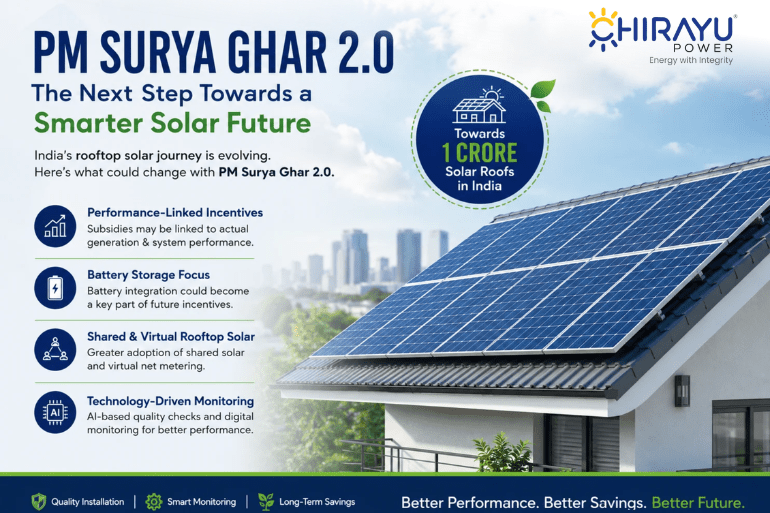
India’s rooftop solar revolution is entering its next chapter. As the PM Surya Ghar: Muft Bijli Yojana approaches its FY 2026-27 target of solarising one crore households, the Ministry of New and Renewable Energy (MNRE) is reportedly working on a redesigned version of the scheme informally being called PM Surya Ghar 2.0.

At Chirayu Power, we’ve been tracking these developments closely so our customers can make informed decisions about going solar. Here’s a breakdown of what the scheme has achieved so far and what could be coming next.

A Quick Recap: What Is PM Surya Ghar?

Launched by Prime Minister Narendra Modi on 15 February 2024, PM Surya Ghar: Muft Bijli Yojana is the world’s largest domestic rooftop solar initiative. With a total outlay of over ₹75,000 crore, the scheme aims to:

  • Solarise 1 crore households across India by FY 2026-27
  • Provide up to 300 units of free electricity per month to beneficiary households
  • Offer a central subsidy of up to ₹78,000 for a 3 kW rooftop system
  • Cover 60% of system cost for capacity up to 2 kW, and 40% of additional cost for the 2–3 kW slab

By March 2025, the scheme had already crossed 10 lakh solarised homes, with discoms designated as State Implementation Agencies responsible for net metering, inspection, and timely commissioning. The Union Budget 2026-27 allocated a further ₹22,000 crore to keep the momentum going.


Why a “2.0” Version Is Being Discussed

The original scheme calculates subsidy purely on installed capacity — you get a fixed payout based on the size of the system you put up, regardless of how much power it actually generates over time. It also doesn’t account for battery storage, and it largely leaves out households that don’t have a suitable independent rooftop, such as apartment residents.

These are the gaps that PM Surya Ghar 2.0 is reportedly trying to close. While nothing has been formally notified yet, media reports and industry commentary point to a few likely shifts:

1. Performance-Based Incentives

Instead of a flat, one-time payout tied to system size, future subsidies may be linked to actual power generated and long-term system performance. The intent is simple: reward systems that keep producing electricity reliably for years, not just systems that get installed and forgotten.

2. Battery Storage Support

Officials are reportedly discussing incentives for battery energy storage systems (BESS) at both the household and community level. This would let homeowners store solar power generated during the day for use after sunset, and could also improve grid stability at scale.

3. Wider Eligibility

The redesigned framework is expected to extend benefits to households that currently sit outside the scheme’s reach — including those without a suitable independent rooftop.

4. Smarter Monitoring

Some reports mention ideas like digital “solar passports” for tracking system performance and ownership history — part of a broader push to make rooftop solar more transparent and data-driven.

It’s worth noting that industry sources also describe a related development already rolling out — often referred to as “Phase 2” or “PM Surya Ghar @ 2” — which reportedly allows hybrid inverters and battery storage systems under Central Financial Assistance for systems up to 2 kW, aligning with India’s broader goal of 500 GW of non-fossil energy capacity by 2030.


What This Means for You Right Now

If you’re considering rooftop solar for your home, here’s the practical takeaway: the current PM Surya Ghar scheme is very much active today, with the ₹78,000 subsidy for 3 kW systems, 60%/40% cost coverage, and free electricity benefits already available through the national portal. PM Surya Ghar 2.0, as of now, is a set of proposed changes under discussion — not a confirmed policy.

At Chirayu Power, our recommendation is straightforward:

  • Don’t wait on unconfirmed changes. If your rooftop and consumption pattern make solar viable today, the current subsidy structure already delivers strong savings.
  • Verify everything through official channels. Subsidy amounts, eligibility, and application steps should always be checked against the PM Surya Ghar National Portal before you commit.
  • Plan for storage anyway. Even if battery incentives aren’t finalised yet, designing your system to be battery-ready means you won’t need a costly retrofit later.

How Chirayu Power Can Help

Navigating subsidy paperwork, net metering approvals, and vendor selection can be confusing — especially with a scheme this large and still evolving. Our team helps households:

  • Assess rooftop suitability and right-size the system (2 kW, 3 kW, or beyond)
  • Handle end-to-end registration on the PM Surya Ghar National Portal
  • Manage discom coordination, net meter installation, and inspection
  • Design systems that are ready for future battery integration

As PM Surya Ghar 2.0 moves from discussion to policy, we’ll keep updating our customers with verified information — no speculation, no misinformation, just what’s actually been notified by the government.

Ready to go solar? Get in touch with Chirayu Power for a free rooftop assessment and subsidy eligibility check.


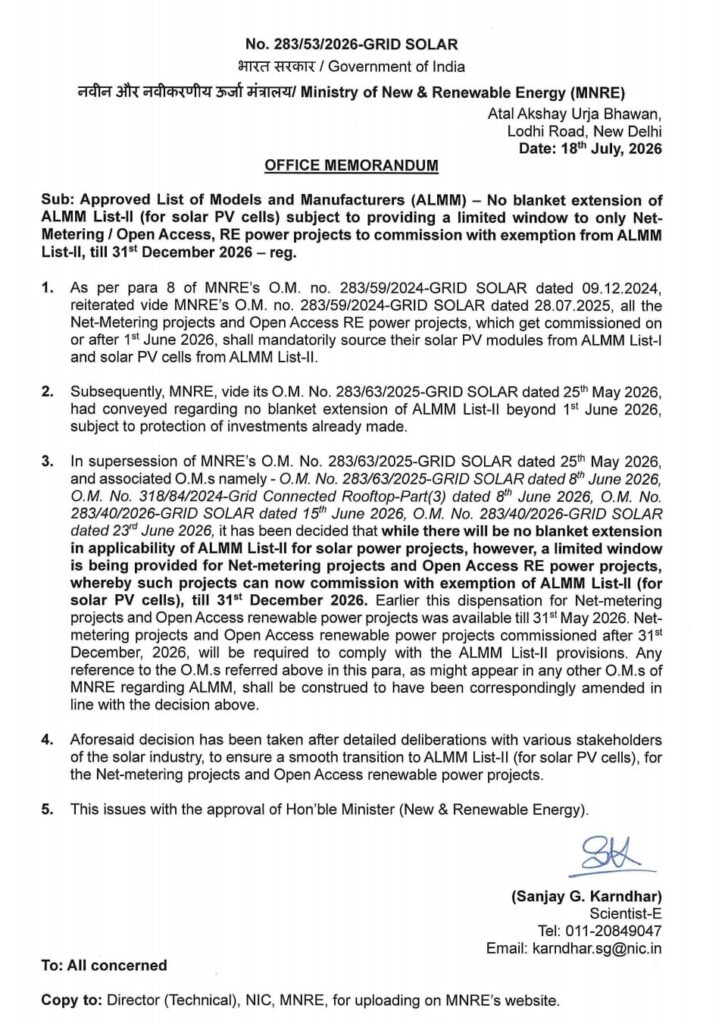
ALMM List-II Deadline Pushed Again: What MNRE’s July 18 Order Really Means for Your Pipeline

If you’ve been sitting on a stack of net-metering or open access projects, watching the ALMM List-II clock tick down, you can exhale for now. MNRE just bought the industry another six months.

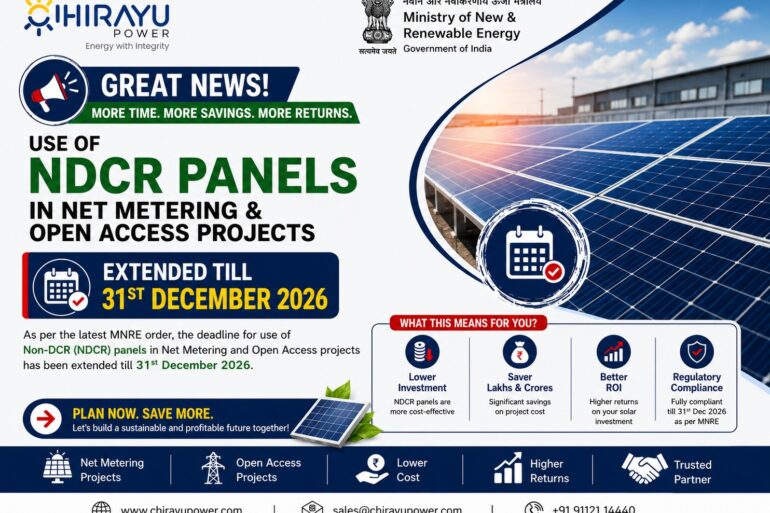
On 18th July 2026, the Ministry of New & Renewable Energy quietly dropped Office Memorandum No. 283/53/2026-GRID SOLAR, and it’s the kind of order that developers will want pinned to the top of their inbox. In short, the exemption from ALMM List-II for solar PV cells, previously set to lapse on 31st May 2026, has been extended to 31st December 2026 for net-metering and open-access RE projects.

That’s a real, practical extension. Not a policy reversal, not a permanent carve-out, but breathing room that many pipelines badly needed.

Why This Order Exists

Anyone who’s been tracking ALMM knows this space has been a moving target all year. A quick timeline, because the paper trail matters here:

  • Dec 2024 / reiterated July 2025: MNRE first laid down the rule that any net-metering or open access project commissioning on or after 1st June 2026 would have to source modules from ALMM List-I and cells from ALMM List-II. No exceptions flagged at the time.
  • 25th May 2026: With the deadline a week away, MNRE signalled there’d be no blanket extension, but investments already committed would be protected. Cue a scramble across the industry to figure out exactly what “protected” meant in practice.
  • Late May through June 2026: A flurry of follow-up O.M.s tried to patch the gaps, one specifically for rooftop, others tweaking dates. If you were tracking compliance during this window, you know how confusing it got.
  • 18th July 2026: This latest order supersedes all of that. Every earlier O.M. referencing ALMM compliance dates is now read in line with this one. One clean deadline, replacing a mess of overlapping ones.

MNRE Notice

What Actually Changed

Here’s the part that matters for your project timeline: domestic solar cell manufacturing capacity still hasn’t caught up with demand, and MNRE has effectively acknowledged that forcing the June 2026 deadline would have stalled a meaningful chunk of the net-metering and open access pipeline.

So instead of a blanket extension across all solar projects which MNRE has explicitly ruled out the relief is narrow and targeted:

  • Who gets it: Net-metering projects and Open Access RE power projects only.
  • What’s exempted: Sourcing solar PV cells from ALMM List-II. (ALMM List-I module sourcing requirements aren’t touched by this order.)
  • Until when: Projects commissioned on or before 31st December 2026 are covered.
  • What happens after: Anything commissioning from 1st January 2027 onward has to comply fully with ALMM List-II no more grace period referenced in this order.

If your project falls outside net-metering or open access say, a utility-scale IPP project this order doesn’t touch you. The “no blanket extension” line in Para 3 is doing a lot of work here, and it’s worth reading twice before assuming you’re covered.

The Real Takeaway for Developers

This isn’t the ministry backing down on domestic manufacturing goals it’s a pressure valve. MNRE says the decision came after “detailed deliberations with various stakeholders of the solar industry,” which, translated, means the industry made its case on cell availability and commissioning timelines, and the ministry listened partially.

Three things worth doing with this news right now:

  1. Re-check your commissioning date against 31st December 2026, not the old May 2026 line. If your project was going to miss the earlier deadline, it may now clear comfortably but don’t assume; confirm the classification (net-metering / open access) actually applies.
  2. Don’t treat this as a new baseline. MNRE has now extended this cutoff more than once in a matter of months. Six months is enough time to actually secure ALMM List-II compliant cells — plan sourcing now rather than waiting for the next possible extension.
  3. Track amendments closely. Para 3 of the order explicitly states that references to superseded O.M.s “in any other O.M.s of MNRE regarding ALMM” are automatically read as amended. If you’re relying on an older circular for compliance guidance, it’s worth re-verifying against this one.

MNRE isn’t walking away from ALMM it’s buying the ecosystem time to get there without stranding half-built projects. For net-metering and open access developers, 31st December 2026 is now the number to plan around. Just don’t bank on another extension after that.

The order is signed by Sanjay G. Karndhar, Scientist-E, MNRE, and issued with the approval of the Hon’ble Minister (New & Renewable Energy).

Reference: Office Memorandum No. 283/53/2026-GRID SOLAR, Ministry of New & Renewable Energy, Government of India, dated 18th July 2026.


About Chirayu Power

Navigating shifting ALMM timelines is exactly the kind of regulatory complexity Chirayu Power Pvt. Ltd. helps its clients manage every day. Founded in 2014 and headquartered in Khamgaon, Maharashtra, Chirayu Power has grown into one of India’s most trusted solar EPC companies, with 3,000+ installations completed across 10+ states covering over 150 MW of rooftop and 200 MW of ground-mounted solar capacity.

As an ISO 9001:2015 certified and MNRE-approved channel partner, Chirayu Power delivers end-to-end, turnkey EPC execution from design and engineering to installation, commissioning, and ongoing O&M for industrial, commercial, residential, and utility-scale projects. The company also specializes in open access and RESCO-based solar solutions, backed by IoT-enabled monitoring, in-house civil and electrical teams, and a track record of 100% regulatory compliance.

With regional offices in Nagpur, Pune, Mumbai, and Hyderabad alongside its Maharashtra head office, Chirayu Power stays close to developments like this ALMM order — helping clients plan commissioning timelines, sourcing, and compliance well ahead of every regulatory deadline.

Get in touch:

  • Website: www.chirayupower.com
  • Phone: +91 9112114440 / +91 7721871188
  • Email: sales@chirayupower.com


Facebook Twitter Instagram LinkedIn youtube