Many commercial complexes, hospital campuses, retail malls, and educational trusts operate multiple separate electricity connections under common ownership. A hospital campus may maintain separate service meters for the main building, an outpatient diagnostic wing, and staff quarters. Without Group Net Metering, a solar plant can only offset the specific meter it is physically wired behind—even if the building with the best roof sits above a low-consumption connection. Group Net Metering allows surplus solar generation from a centralized rooftop plant to be allocated across all designated service connections within the same DISCOM distribution area.



Install a single large solar plant on the optimal roof surface.
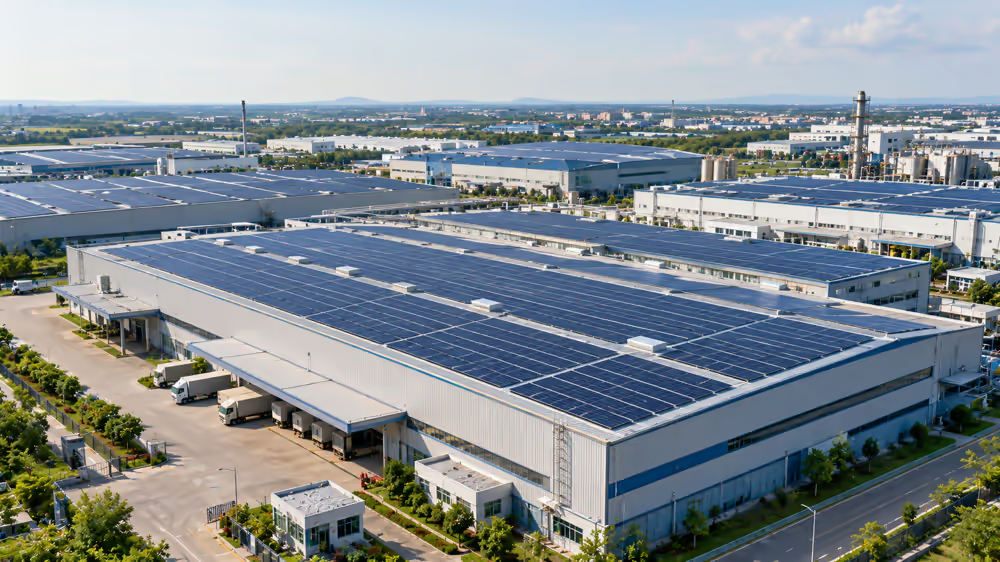
A high-capacity solar plant is installed on the building with the largest, most structurally sound, shadow-free roof across your commercial complex, connected behind that building main service connection.
Campuses with varied roof conditions where consolidating into one large array reduces installation and maintenance costs.
Deploy panels on the highest-integrity shadow-free terrace
One large plant is cheaper per kW than several scattered micro-arrays
Centralized inverters, cleaning water lines, and monitoring hardware
Group Net Metering transforms fragmented electrical meters into a unified, highly efficient clean power ecosystem.
Maximize Available Rooftop Area
Avoid stranding solar generation on a low-consumption roof. Feed generation into a high-consumption meter elsewhere on campus.
Consolidated Plant Economics
Building one 200 kW solar array costs significantly less per watt than installing four separate 50 kW systems with duplicate switchgear.
Target Highest Tariff Slabs
Allocate surplus solar units strategically to the specific meter billed under the highest commercial tariff slab to maximize monetary savings.
| Parameter | Group Net Metering | Individual Net Meters | Group Captive (Open Access) |
|---|---|---|---|
| Physical Plant Location | On-site commercial roof / campus | Scattered on individual roofs | Off-site remote utility solar park |
| Number of Meters Credited | Multiple meters under same entity | Only 1 physical meter per plant | Multiple corporate off-takers |
| Equity Investment Required | ₹0 (Standard rooftop asset) | ₹0 (Standard rooftop asset) | Min 26% equity in generator SPV |
| Wheeling / CSS Charges | ₹0 (Zero wheeling / CSS fees) | ₹0 (Zero wheeling / CSS fees) | Wheeling applies; CSS exempt |
| Scale of Implementation | 50 kW to 1 MW (Commercial) | 10 kW to 200 kW per meter | 1 MW to 50 MW+ (Utility Scale) |